

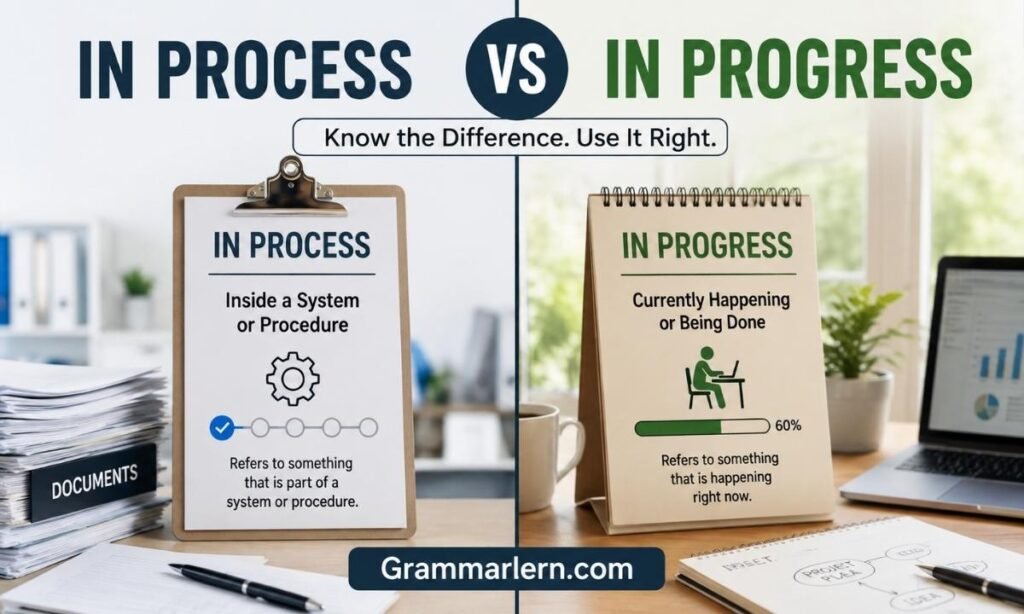
“In process” and “in progress” look almost identical, yet they mean two very different things. One describes a system quietly working behind the scenes, while the other describes active human effort happening right now. Mixing them up can confuse a client, a manager, or even a customer waiting on a refund.
This guide breaks down the exact difference, backed by real examples from everyday life, business, and technology. By the end, you’ll know instantly which phrase fits your sentence — no guesswork, no second-guessing.
Quick Answer: “In progress” means something is actively being worked on right now. “In process” means something is moving through a formal system or set of steps, with or without active human effort.
What “In Process” vs “In Progress” Really Mean
Both phrases describe something unfinished, but they focus on different things. “In progress” highlights the action itself. “In process” highlights the system or steps that action moves through. Once you separate these two ideas, choosing the right phrase becomes automatic.
Meaning of “In Process”
“In process” means something is currently moving through a defined set of steps, a workflow, or a formal procedure. It does not always mean a person is actively touching it at that moment.
- Your visa application is in process.
- The refund is in process at the bank.
- The order is in process at the warehouse.
Meaning of “In Progress”
“In progress” means something has started and is actively being worked on. Effort is visible, and the action is happening now.
- The report is in progress.
- Construction is in progress on Main Street.
- Her thesis is in progress.
Side-By-Side Comparison: “In Process” vs “In Progress”
| Feature | In Process | In Progress |
| Core focus | A system or procedure | Active human effort |
| Tone | Formal, administrative | Everyday, natural |
| Implies action right now | Not always | Yes |
| Common in | Applications, refunds, manufacturing | Projects, tasks, creative work |
| Everyday frequency | Less common | Much more common |
Where These Words Come From (And Why It Matters)
Looking at the roots of “process” and “progress” explains why each word settled into its own lane of meaning.
Origin of “Process”
“Process” comes from the Latin word processus, meaning “a going forward” or “a method.” This is why it naturally connects to procedures, sequences, and formal systems rather than hands-on effort.
Origin of “Progress”
“Progress” comes from the Latin progressus, meaning “an advance” or “movement forward.” Historically, it has been tied to growth, development, and visible action — which is exactly how we use it today.
Why “In Progress” Is More Common Today
“In progress” shows up far more often in modern English, especially at work. There are a few clear reasons why.
1. It’s Clearer
People immediately understand that work is actively happening — there’s no ambiguity about who or what is involved.
2. It Feels More Active
Modern workplace language favors action over procedure, and “in progress” sounds more energetic and direct.
3. It’s Used in Project Management
Tools like Jira, Trello, Asana, and ClickUp all use “In Progress” as a standard workflow column, reinforcing the phrase in daily use.
4. It Works in More Contexts
“In progress” fits almost anything — projects, homework, renovations, meetings — while “in process” is limited to formal systems.
Also Read This Incoming vs Upcoming vs Oncoming: Meaning, Examples & Common Mistakes
When to Use “In Progress” vs. “In Process” (Context-Based Guide)
The right choice depends on whether a person or a system is doing the work.
Use “In Progress” When:
- A task is actively being worked on
- Human effort is clearly involved
- Something is being created, built, or developed
Use “In Process” When:
- Something is moving through formal steps
- A system, not a person, is handling it
- The action depends on approval or procedure
Comparison Examples (To Make It Crystal Clear)
Example 1
In Progress: The designer is working on your logo. In Process: The invoice is moving through the approval flow.
Example 2
In Progress: The essay is halfway written. In Process: The submission is being reviewed by an automated system.
Example 3
In Progress: The software update is being coded. In Process: The software update is being tested in staged rollouts.
How Different Industries Use “In Process” vs “In Progress”
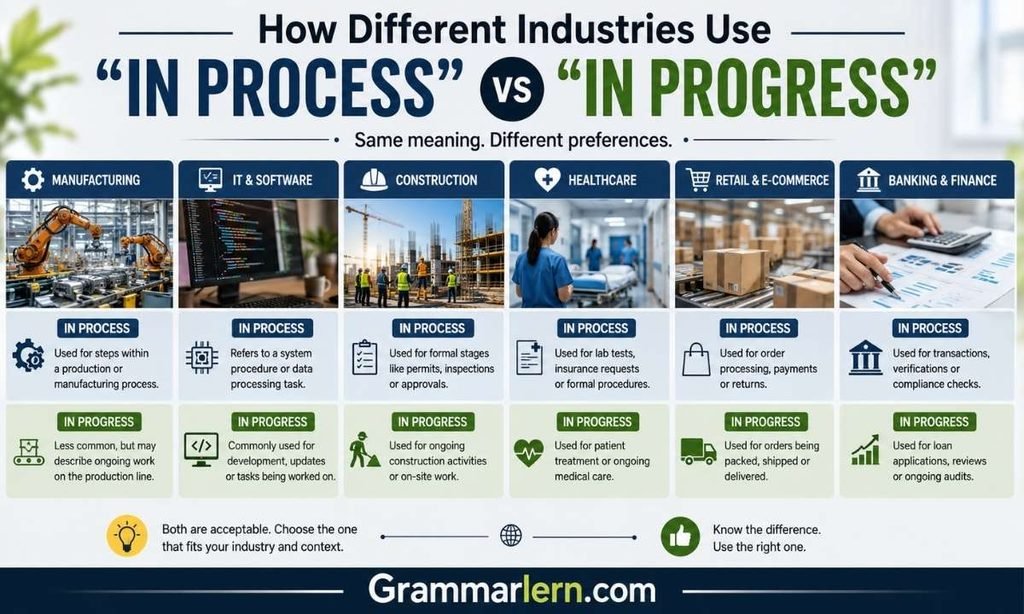
Different fields lean toward one phrase over the other, depending on how work happens there.
Technology & Agile Workflows
Developers say a task is “in progress” when someone is actively coding it. A build or deployment pipeline is often described as “in process” since automation handles the steps.
Business & Operations
Contracts, procurement requests, and audits are usually “in process,” since they follow structured approval chains.
Customer Service
A support ticket is “in progress” when an agent is actively working on it. A refund is “in process” when the payment system is handling it automatically.
Manufacturing & Supply Chain
Items moving through production stages are described as “in process,” giving rise to the well-known term “work in process” inventory.
Academia & Research
Research and manuscripts are typically “in progress,” since they rely on ongoing human effort rather than automated steps.
Creative Industries (Art, Design, Writing)
“Work in progress” is the standard phrase for unfinished creative projects. “In process” appears occasionally but is far less common in these fields.
“Work in Process” vs “Work in Progress” — What’s the Difference?
Both phrases are correct, but they serve different purposes. “Work in process” (often abbreviated WIP) is an accounting and manufacturing term for partially finished goods, usually listed as a current asset. “Work in progress” is the broader, everyday term used for ongoing projects of any kind, from construction to writing to software development. In British English, “work in progress” is the standard choice, while “work in process” is rarely used at all.
Grammar Rules: How to Use Each Phrase Correctly
Sentence Construction
Both phrases usually follow a form of the verb “to be”: is in progress, are in progress, is in process, was in process.
Correct Placements
They can appear after a verb (“The project is in progress”), before a noun as a hyphenated modifier (“an in-progress project”), or after an object (“We left the request in process”).
Verb Combinations
Certain verbs naturally pair with each phrase, reinforcing their different tones.
Pairs with “In Progress”
is, are, remains, continues, stays
Pairs with “In Process”
is, remains, undergoes, moves through
Capitalization Notes
Lowercase both phrases in normal sentences. Capitalize them only in titles, headings, or interface labels like status columns.
Quick Memory Tricks (Easy to Remember)
Mnemonic 1
Progress = doing. Process = steps.
Mnemonic 2
If a person is actively working, use in progress. If a system is handling it, use in process.
Mnemonic 3
Progress moves forward. Process follows a method.
Quick Test
Ask yourself: is a person doing this right now? If yes, use in progress. If no, use in process.
Also Read This Incoming vs Upcoming vs Oncoming: Meaning, Examples & Common Mistakes
Common Mistakes (Avoid These)
Mistake 1: Using “In Process” for Tasks
Wrong: The engineer’s task is in process. Correct: The engineer’s task is in progress.
Mistake 2: Using “In Progress” for System Steps
Wrong: Your refund is in progress. Correct: Your refund is in process.
Mistake 3: Mixing Them in Documentation
Switching between the two phrases inconsistently confuses readers. Pick one term per workflow stage and stick with it.
Mistake 4: Over-Formalizing Everyday Language
“In process” sounds stiff in casual writing. For everyday tasks, “in progress” almost always sounds more natural.
Real Case Study: A Technical Team Miscommunication
A support team once told a customer, “Your refund is in progress.” The customer assumed someone was handling it immediately and expected same-day resolution. In reality, the request had entered an automated three-stage process, and no human would touch it for two to three days. Saying “in process” instead would have set the right expectation from the start.
Another Case Study: Manufacturing Confusion
A warehouse manager reported that certain items were “in progress.” Accounting interpreted this as active hands-on work, when the items were actually going through a routine quality-check process. That single word choice delayed inventory classification by two days.
Helpful Quotes to Remember
“Progress is movement. Process is structure.”
“If hands are on it, it’s in progress. If paperwork is on it, it’s in process.”
Frequently Asked Questions
What is the difference between “progress” and “process”?
“Progress” means forward movement, while “process” means a series of steps. That’s why “in progress” implies action and “in process” implies a system.
Is it better to say “in process” or “in progress”?
It depends on context. Use “in progress” for active human work and “in process” for formal, system-driven steps.
Is it “work in process” or “work in progress”?
Both are correct. “Work in process” is used in manufacturing and accounting, while “work in progress” is the everyday term for ongoing projects.
Is a job application “in process” or “in progress”?
Usually “in process,” since it moves through automated screening and approval steps rather than constant human review.
What does “in process” mean on Workday?
It means the application is sitting in a pipeline stage, not necessarily being actively reviewed at that exact moment.
Can “in process” and “in progress” mean the same thing?
Sometimes, in casual speech. But in precise writing, they signal different things — one is action, the other is procedure.
Final Thoughts
Understanding in process vs in progress comes down to one simple idea: progress means someone is actively working, while process means something is moving through a system. Once that distinction clicks, choosing the right phrase in emails, job applications, or project updates becomes effortless.
Both phrases are correct — the key is matching them to the right context. Use “in progress” when human effort is visible, and “in process” when a formal system is doing the work. Getting this right makes your communication clearer, more accurate, and more professional every time.
1 thought on ““In Process” vs “In Progress”: The Real Difference (With 20+ Examples)”