

Ever typed “tomatos” and paused, unsure if it looked right? You’re not alone. This is one of the most common spelling mistakes in English. The correct plural is always “tomatoes,” never “tomatos,” and the reason comes down to a simple spelling rule.
Words ending in “-o” like tomato often confuse writers because English doesn’t follow one fixed pattern. In this guide, you’ll learn the correct spelling, the grammar rule behind it, and simple tricks to never make this mistake again.
Quick Answer: Is It “Tomatoes” or “Tomatos”?
The correct plural of tomato is tomatoes. “Tomatos” is a common misspelling and is never correct in standard English, whether in casual writing, professional documents, or academic work.
What the Word “Tomato” Actually Means (And Why It Matters to Spell It Right)
A tomato is a fruit used as a vegetable in everyday cooking, eaten raw or prepared in countless dishes worldwide. But the meaning isn’t why most people search for this word. It’s the spelling.
The word shows up everywhere: recipes, menus, food packaging, diet plans, and business names. A single missing letter on a menu or label can make a brand look careless. Spelling “tomatoes” correctly isn’t just a grammar detail, it’s a credibility signal.
The Real Reason This Debate Exists: English’s Messy Plural Rules
English pulls vocabulary from many languages, and that mix creates inconsistent plural patterns. Words ending in “-o” are a good example of this inconsistency.
Sometimes you add “-es”: tomato becomes tomatoes, potato becomes potatoes. Sometimes you only add “-s”: photo becomes photos, studio becomes studios. Sometimes both forms are accepted: volcano can become volcanoes or volcanos.
There’s no single formula, which is exactly why the tomato spelling debate keeps resurfacing.
So Which Is Correct—Tomatoes or Tomatos?
Here’s the answer in the simplest possible terms.
✔ Correct: Tomatoes
This is the only accepted plural form in modern English, used in dictionaries, textbooks, and professional writing.
✘ Incorrect: Tomatos
This spelling is never correct. There’s no regional variation, no informal exception, and no accepted alternative.
Understanding “-ES” Plurals for Words Ending in -O
Most nouns that end in a consonant plus “o” and come from a foreign language take “-es” in the plural form.
When the Word Ends in a Consonant + O → Add -ES
- tomato → tomatoes
- potato → potatoes
- hero → heroes
- echo → echoes
The extra syllable makes the word smoother to pronounce, which is part of why English speakers naturally settled on this spelling pattern.
Why “Tomatoes” Takes -ES: The Linguistic Explanation
Three main forces shaped this spelling rule.
1. Origin (Borrowed Word Behavior)
“Tomato” entered English through Spanish, and English often preserves plural tendencies from a word’s original language.
2. Phonetics (How It Sounds)
Saying “tomato-s” feels abrupt, while “tomato-es” flows naturally. Pronunciation influenced spelling over time.
3. Standardization (Dictionaries + Education)
By the 1800s, dictionaries and schools had standardized “tomatoes” as the only correct plural, and that standard has remained unchanged since.
Origin of the Word “Tomato” (Short But Important)
| Stage | Language | Word | Meaning |
| Original | Nahuatl | tomatl | swelling fruit |
| Borrowed into | Spanish | tomate | the fruit we know |
| Adopted by | English | tomato | same meaning |
This borrowed history explains why the plural follows a foreign-influenced pattern instead of a simple “add s” rule.
“Tomatoe” or “Tomato”? Fixing the Singular Spelling Confusion
Some writers mistakenly add an extra “e” to the singular form, writing “tomatoe” instead of “tomato.” This is incorrect. The singular form never includes an “e.” Only the plural form, “tomatoes,” carries the extra letter.
Tomato’s, Tomatoes, or Tomatoes’? Plural vs Possessive Explained
These three forms are often confused, but each has a distinct role.
- Tomato’s shows singular possession, as in “the tomato’s skin.”
- Tomatoes is simply the plural form, as in “I bought tomatoes.”
- Tomatoes’ shows plural possession, as in “the tomatoes’ freshness.”
Mixing these up is a common writing mistake, so it helps to pause and ask whether you’re describing quantity or ownership.
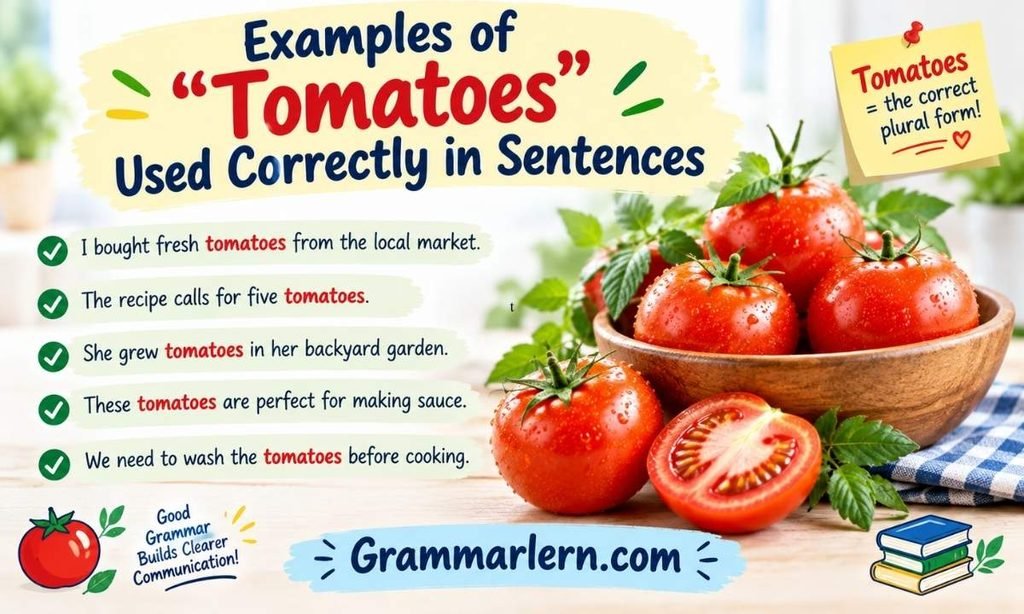
Examples of “Tomatoes” Used Correctly in Sentences
Correct Usage
- I bought fresh tomatoes from the market.
- These tomatoes are perfectly ripe.
- We added chopped tomatoes to the salad.
- The chef roasted the tomatoes with garlic.
Incorrect Usage
- I need two tomatos for the soup. ✘
- Green tomatos can be fried. ✘
Common Spelling Errors People Make (And Why They Happen)
1. Over-Applying the Photo Rule
Many assume that if “photo” becomes “photos,” then “tomato” should follow the same pattern. But “photo” is a clipped form of “photograph,” so it doesn’t follow the same rule.
2. Phonics Confusion
Because “tomato” ends in an “oh” sound, some writers assume adding just “s” is enough, without realizing the word requires the extra syllable.
3. Fast Typing + Autocorrect
Older keyboards and rushed typing can lead to dropped letters, and “tomatoes” is an easy word to shorten by accident.
4. Exposure to Bad Spelling Online
Informal writing on social media spreads spelling mistakes quickly, and repeated exposure can make an incorrect spelling start to look normal.
Other Words That Follow the Same Pattern as “Tomatoes”
| Singular | Plural |
| hero | heroes |
| potato | potatoes |
| echo | echoes |
| mosquito | mosquitoes |
| volcano | volcanoes |
| torpedo | torpedoes |
| veto | vetoes |
Words Ending in -O That Don’t Add -ES
| Singular | Plural |
| photo | photos |
| studio | studios |
| piano | pianos |
| cello | cellos |
| logo | logos |
| video | videos |
These words are either clipped forms or borrowed terms whose original language didn’t influence an “-es” ending, which is why they simply add “s.”
Tomatoes or Tomatos in British vs American English
Both British and American English use the exact same spelling: tomatoes. There’s no regional difference in how the word is written. The only variation is in pronunciation, where American English favors “toh-MAY-toh” and British English favors “toh-MAH-toh.” Spelling-wise, both dialects agree completely.
How to Always Remember the Correct Spelling “Tomatoes”
1. The Potato Rule
If you remember potato becomes potatoes, apply the same pattern to tomato.
2. The “Two Syllable” Trick
Words with two or more syllables ending in an “oh” sound often take “-es,” as seen in to-ma-to and po-ta-to.
3. The Food Rule
Most common food words ending in “o” take “-es,” while everyday objects usually just take “-s.”
4. The “Add an E to Eat” Trick
Since you eat tomatoes, remember to add an “e” before the “s.”
5. The Spanish Memory Hook
Tomato comes from Spanish, and Spanish-origin food words in English commonly take “-es.”
Case Study: Tomato Spelling Errors in the Real World
Spelling mistakes on packaging and menus aren’t just embarrassing, they can cost a business credibility and money. Misspelled labels or signage often get shared online, and once a mistake goes viral, reprinting costs and reputational damage can add up quickly. This is exactly why getting a simple word like “tomatoes” right matters more than it seems.
A Quick Reference Table: Tomato Plural Rules
| Topic | Explanation |
| Correct plural | tomatoes |
| Wrong plural | tomatos |
| Why -es? | Spanish origin plus pronunciation |
| Word type | Consonant + “o” ending |
| Similar words | potatoes, heroes, echoes |
| Opposite pattern | photos, pianos, studios |
Frequently Asked Questions
What is the plural form of tomato?
The plural form of tomato is tomatoes. This is the only correct spelling accepted in dictionaries and formal writing.
Is it “tomatos” or “tomatoes”?
It’s always tomatoes. “Tomatos” is a common misspelling and isn’t recognized as correct in any form of English.
Is it “potatoes” or “potatos”?
The correct spelling is potatoes. It follows the same pattern as tomatoes, since both words come from a similar linguistic background.
How do Americans spell tomatoes?
Americans spell it exactly the same way as British English: tomatoes. The spelling doesn’t change between dialects, only the pronunciation does.
Do British and American English spell tomatoes differently?
No. Both use “tomatoes.” The well-known difference is in pronunciation, not spelling.
What is the singular form of tomatoes?
The singular form is tomato, without an added “e.” “Tomatoe” is an incorrect spelling of the singular form.
Conclusion
The tomatoes versus tomatos confusion comes down to one simple rule: words like tomato that end in a consonant plus “o” take “-es” in their plural form. Once you understand the origin and pattern behind it, the correct spelling becomes easy to remember for good.
Whether you’re writing a recipe, a menu, or a school assignment, using “tomatoes” correctly reflects attention to detail and strengthens your writing. Keep the potato rule in mind, and you’ll never second-guess this spelling again.