

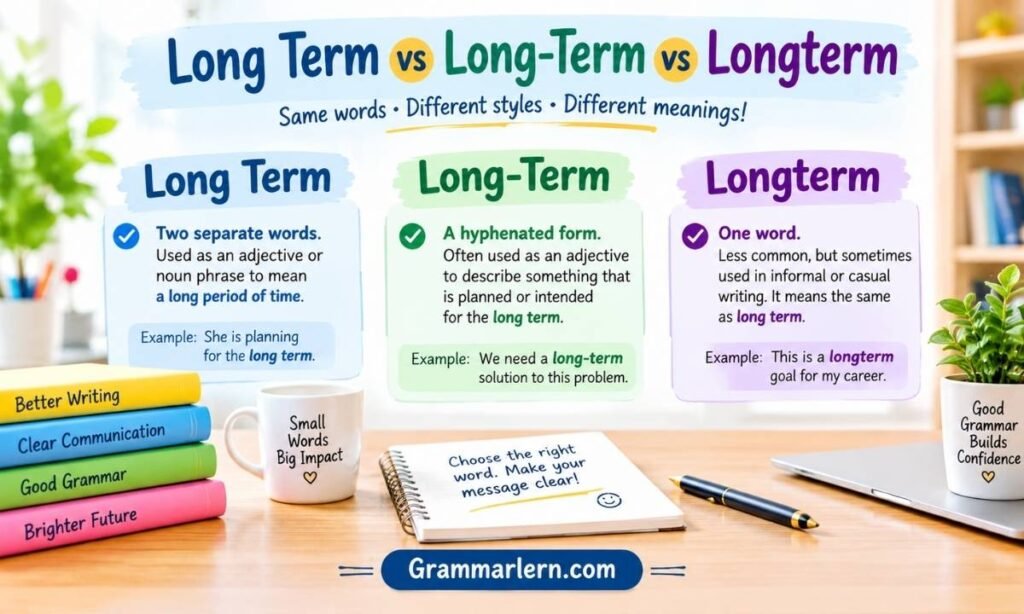
Confused about long term, long-term, or longterm? You’re not alone this is one of the most searched grammar mix-ups in English writing. The good news: the rule is simpler than it looks, and once you learn it, you’ll never second-guess yourself again.
In this guide, you’ll learn the exact difference between long term and long-term, discover why longterm is not a recognized word, and see clear examples that make the rule stick. By the end, choosing the correct form will feel completely natural and instant.
Quick Answer
Is “Longterm” Correct?
No. Longterm, written as a single word, is not accepted by standard dictionaries or major style guides. It is always written as two words (long term) or as a hyphenated compound (long-term), depending on how it functions in the sentence.
When to Use “Long Term”
Use long term without a hyphen when it works as a noun phrase, usually after words like in, over, or for.
Example: In the long term, this plan will save money.
When to Use “Long-Term”
Use long-term with a hyphen when it works as a compound adjective describing a noun that follows it.
Example: She made a long-term investment.
One-Line Grammar Rule You Can Memorize
If the phrase comes before a noun, add a hyphen. If it stands alone, leave it open. Simple, consistent, and easy to apply every time.
What Does “Long-Term” Mean?
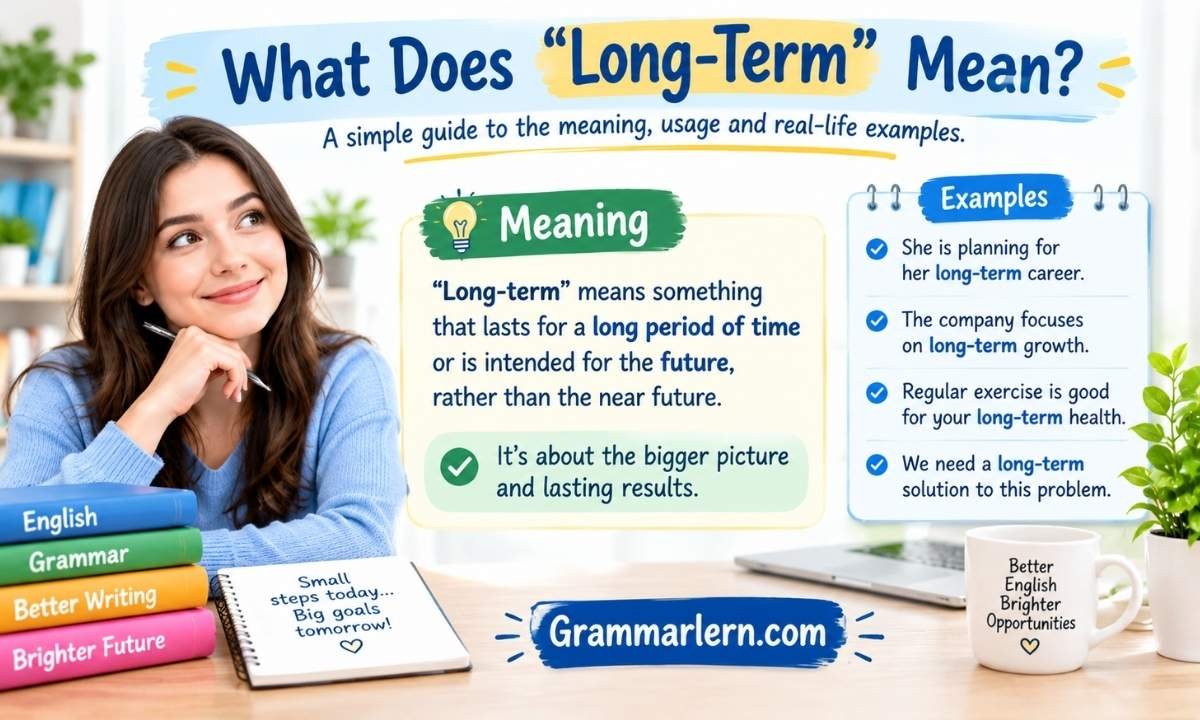
Long-term functions as an adjective in English grammar, meaning it gives more detail about a noun. When two words combine to describe a single noun, they form what is called a compound adjective, and the hyphen signals that connection to the reader.
Common phrases include long-term plan, long-term goals, and long-term relationship. This form appears frequently in formal writing, business documents, healthcare records, and academic content, where precise sentence structure and clarity matter most.
What Does “Long Term” Mean?
Long term, without a hyphen, functions as a noun phrase rather than a modifier. It typically follows prepositions such as in, over, or for, and refers to a general period of time rather than describing a specific noun.
For example, thinking about the long term or planning for the long term both use the phrase as a standalone concept. Since no noun is being directly modified, the hyphen is unnecessary here.
Why Is “Longterm” Considered Incorrect?
Despite frequent appearances on social media and in casual writing, longterm as a single word has not been adopted by leading dictionaries, including Merriam-Webster, or by widely used style guides such as APA, Chicago, and AP.
Some brands or software products may use “longterm” as a stylistic choice in naming, but this does not make it grammatically correct for standard writing. For essays, professional documents, and web content, the safer and more credible choice remains long term or long-term, chosen according to sentence structure.
The Simple Grammar Rule (Easy Memory Trick)
The easiest way to apply this rule is to ask one question: does the phrase come immediately before a noun? If yes, add the hyphen, as in long-term strategy. If the phrase stands alone and refers to a period of time, skip the hyphen, as in over the long term.
This memory trick works because English hyphenation rules generally exist to prevent ambiguity. A compound adjective needs the hyphen so the reader instantly understands both words are working together to modify one idea, improving overall readability and writing clarity.
Long Term vs Long-Term vs Longterm (Side-by-Side Comparison)
| Form | Correct? | Grammatical Role | Example |
| Long term | Yes | Noun phrase | We are planning for the long term. |
| Long-term | Yes | Compound adjective | We need a long-term plan. |
| Longterm | No | Not standard | Avoid using this spelling. |
This comparison makes the distinction easy to reference at a glance, especially when proofreading longer documents or checking consistency across a website.
Long-Term vs Short-Term: What’s the Difference?
Long-term and short-term follow identical hyphenation rules, since both are compound adjectives describing duration. The only difference lies in the length of time being referenced long-term implies an extended period, while short-term refers to something temporary or immediate.
Examples: long-term memory versus short-term memory, or long-term goals versus short-term goals. Understanding this parallel structure makes it easier to apply the same hyphenation logic consistently across related phrases.
Why Do People Get Confused?
Much of the confusion comes from inconsistent usage across the internet. Social media posts, marketing copy, and informal blogs often merge words that are technically still meant to be separate, such as website or email, which has led some writers to assume longterm is following the same evolution.
Additionally, style guides do not always align perfectly on hyphenation preferences, and many writers never learned the underlying rule distinguishing an adjective from a noun phrase. Once that grammatical foundation is clear, the confusion around long term vs long-term tends to disappear quickly.
Common Mistakes Writers Make
One frequent mistake is omitting the hyphen before a noun, writing long term plan instead of long-term plan. Another is the reverse error, adding an unnecessary hyphen in a sentence like thinking about the long-term when it should remain open as the long term.
Writing longterm as a single word is also common, particularly in casual or rushed writing, but it remains incorrect in professional and academic contexts. Mixing all three forms within the same document is another issue that affects consistency and can make content look unpolished.
Real-Life Usage Examples (High SEO Value)
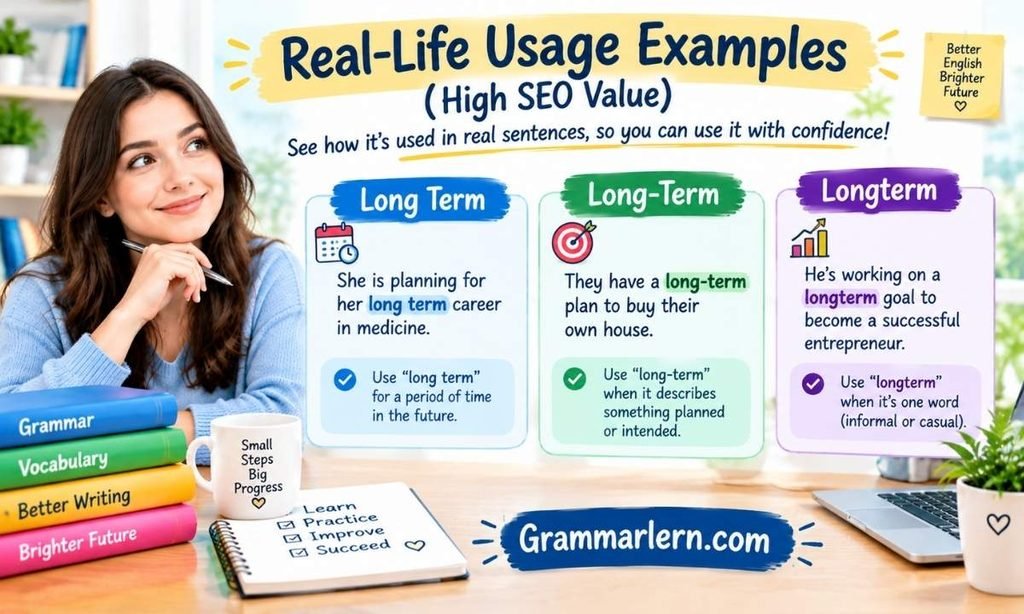
Long-Term Success
Long-term success depends on consistent effort rather than quick wins. Example: Her long-term success came from years of steady, disciplined work.
Long-Term Relationship
In a long-term relationship, trust and communication matter more over time. Example: They have been in a long-term relationship for over a decade.
Long-Term Goals
Setting long-term goals helps guide decisions made today. Example: His long-term goal is to open his own business.
Long-Term Memory
Long-term memory stores information for extended periods, unlike short-term memory. Example: Repetition helps move information into long-term memory.
Long Term / Long-Term in Sentences
Noun phrase: In the long term, healthy habits pay off. Adjective use: She adopted a long-term approach to fitness.
Quick Grammar Test (Interactive Section)
Test yourself with this simple question: does the phrase describe a noun, or does it refer to time in general?
- We need a ___ solution. (long-term)
- Thinking about the ___. (long term)
- She has a ___ investment plan. (long-term)
- Success requires focusing on the ___. (long term)
If you answered these correctly, you have already mastered the rule.
Frequently Asked Questions
Is it long term or long-term?
Both are correct, but they serve different roles. Use long term as a noun phrase (in the long term) and long-term as an adjective before a noun (long-term plan).
Is “long-term” always hyphenated?
No. It only needs a hyphen when it directly describes a noun, such as long-term goals. When it stands alone as a noun phrase, no hyphen is used.
Can I write “longterm”?
No. Longterm as one word is not recognized by standard dictionaries or style guides. Stick with long term or long-term depending on context.
Does long-term care have a hyphen?
Yes. In long-term care, the phrase acts as a compound adjective describing “care,” so the hyphen is required.
What is the difference between long term and long-term?
Long-term is an adjective used before a noun. Long term is a noun phrase describing a general period of time. The meaning is similar, but the grammatical role changes.
Why is hyphen used in long-term?
The hyphen joins two words into one descriptive unit, known as a compound adjective, so readers instantly understand they modify a single noun together.
Final Thoughts
Choosing between long term, long-term, and longterm comes down to one simple rule: if the phrase describes a noun, add the hyphen, and if it stands alone, leave it open. Longterm, written as one word, is never the correct choice in standard English.
Once this rule becomes second nature, writing with confidence gets much easier. Whether you are drafting a business plan or a casual message, using long term and long-term correctly instantly makes your writing look sharper and more professional.