


Someone says “I’ll be there soon,” and you’re left staring at your phone, wondering what that actually means. The truth is, “soon” has no fixed timeframe. It could mean five minutes, or it could mean five days.
Its real meaning always depends on context, not the clock. In this guide, you’ll learn how to decode “soon” in any situation, from texts to business emails, so you never have to guess again.
Quick Answer
“Soon” means “in a short time” or “before long,” but it has no exact, universal length. Depending on the situation, it can mean a few minutes, a few hours, several days, or even weeks. The best way to understand what someone means by “soon” is to look at the context: who is speaking, what they’re talking about, and how urgent the situation is.
What Does “Soon” Mean?

“Soon” is an adverb that describes something happening in the near future, without giving an exact time. It sits somewhere between “now” and “later,” but exactly where depends entirely on the situation.
When a friend texts “I’ll call you soon,” they usually mean sometime today. When a company says a feature is “coming soon,” they might mean next month. The word itself never changes. Only the context around it does.
Why Soon Does Not Have an Exact Time Limit
Unlike words such as “five minutes” or “next Tuesday,” “soon” is a relative time expression. It was never designed to carry a fixed duration. It’s meant to be flexible.
People use it when they don’t know the exact timing, or when they want to leave room for delays. A waiter, a delivery driver, and a software company all use “soon” differently, because their timelines are naturally different.
That flexibility is exactly why the word causes so much confusion, and why context always matters more than the dictionary definition.
How Long Is Soon Exactly?
If you ask ten people “how long is soon,” you’ll likely get ten different answers. There is no single correct number of minutes, hours, or days attached to it.
The best approach is to judge “soon” based on the size of the task involved. A small, quick task, like replying to a text, usually means soon equals minutes. A large task, like a product launch, usually means soon equals weeks or months.
Instead of expecting an exact time, ask yourself what the smallest reasonable wait is for that specific situation.
Typical Timeframes for “Soon” in Different Situations
| Situation | Typical Meaning of “Soon” |
| Text message | A few minutes to a few hours |
| Meeting a friend | 10 to 60 minutes |
| Workplace task | A few hours to a few days |
| Customer support reply | 1 to 7 days |
| Package delivery | Same day to several days |
| Product launch | Weeks to months |
| Large business project | Months or longer |
Soon in Text Messages
In texting, “soon” almost always means a short wait, minutes to a few hours. Since texting is instant by nature, people expect a relatively quick reply when someone says “I’ll text you soon.”
Soon at Work
At work, “soon” is more elastic. A manager saying a task will be done “soon” could mean later today, tomorrow, or by the end of the week, depending on workload and priorities.
Soon in Relationships
In personal relationships, “soon” depends heavily on the two people involved. “Let’s meet soon” might mean this weekend to one person and sometime next month to another, which is often where misunderstandings start.
Why Is the Word “Soon” So Vague?
“Soon” is vague because it has no built in boundaries. It doesn’t tell you the start point or the end point, only that something is expected before too long.
Every person also experiences time differently. Someone waiting for a refund might see three days as a long delay, while a business might see it as fast service. That mismatch in expectations is what makes “soon” feel unreliable.
Why People Use the Word “Soon” Instead of Giving Exact Times
People often choose “soon” because they genuinely don’t know the exact timing yet. Rather than promise something they can’t guarantee, they use a flexible word instead.
It’s also a way to avoid pressure. A manager might say a report will be ready “soon” simply because the finish date isn’t confirmed. Customer service teams do the same thing while waiting on updates from another department.
In many cases, “soon” is really just a polite placeholder for “I don’t have an exact answer yet, but it’s coming.”
How to Interpret “Soon” Correctly
To understand what someone actually means by “soon,” look past the word itself and focus on the situation.
- Consider the task size. Small tasks mean a shorter “soon.” Big projects mean a longer one.
- Think about the person’s habits. Some people use “soon” loosely, others use it precisely.
- Factor in urgency. A hospital and a restaurant don’t operate on the same clock.
- Ask directly if it matters. “How soon is soon?” is a completely reasonable follow up question.
Real-Life Examples of “Soon”
Seeing “soon” in real sentences makes its flexibility easier to understand.
“I’ll be there soon” usually means within minutes, especially in face to face or travel contexts.
“I’ll get back to you soon” in emails or workplace chats often means within hours to a few days, depending on workload.
“Coming soon” in marketing and product launches can mean anywhere from days to several months.
“Talk to you soon” is usually just a friendly sign off, not a real timeframe promise.
“See you soon” can range from hours to weeks, depending on how close the relationship is.
How Long Is “Soon” When a Guy Says It?
When it comes to texting or dating, “soon” from a guy often means he’s being intentionally vague, not evasive. It could reflect an unpredictable schedule, uncertainty about plans, or simply casual communication habits.
In most dating and texting contexts, “soon” from a guy typically falls somewhere between a few hours and a few days. If the timing genuinely matters to you, a direct question like “when exactly?” usually gets a clearer answer than reading into the word itself.
Does “Soon” Mean Minutes, Hours, Days, or Weeks?
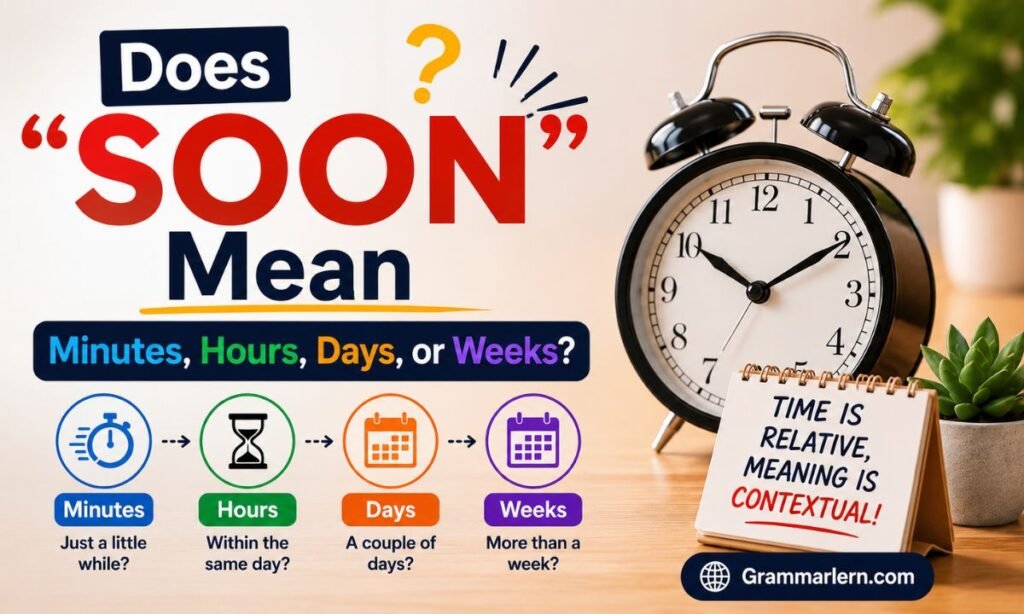
The honest answer is: it can mean any of these, depending entirely on context.
When Soon Means Minutes
Food preparation, ride hailing apps, and in person meetups often use “soon” to mean just a few minutes.
When Soon Means Hours
Texts, emails, and routine work tasks commonly fall into the “a few hours” category.
When Soon Means Days
Customer support tickets, document reviews, and business approvals frequently mean soon equals 1 to 7 days.
When Soon Means Weeks or Months
Product launches, hiring processes, and large projects often stretch “soon” out to weeks or even months.
When Soon Means Years
In science, research, and long term planning, “soon” can occasionally stretch to years. For example, when scientists say a discovery or treatment is “coming soon,” it may still be several years away from public release.
Soon vs Other Time Expressions
Comparing “soon” to similar words helps clarify exactly what it does, and doesn’t, promise.
Soon vs Shortly
Both suggest the near future, but “shortly” tends to sound slightly more immediate and formal than “soon.”
Soon vs Later
“Soon” implies a relatively near timeframe, while “later” can mean almost any point in the future, near or distant.
Soon vs Immediately
“Immediately” means without any delay. “Soon” always leaves room for some waiting time.
Soon vs Eventually
“Eventually” suggests a longer, far less predictable timeframe than “soon,” with no real sense of urgency attached.
Common Misunderstandings About the Word “Soon”
Most confusion around “soon” happens because people assume everyone shares the same definition of it.
One common mistake is expecting a specific timeframe when none was ever promised. Another is interpreting “soon” based on personal expectations rather than what the speaker actually intended.
In relationships, one person might expect contact within hours, while the other thinks a few days is completely reasonable, and neither one is technically wrong.
How Different Industries Use the Word “Soon”
Different industries treat “soon” very differently, based on how their timelines typically work.
- Marketing: “Coming soon” builds anticipation before a launch, often meaning weeks or months.
- Technology: Developers use “soon” when release dates aren’t locked in yet.
- Customer support: Reps often say “soon” while waiting on another team or department.
- Project management: “Soon” can describe a milestone that’s close but not yet confirmed.
- Healthcare: Doctors and clinics use “soon” for appointments or results, usually meaning hours to a few days.
Alternatives to Saying “Soon”
If precision matters, swapping “soon” for a specific timeframe removes the guesswork entirely.
| Instead of Saying | Say This Instead |
| I’ll call you soon. | I’ll call you this afternoon. |
| The update is coming soon. | The update launches next week. |
| We’ll get back to you soon. | We’ll respond within two business days. |
| I’ll finish it soon. | I’ll finish it by 3:00 PM. |
Specific deadlines build trust and reduce unnecessary follow up questions, especially in professional communication.
Popular Quotes and Phrases About “Soon”
“Soon” shows up in plenty of everyday expressions, each carrying a slightly different tone:
- “Get well soon”: a wish for a quick recovery.
- “See you soon”: a casual, friendly farewell.
- “Too soon”: something happening earlier than expected or comfortable.
- “As soon as possible (ASAP)”: a request for the fastest reasonable response.
- “Sooner rather than later”: a gentle push for quicker action.
- “How soon is soon?”: the classic clarifying question people ask when the word alone isn’t enough.
Frequently Asked Questions
How long can “soon” mean?
“Soon” can mean anywhere from a few minutes to several months, depending on the situation. There’s no fixed upper limit. Context decides the length.
What qualifies as “soon”?
Something qualifies as “soon” when it’s expected to happen sooner than the average or expected timeframe for that specific situation, even without an exact deadline attached.
How many days is “very soon”?
“Very soon” usually suggests a shorter wait than plain “soon,” typically within 1 to 3 days in most everyday and business contexts.
How soon is “real soon”?
“Real soon” is an informal way of emphasizing urgency. It generally implies hours to a couple of days, signaling that the wait should be shorter than usual.
Does “soon” mean today or tomorrow?
It can mean either. In casual conversation, “soon” often implies later today, but in business or project contexts, it can easily stretch into tomorrow or later in the week.
Is “soon” the same as “immediately”?
No. “Immediately” means without any delay, while “soon” always allows for some waiting time, however short.
Final Thoughts
At the end of the day, “soon” is one of the most flexible words in the English language, and that flexibility is exactly why it causes confusion. Its real meaning always depends on the situation, the speaker, and how much urgency is involved.
Rather than searching for one universal answer, the smartest approach is to read the context. The task size, the relationship, and the industry all shape what “soon” really means. When timing truly matters, don’t hesitate to simply ask.
So the next time someone tells you they’ll be there “soon,” you’ll know exactly what to look for, and how to get a clearer answer if you need one.