

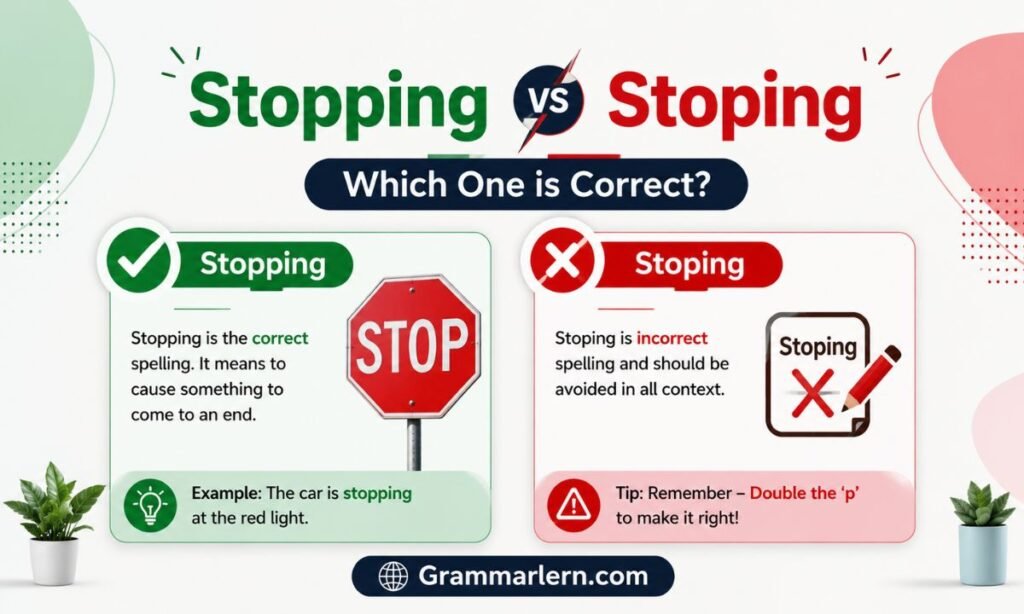
Ever typed “stoping” instead of “stopping” and wondered if it was a typo or a real word? You’re not alone. It’s one of the most common spelling mix-ups in English.
The confusion makes sense: stopping is the word we use every day, while stoping is a completely different term used only in mining and geology. Mixing them up is an easy mistake to make.
In this guide, we’ll settle the confusion for good. You’ll learn the correct spelling, the simple rule behind it, and what “stoping” really means.
Stopping or Stoping: Quick Answer
Quick Answer: The correct spelling for everyday English is stopping.
Stopping
“Stopping” is the present participle of the verb “stop.” It describes the action of coming to a halt or ceasing movement. Example: “She is stopping at the store on her way home.”
Stoping
“Stoping” is a specialized noun used almost exclusively in mining and geology. It refers to the process of excavating underground ore or the way magma is thought to move upward through rock. Example: “The engineers used stoping to extract ore from the underground mine.”
Remember: Unless you’re writing about mining or geology, “stopping” is always the word you need.
The Origin of Stopping
The word “stop” comes from the Middle English “stoppen,” meaning to block, close, or prevent movement.
When “-ing” is added to form the present participle, English spelling rules often double the final consonant if the word is short, stressed, and ends with a single vowel followed by a consonant.
- Stop to Stopping (double “p”)
This is why “stoping,” without the doubled “p,” isn’t standard outside of technical mining contexts. It simply doesn’t follow the spelling pattern that governs everyday words like “stop.”
🔹 How to Spell “Stopping” Correctly (Common Questions)
Many people search phrases like how to spell stopping, is it stopping or stoping, or what is the correct spelling of stopping because the double-consonant rule can be confusing.
The correct spelling is stopping, with a double “p.”
- Correct: stopping
- Incorrect: stoping (outside of mining/geology)
Why do we double the “p”?
Because “stop” is:
- One syllable
- Ends in a vowel followed by a consonant
So it follows the standard English spelling rule: stop becomes stopping.
What about “stopped”?
The same rule applies to the past tense. Another common mix-up is stopped vs. stoped.
- Stopped ✅ correct
- Stoped ❌ incorrect
Example: “The car stopped suddenly.”
The final consonant is doubled the same way before adding “-ed” as it is before adding “-ing.”
British English vs American English Spelling
English spelling often differs between regions, but in this case, both British and American English agree.
| Aspect | British English | American English | Notes |
| Present participle of “stop” | stopping | stopping | Both double the “p” after a single vowel |
| Incorrect form | stoping | stoping | Only valid in mining terminology |
| Past tense | stopped | stopped | Same in both variants |
| Spelling pattern | Consonant doubling after a short vowel | Consonant doubling after a short vowel | Standard rule applies universally |
Key takeaway: The double “p” rule applies no matter which English variant you write in. Save “stoping” for mining and geology contexts only.
Which Spelling Should You Use?
For everyday writing, including emails, reports, social media, and formal documents, always use stopping.
- US audience: “stopping” is standard in all writing.
- UK & Commonwealth audience: “stopping” is equally correct. There’s no regional variation.
- Specialized fields: Only use “stoping” when discussing mining or geology.
Tip: When in doubt, double the “p.” This one rule keeps your writing correct anywhere in the world.
Common Mistakes with Stopping
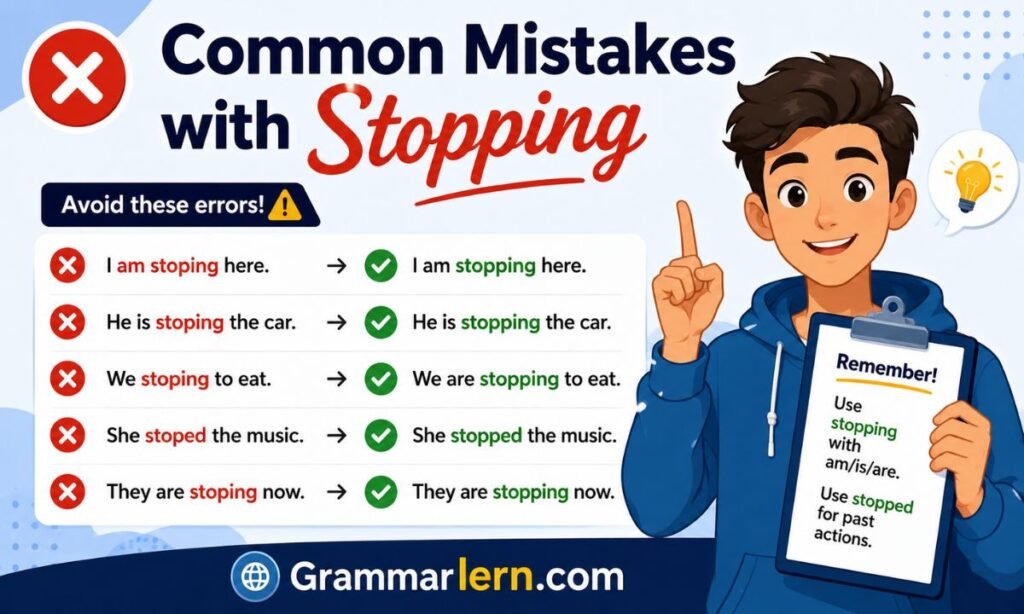
Even confident writers slip up here. Below are the most frequent errors and their corrections.
| Mistake | Correction | Explanation |
| stoping | stopping | Always double the “p” for the present participle |
| stoping the car | stopping the car | Verb form must follow standard spelling rules |
| I am stoping | I am stopping | Present continuous tense needs the correct participle |
| stoppinged | stopped | “Stoppinged” is never correct; the past tense is “stopped” |
| she is stoping here | she is stopping here | Correct form follows standard grammar rules |
Quick rule: If a one-syllable verb ends in a single vowel plus a consonant, double that consonant before adding “-ing.”
Stopping in Everyday Examples
Using “stopping” correctly makes your writing clearer and more professional. Here’s how it looks across different contexts.
- Email: “I will be stopping by your office at 3 PM.”
- News headline: “Train services are stopping temporarily due to maintenance.”
- Social media post: “I’m stopping by the café before heading home.”
- Formal writing: “The project team is stopping all non-essential tasks to meet the deadline.”
- Conversation: “He is stopping the car at the red light.”
Observation: Outside of technical writing, you’ll rarely, if ever, need “stoping.”
How to Pronounce “Stopping” and “Stoping”
Both words are pronounced similarly, which adds to the confusion when people hear them rather than read them.
- Stopping (British English): sto-puhng
- Stopping (American English): staa-puhng
- Stoping: pronounced the same way as “stopping.” The spelling difference doesn’t change the sound; the words are distinguished only in writing and by context (everyday vs. technical).
This is part of why the misspelling happens so often. Since both words sound alike, writers sometimes assume the shorter spelling (“stoping”) is correct, a pattern similar to words like “hoping” or “roping,” which genuinely do use a single “p.”
Stoping in Mining: What Does It Mean?
While “stopping” belongs to everyday English, “stoping” has a real and important meaning in a very different field.
In mining, stoping refers to the process of excavating ore from an underground deposit, creating open spaces (called “stopes”) as material is removed. In geology, the term also describes a theory of how molten magma rises through the Earth’s crust by breaking off and absorbing surrounding rock fragments as it pushes upward.
Example: “Engineers used sublevel stoping to safely extract ore from the underground mine.”
This is the only context where “stoping” is considered correct. Outside of mining, geology, or related engineering fields, it should always be corrected to “stopping.”
Synonyms for Stopping
If you want to vary your word choice, several synonyms can replace “stopping” depending on context:
- Halting
- Ceasing
- Pausing
- Ending
- Discontinuing
- Concluding
- Interrupting
Note that “stoping” has no everyday synonyms, since it’s a technical term specific to mining and geology rather than a general-use word.
Stopping: Google Trends & Usage Data
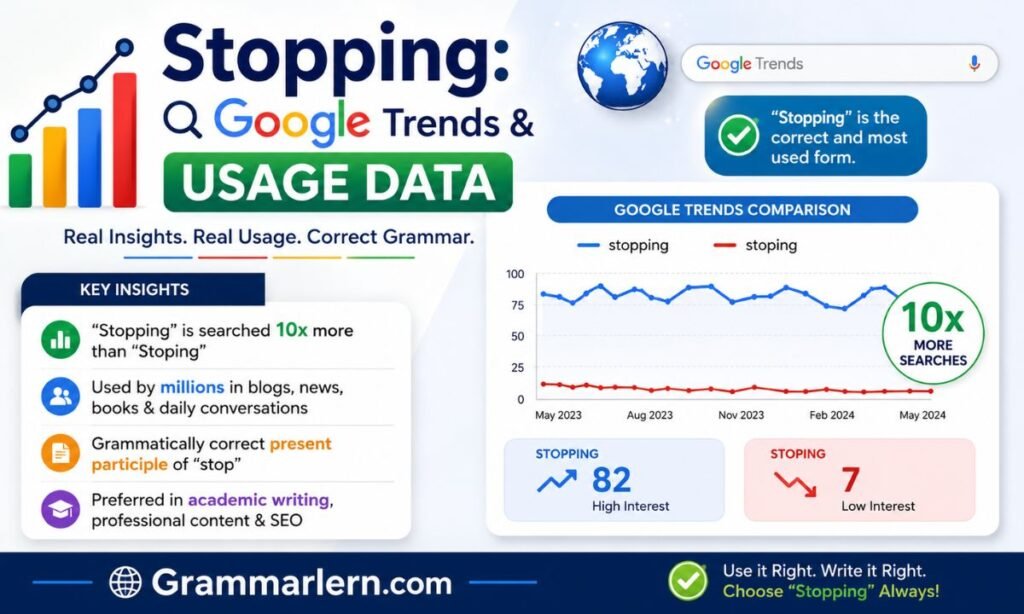
Search and usage data consistently show that “stopping” is used far more often than “stoping.”
- Common contexts for “stopping”: grammar guides, language learning resources, driving instructions, everyday communication, and software tutorials.
- Common contexts for “stoping”: mining publications, geology textbooks, and engineering resources.
This usage pattern confirms what the spelling rule already tells us: for general audiences, “stopping” is the only correct and expected choice.
Keyword Variations Comparison Table
| Keyword Variation | Correct Usage | Notes |
| stopping | ✅ Correct | Present participle, everyday use |
| stoping | ❌ Incorrect (outside mining) | Only valid in mining/geology context |
| stopped | ✅ Correct | Past tense of “stop” |
| stop | ✅ Correct | Base form |
| stops | ✅ Correct | Third-person singular |
🔹 Stopping vs Stoping: Spelling Rules and Meaning
Correct usage:
- Stopping: standard English, used daily
- Stoping: technical term, mining/geology only
Key difference:
| Word | Meaning | Usage |
| Stopping | Action of “stop” | Everyday English |
| Stoping | Mining/geology process | Technical writing only |
Common search variations explained:
People often search for:
- stoping spelling
- stoping vs stopping
- stopping or stoping
- is it stoping or stopping
For nearly all everyday situations, the clear answer is stopping.
Related verb forms (important for clarity):
Understanding the full verb pattern helps avoid future confusion:
- stop: base form
- stops: present tense
- stopping: present participle
- stopped: past tense
Example: “Are you stopping here? He stopped the car.”
Frequently Asked Questions
What does “stopping” mean?
“Stopping” is the present participle of the verb “stop,” meaning to bring an action, movement, or process to a halt. It’s used in everyday English, such as “The car is stopping at the light.”
What does “stoping” mean?
“Stoping” is a specialized term used in mining and geology. It refers to the process of excavating underground ore or the way magma is thought to move upward by breaking off and absorbing surrounding rock.
Is “stoping” ever the correct spelling?
Yes, but only in mining and geology contexts. Outside of those specialized fields, “stoping” is always a misspelling of “stopping.”
How do you use “stopping” in a sentence?
You can use it to describe any action coming to a halt, such as “She is stopping by the store on her way home” or “The train is stopping at every station today.”
How do you use “stoping” in a sentence?
It’s used in technical writing, such as “Engineers used sublevel stoping to extract ore safely from the underground mine.”
Why do we double the “p” in stopping?
Because “stop” is a one-syllable word ending in a single vowel followed by a consonant. English spelling rules require doubling that final consonant before adding “-ing.”
Is there a difference between British and American spelling of “stopping”?
No. Both British and American English use “stopping” with a double “p.” There’s no regional variation for this word.
Final Thoughts
At the end of the day, the choice between stopping or stoping comes down to context. For everyday writing, including emails, messages, and conversations, “stopping” is always the correct spelling, thanks to a simple consonant-doubling rule.
“Stoping,” on the other hand, has its own place in mining and geology, where it describes a very specific underground process. Unless you’re writing about that field, this spelling won’t apply to you.
Keep this guide handy the next time you second-guess your spelling. With the rule and examples covered here, you’ll never confuse “stopping” and “stoping” again.