

You write “the analysis shows a clear trend,” then a few lines later type “these analyses confirm it” — and suddenly you’re not sure which one is even correct. It happens to students, professionals, and native speakers alike, because the two words look almost identical yet mean something different.
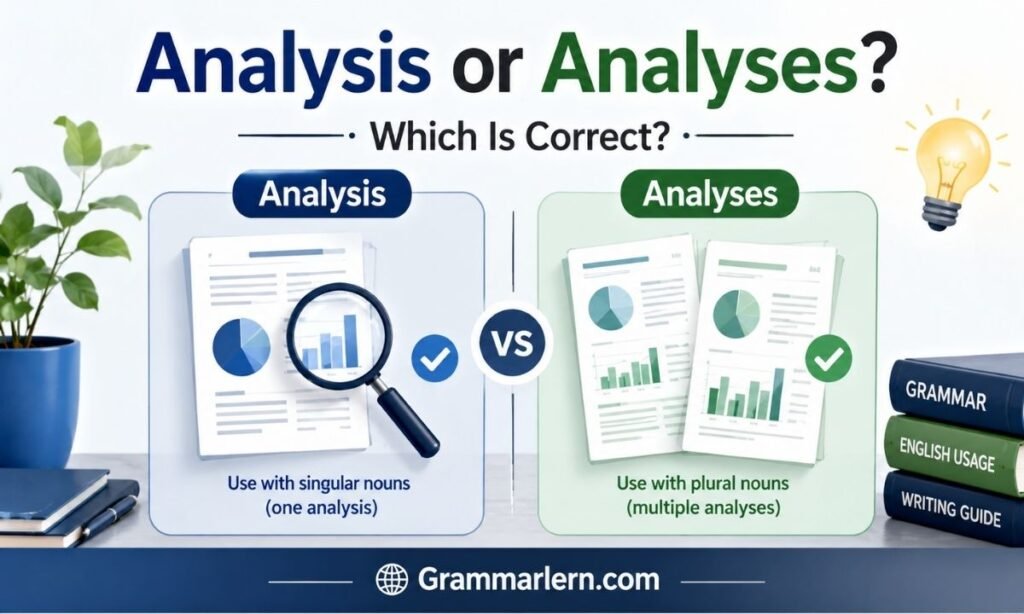
Analysis is singular, meaning one detailed study or examination. Analyses is its plural, meaning more than one. This guide breaks the rule down in plain language, with real examples, common mistakes, and a simple memory trick you’ll actually remember the next time you write either word.
Quick Answer: Analysis vs Analyses at a Glance
Use analysis when you’re talking about one examination, study, or report. Use analyses when you’re talking about two or more. The plural doesn’t follow the usual “add an s” rule because the word comes from Greek, so analysis becomes analyses, not “analysises.”
Core Definitions
What “Analysis” Means (Singular)
Analysis is a noun that describes a single, detailed examination of something, whether that’s a dataset, a piece of writing, or a business problem. It refers to the process of breaking a subject into parts to understand it better.
Example: The professor praised her analysis of the poem.
Example: This analysis explains why sales dropped last quarter.
What “Analyses” Means (Plural)
Analyses is simply more than one analysis. It refers to multiple studies, reports, or evaluations, whether that means several people examining the same thing or one person examining several different things.
Example: The three analyses reached different conclusions.
Example: Her analyses of consumer behavior shaped the company’s strategy.
Grammar Breakdown
Singular vs Plural: The Rule Behind the Change
Most English nouns become plural by adding “s” or “es.” Analysis doesn’t follow that pattern because it’s a Greek loanword. Words ending in “-is” that come from Greek typically become “-es” in the plural.
| Singular | Plural |
| analysis | analyses |
| crisis | crises |
| thesis | theses |
| hypothesis | hypotheses |
| diagnosis | diagnoses |
Once you recognize this pattern, the plural stops feeling random and starts feeling predictable.
Why “Analysises” Is Never Correct
Some writers instinctively add “-es” straight onto “analysis,” producing “analysises.” This form doesn’t exist in standard English. Because the word follows Greek pluralization rules rather than regular English ones, the correct plural is always analyses.
Wrong: The lab ran three analysises.
Correct: The lab ran three analyses.
Also Read This “In Process” vs “In Progress”: The Real Difference (With 20+ Examples)
Greek Origin of the Word “Analysis”
Analysis comes from the Greek word analusis, built from ana (meaning “up” or “apart”) and lysis (meaning “loosening”). Together, they describe the act of breaking something apart to study it. The Greek plural, analyseis, is where the modern English plural analyses comes from. English kept the Greek plural pattern instead of anglicizing it, which is why the word behaves differently from most nouns.
Special Plural Patterns in English
Analysis belongs to a small family of English words borrowed from Greek and Latin that follow irregular plural rules. Recognizing the pattern helps with more than just this one word.
| Pattern | Singular | Plural |
| -is to -es | analysis | analyses |
| -is to -es | basis | bases |
| -on to -a | phenomenon | phenomena |
| -um to -a | datum | data |
| -a to -ae | formula | formulae |
If a word ends in “-is” and has Greek roots, there’s a good chance its plural ends in “-es” too.
American vs British English Usage

Analysis and analyses are spelled and used identically in American and British English. There’s no regional variation for the nouns. The only difference shows up in the related verb: American English uses analyze, while British English uses analyse.
US: I need to analyze this data.
UK: I need to analyse this data.
Is “Analyses” a Verb? Clearing Up the Confusion
This is where most explanations fall short. In American English, the verb form is always analyzes (“she analyzes the results”), and analyses only ever functions as a plural noun. In British English, however, analyses does double duty: it’s both the plural noun and the third-person singular verb form of analyse (“she analyses the results”). So a British sentence with “analyses” could be a noun or a verb depending on context, while in American English, that ambiguity doesn’t exist.
Common Errors and How to Fix Them
Error 1: Using “Analyses” as a Singular
Wrong: The analyses shows a clear pattern.
Correct: The analysis shows a clear pattern.
If you’re describing one study, use the singular form and a singular verb.
Error 2: Using “Analysis” to Refer to Multiple Cases
Wrong: We completed five analysis last week.
Correct: We completed five analyses last week.
Any number greater than one calls for the plural form.
Error 3: Pronouncing Them the Same
Many people say both words identically, which then bleeds into their spelling. They’re pronounced differently:
Analysis: uh-NAL-uh-sis
Analyses: uh-NAL-uh-seez
Practicing the “seez” ending out loud makes the plural spelling easier to remember.
Analysis vs Analyses: Examples in a Sentence

Singular:
The financial analysis revealed a major risk.
Her analysis of the poem impressed the class.
Plural:
The committee reviewed five separate analyses.
Different economists produced conflicting analyses of the same data.
Is “Data Analysis” Singular or Plural?
Data analysis is treated as a singular, uncountable concept when it refers to the general field or process, not a countable set of studies.
Example: Data analysis is essential for good decision-making.
If you’re referring to specific instances of the process, the plural still applies.
Example: The team ran several data analyses before finalizing the report.
Practical Usage in Writing
Using “Analysis” in Academic Work
Academic writing uses analysis when discussing one focused study, one dataset, or one argument. It’s common in methods sections, literature reviews, and case studies.
Example: This analysis focuses on three key variables.
Using “Analyses” in Research
Research writing uses analyses when comparing multiple experiments, tests, or datasets.
Example: The meta-study combined analyses from twelve separate trials.
Also Read This “In Process” vs “In Progress”: The Real Difference (With 20+ Examples)
Why Proper Pluralization Matters in Research
Using the wrong form doesn’t just look careless, it creates real ambiguity. “The analysis were reviewed” forces a reader to pause and guess whether one study or several are being discussed. In academic and professional writing, that kind of confusion undermines clarity and, over time, credibility.
Tips for ESL Learners
Simple Memory Tricks
Think of the letter “i” in analysis as standing for “individual,” one single study. When there’s more than one, that “i” shifts to an “e,” giving you analyses.
Visual Cue
analysis (one study)
↓
analyses (many studies)
Picture the singular splitting apart into several pieces. That mental image mirrors what the word itself means.
Pronunciation Trick
Say both words out loud in rhythm:
Analysis: buh-DUH-duh-duh
Analyses: buh-DUH-duh-SEEZ
The stretched-out ending on “analyses” is your cue that you’re dealing with the plural.
Quick Practice
Fill in the blanks with analysis or analyses:
- The ______ took two weeks to complete.
- Multiple ______ confirmed the same result.
- Her ______ was more detailed than the others.
(Answers: analysis, analyses, analysis)
Frequently Asked Questions
Is there a plural of analysis?
Yes. The plural of analysis is analyses, formed by changing the Greek-derived “-is” ending to “-es.”
What does the word “analyses” mean?
Analyses means more than one analysis. It can refer to several separate studies of one subject, one study covering several subjects, or several studies covering several subjects.
What’s the difference between “analyse” and “analyze”?
They’re the same verb with different regional spellings. Analyse is British English, and analyze is American English. Both mean “to examine something in detail.”
Can “analysis” ever be used as a plural?
No. Analysis is always singular. If you’re referring to more than one, the correct word is analyses.
How do you pronounce “analyses”?
It’s pronounced uh-NAL-uh-seez, with the ending sounding like “seez,” unlike the singular “sis” ending in analysis.
Do “analysis” and “analyses” mean the same thing?
Not exactly. They share the same root meaning, detailed examination, but analysis refers to one study and analyses refers to more than one.
Final Thoughts
The rule behind analysis and analyses comes down to a single question: are you talking about one study, or more than one? Analysis stays singular, analyses covers the plural, and the Greek origin explains why the ending changes the way it does instead of just adding an “s.”
Once that pattern clicks, you’ll stop second-guessing yourself mid-sentence. Whether you’re writing a report, a research paper, or a quick email, getting analysis vs analyses right is a small detail that makes your writing sound sharper and more precise.
1 thought on “Analysis or Analyses? The Simple Rule You’ll Never Forget”