

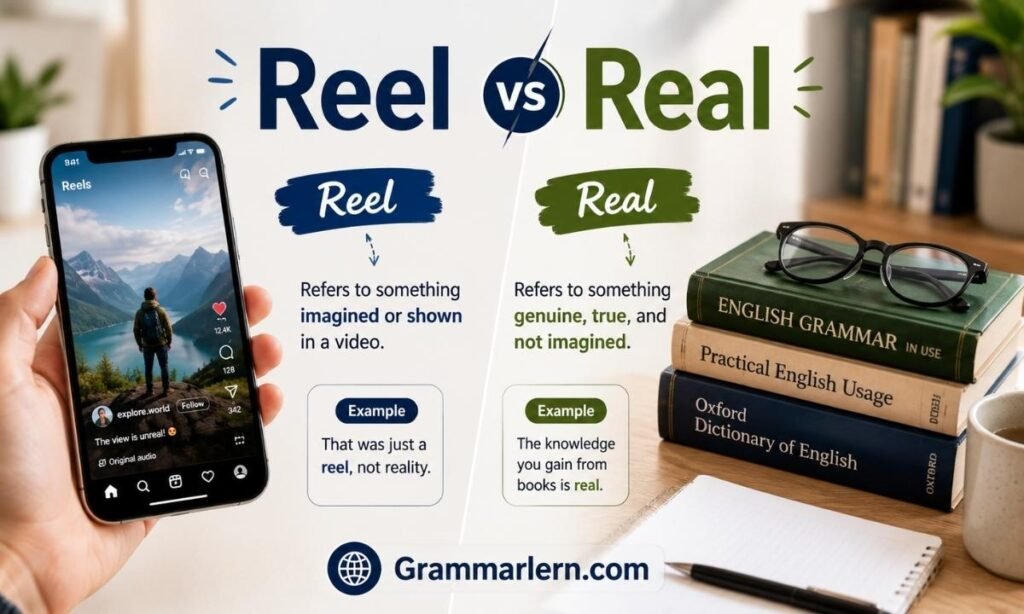
Reel and real sound exactly the same, but they mean completely different things. One word describes something true and authentic, while the other refers to film, fishing line, or Instagram videos. This mix-up is one of the most common English homophone mistakes writers make.
Knowing the difference between reel and real instantly improves your writing accuracy. In this guide, you’ll learn clear meanings, correct usage rules, and simple examples for both words. By the end, you’ll never confuse them again.
Quick Answer
Real is an adjective that means something is true, genuine, or actually exists — for example, “This is a real diamond.” Reel, on the other hand, is a noun (and sometimes a verb) that refers to a spinning object like a film or fishing reel, or a short video on platforms like Instagram. Both words are homophones, so they sound identical but are spelled and used differently.
What Does “Real” Mean in English?

The word real describes something that is true, factual, or not fake. It’s one of the most commonly used adjectives in English, appearing in everyday phrases like “real life,” “real story,” or “real problem.” When you say something is real, you’re confirming it actually exists or is happening.
Real can also function as an adverb in informal speech, such as “She played real well tonight,” and even as a noun in mathematics, where “real numbers” refers to a specific number category. In most cases, though, you’ll use real to talk about authenticity, sincerity, or truth — the opposite of fake, imaginary, or artificial.
What Does “Reel” Mean in English?
The word reel has several meanings, and context decides which one applies. In its oldest sense, a reel is a cylindrical object used to wind thread, wire, film, or fishing line — think of a fishing reel or an old-fashioned movie reel. As a verb, “to reel” means to stagger or lose balance, as in “he reeled back in shock.”
Reel also has a lesser-known meaning as a lively folk dance, especially in Scottish and Irish traditions. But the meaning most people search for today is much more modern.
Reel in Movies, Shows & Pop Culture
In filmmaking, a “reel” traditionally referred to the physical spool that held strips of film. Even though most movies are now digital, the term stuck around — you’ll still hear phrases like “highlight reel” or “blooper reel” in the entertainment industry. This is also where the popular idiom “reel life vs. real life” comes from, often used to compare dramatized on-screen stories (like a movie or a Korean drama) with what actually happens in reality.
Reel on Instagram & Social Media
The newest and fastest-growing meaning of reel comes from social media. Instagram Reels, along with similar short-form video features on Facebook and other platforms, are quick, vertical video clips. When someone asks “is it reel or real on Instagram,” they’re usually confusing the spelling of this video feature with the adjective “real,” but the correct term is always Reel — no “a” involved.
Reel vs Real: Key Differences Explained
The core difference comes down to meaning and word type. Real is primarily an adjective describing truth or authenticity. Reel is primarily a noun (and sometimes a verb) describing something that spins, winds, or plays — whether that’s a fishing reel, a film reel, or a social media video. Because they’re pronounced identically, the only way to choose the right word is to look at the context of the sentence.
Reel vs Real Pronunciation
Both words are pronounced the same way: /riːl/, rhyming with “feel,” “peel,” and “wheel.” Some dialects may soften it slightly to /rɪəl/ for “real,” but in standard English, there’s no audible difference between the two. This is exactly why they’re classified as homophones — and why spelling, not sound, is what matters when writing.
Are “Reel” and “Real” Homophones?
Yes, reel and real are homophones — words that sound alike but have different spellings and meanings. This shared pronunciation is the main reason people mix them up in writing, even though native speakers rarely confuse them in conversation. Once you separate the sound from the spelling, choosing the correct word becomes much easier.
Reel vs Real in Sentences (Clear Examples)
Seeing both words in context makes the difference easy to remember.
Real:
- “Is this story real, or did you make it up?”
- “That was a real diamond, not a fake one.”
Reel:
- “He wound the fishing line back onto the reel.”
- “I watched a funny Instagram reel this morning.”
Notice how real always connects to truth, while reel always connects to something spinning, playing, or streaming.
Real Life vs Reel Life: What’s the Difference?
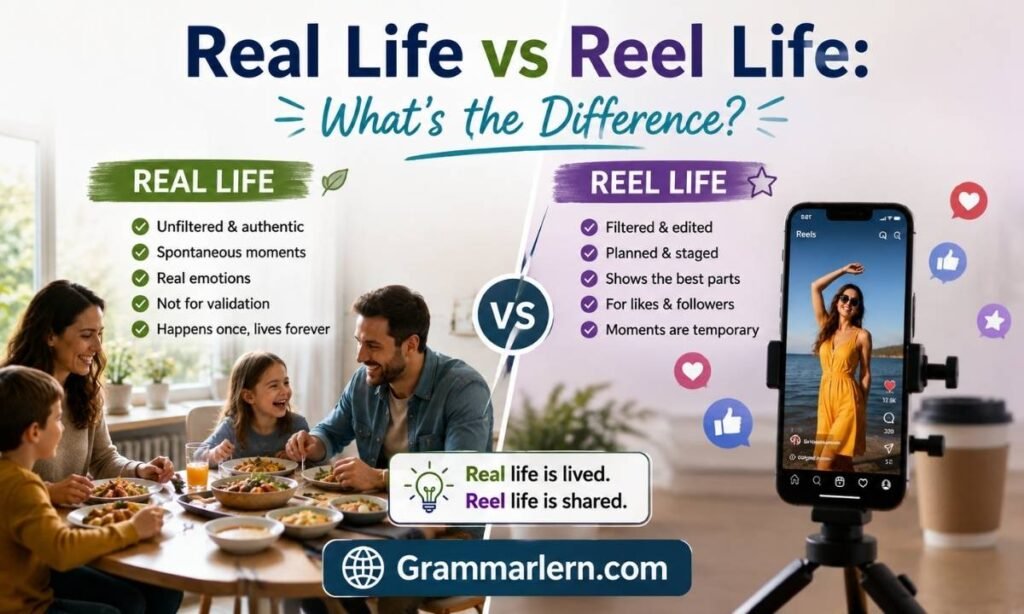
“Reel life” is a popular expression that refers to what happens in movies, shows, or dramatized content — think of a gripping film like Dhurandhar or an emotional Korean drama. “Real life,” by contrast, refers to actual, lived experience outside the screen. People often use “reel life vs real life” to point out how fictional or edited storytelling can feel more dramatic, glamorous, or exaggerated than everyday reality. It’s a popular phrase in film reviews, social commentary, and even motivational content about staying grounded.
Common Mistakes Learners Make
The most frequent error is swapping the two words in writing — for example, typing “this story is reel” instead of “real.” Another common mistake is assuming both words share a similar meaning simply because they sound alike. Learners also struggle when both words could technically “fit” a sentence phonetically but not logically. The fix is simple: always pause and ask whether you mean something true (real) or something that spins or plays (reel).
Real vs Reel in Writing and Communication
In formal writing, real is used constantly to describe facts, emotions, or situations — for instance, “This is a real concern for the industry.” Reel, meanwhile, shows up in more specific contexts: film production, fishing, dance, or social media captions. Using the wrong word doesn’t just look like a typo — it can genuinely confuse your reader, since the two words carry entirely different meanings.
Quick Comparison Table: Reel vs Real
| Feature | Real | Reel |
| Word type | Adjective (mainly) | Noun / Verb |
| Core meaning | True, genuine, authentic | Spinning object, film, or short video |
| Common use | Real life, real story, real problem | Fishing reel, film reel, Instagram reel |
| Pronunciation | /riːl/ | /riːl/ |
| Example | “This is a real problem.” | “I watched an Instagram reel.” |
Memory Trick to Never Confuse Reel and Real Again
Here’s a simple way to lock it in: think of “real” as reality — both words share that “rea-” root, and reality is all about things that truly exist. Then think of “reel” as a wheel — the extra “e” mimics the shape of something round and spinning, like a film reel or fishing reel. A fun way to remember both at once: “A real angler uses a real reel to reel in a real big fish.”
Practice Section: Test Your Understanding
Choose the correct word for each sentence:
- This story is (real / reel).
- I watched an Instagram (real / reel) today.
- The fishing (real / reel) was broken.
- Is this a (real / reel) diamond?
- He (realed / reeled) back in surprise.
(Answers: 1. real, 2. reel, 3. reel, 4. real, 5. reeled)
Frequently Asked Questions
What is the difference between reel and real?
Real means something true, genuine, or actually existing, while reel refers to a spinning object like a fishing or film reel, or a short video on platforms like Instagram.
Is it reel or real?
It depends on the meaning you want. Use “real” when talking about truth or authenticity, and use “reel” when referring to film, fishing equipment, or a social media video.
What is a reel-to-reel?
A reel-to-reel is a type of tape recorder or player where audio tape winds from one reel to another. The term comes from the traditional meaning of “reel” as a spool.
Is the correct spelling “reeling” or “realing”?
“Reeling” is correct. It’s the verb form of “reel,” used to describe staggering, spinning, or winding something, as in “she was reeling from the news.” “Realing” is not a real word.
What does “reel” mean on Instagram?
On Instagram, a “Reel” is a short, vertical video feature similar to TikTok clips, used for entertainment, tutorials, or quick updates.
Is “real” a noun or an adjective?
Real is mostly used as an adjective (a real story), but it can also function as an adverb in casual speech (“real good”) or as a noun in mathematics (“real numbers”).
Final Thoughts
Understanding the difference between reel and real comes down to one simple rule: real means truth, and reel means something that spins, plays, or streams. Once you connect each word to its core meaning, the confusion disappears completely, whether you’re writing a sentence or captioning a video.
Keep this guide handy the next time you’re unsure which word to use. With a little practice, choosing between reel and real will become second nature, and your writing will always stay clear and accurate.