

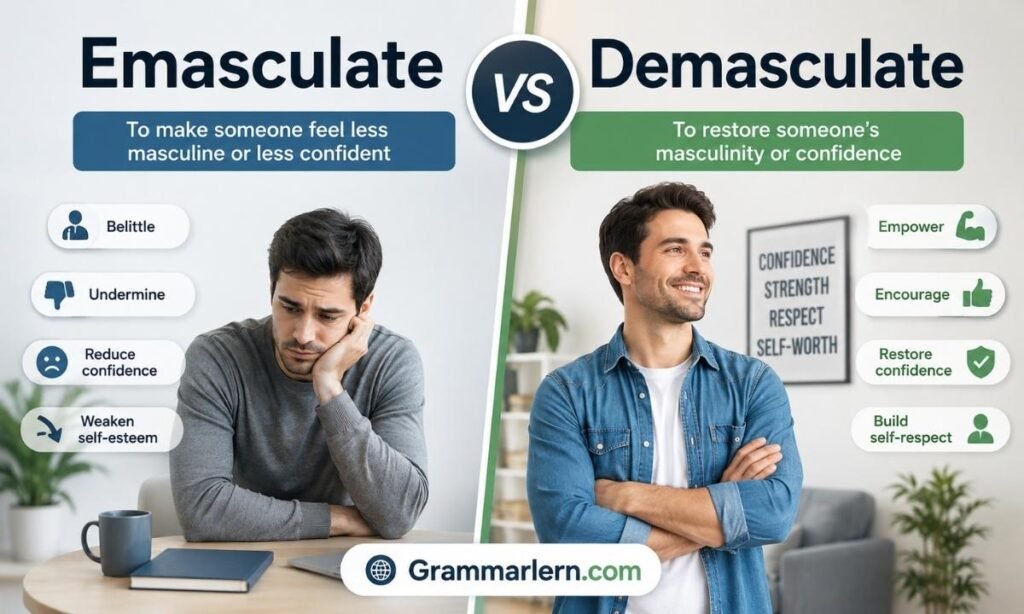
Only one of these words is actually correct English, and most people have no idea which one. “Emasculate” is a real, dictionary-recognized word with centuries of use behind it. “Demasculate,” despite sounding just as valid, isn’t found in any major dictionary.
This mix-up happens for a simple reason: the “de-” prefix tricks people into assuming both forms should work. Below, you’ll learn the correct meaning, the real origin, and exactly which word to use, so you never second-guess it again.
Understanding “Emasculate vs. Demasculate”: What’s the Real Difference?
The short answer is simple. Emasculate is a standard English verb recognized by every major dictionary, including Merriam-Webster, Oxford, and Cambridge. Demasculate is not. It appears online and in casual conversation as a colloquialism, but it has no formal dictionary entry and no accepted grammatical standing. If you’re writing anything formal, academic, or professional, emasculate is always the safer and correct choice.
Understanding “Emasculate”: Meaning, Usage, and Real-World Contexts

Emasculate shows up in news articles, literature, psychology, biology, and everyday conversation. It carries both a literal and a figurative meaning, and the correct interpretation always depends on context. In most modern writing, it describes a loss of power, confidence, authority, or perceived virility rather than anything physical.
What “Emasculate” Means (Core Definition)
The word has two core definitions:
- Literal meaning: to remove or destroy the male reproductive organs of an animal or plant, a process also known as castration or gonadectomy in biological terms
- Figurative meaning: to weaken someone’s confidence, authority, strength, or perceived masculinity
The figurative sense is far more common in modern English, appearing in politics, relationships, workplace power dynamics, and media commentary on gender identity and gender norms.
Also Read This Smooth vs. Smoothe: Which Spelling Is Correct?
Linguistic Roots of “Emasculate”
Emasculate comes from the Latin word emasculare, formed from e- (meaning “out of” or “remove”) and masculus (meaning “male”). It entered the English language in the early 1600s as a Latin derivative, originally describing a literal biological act before gradually taking on its modern figurative meaning through natural linguistic evolution.
Evolution of the Meaning: Quick Timeline Table
| Time Period | Meaning of “Emasculate” |
| Ancient Rome | Literal removal of male reproductive organs |
| 17th century | Word enters English with its literal biological sense |
| 18th to 19th century | Figurative meaning emerges in literature and politics |
| Modern day | Mostly figurative, referring to weakened authority or confidence |
Literal Uses of “Emasculate”
Biological Use
In biology and veterinary medicine, to emasculate an animal means to remove its testicles, typically to prevent reproduction or reduce aggression. This usage still appears in agricultural, medical, and historical texts, though it’s rare in everyday conversation.
Botanical Use: A Critical Term in Plant Breeding
What It Means in Plant Science
In botany, emasculation refers to removing a flower’s anthers before pollen is released. This prevents self-pollination and allows plant breeders to control which pollen fertilizes the plant, a technique essential for hybridization and crop improvement.
How Emasculation Works in Botany
Breeders select an unopened flower bud, carefully remove its anthers, then apply pollen from a chosen parent plant. The flower is often covered afterward to prevent contamination from unwanted pollen, ensuring successful cross-pollination.
Botanical Emasculation: Step-by-Step Table
| Step | Action | Purpose |
| 1 | Select an unopened flower bud | Ensure pollen hasn’t been released |
| 2 | Remove the anthers | Prevent self-pollination |
| 3 | Apply selected pollen | Enable controlled cross-pollination |
| 4 | Cover the flower | Protect against outside contamination |
Metaphorical Uses of “Emasculate”: The Most Common Meaning Today
Metaphorical Emasculation Means:
- Undermining someone’s confidence or authority
- Weakening the effectiveness of a policy, law, or institution
- Making someone feel powerless, disempowered, or stripped of control
Examples of Metaphorical Emasculation
- The new regulations emasculated the agency’s authority.
- Public criticism can emasculate a leader’s confidence.
- The heavy editing emasculated the original argument of the essay.
Parts of Speech and Verb Forms of “Emasculate”
| Word Form | Part of Speech | Example |
| Emasculate | Verb (base form) | Critics said the changes would emasculate the proposal. |
| Emasculates | Verb (present) | The policy emasculates local authority. |
| Emasculated | Past tense | The revised law emasculated the committee’s power. |
| Emasculating | Present participle | Constant micromanagement felt emasculating to employees. |
| Emasculation | Noun | The article discussed the emasculation of local government. |
Emasculate and Demasculate Pronunciation
Emasculate is pronounced ee-MASS-kyuh-layt, with the stress on the second syllable. Since demasculate isn’t a standard word, it has no official pronunciation, though it’s commonly spoken as dee-MASS-kyuh-layt by analogy with similar “de-” prefix verbs.
Why the Word “Emasculate” Gets So Emotional
The word carries emotional weight because it’s tied to identity, gender expectations, and social norms around masculinity. Calling something or someone “emasculated” often implies more than weakness. It suggests a challenge to deeply held ideas about strength and patriarchy, which is why the term frequently sparks strong reactions in cultural debate.
“Demasculate”: Is It a Real Word? (What People Think It Means)
No, demasculate is not a recognized English word. It doesn’t appear in Merriam-Webster, Oxford, or Cambridge dictionaries, and it has no established, agreed-upon definition or standard grammatical usage.
Why People Think It’s a Real Word
- The prefix “de-” usually signals removal, as in deactivate or defrost
- Social media repetition makes the neologism feel more familiar than it is
- People assume “masculine” plus “de-” naturally forms “demasculate”
- Limited exposure to the actual word emasculate and its Latin etymology
Key Differences: Emasculate vs Demasculate
Comparison Table
| Feature | Emasculate | Demasculate |
| Recognized by dictionaries | Yes | No |
| Standard English word | Yes | No |
| Literal scientific use | Yes | No |
| Figurative use | Common | Informal only |
| Acceptable in professional writing | Yes | No |
Example Sentences: Emasculate vs Demasculate
- Incorrect: The scandal demasculated his political career.
- Correct: The scandal emasculated his political career.
- Incorrect: She felt demasculated after the harsh review.
- Correct: She felt emasculated after the harsh review.
Why People Confuse the Terms
Main Reasons
- Assuming the “de-” prefix automatically applies
- Autocorrect and typing errors
- Informal online slang blending into formal writing
- Lack of familiarity with the word’s Latin roots and etymology
Also Read This Smooth vs. Smoothe: Which Spelling Is Correct?
Demasculinize vs. Demasculate: Is There a Real Alternative Word?
“Demasculinize” is sometimes suggested as a more technical-sounding alternative to demasculate, and it does appear occasionally in specialized or academic writing about gender identity. However, it still lacks broad dictionary recognition and remains far less common than emasculate. If your goal is standard, professional English, emasculate is still the safer and more widely accepted choice in nearly every context.
Words Commonly Confused with “Emasculate”
Castrate vs. Emasculate
Castrate refers specifically to the literal, biological removal of male reproductive organs. Emasculate covers that same literal meaning but extends much further into figurative use, describing weakened power, confidence, or authority.
Feminize vs. Emasculate
Feminize means to make something more feminine in nature or style. It doesn’t imply weakness. Emasculate, by contrast, specifically implies a loss of strength, confidence, or authority.
Humiliate vs. Emasculate
Humiliate focuses on embarrassment or shame. Emasculate focuses on a loss of power or perceived masculinity. Someone can be humiliated without being emasculated, and vice versa.
Is “Emasculate” Offensive? Understanding Context
Whether the word feels offensive depends heavily on context. In academic, political, or literary discussions, it’s usually seen as an accurate, neutral term with a clear denotation. When directed at a specific person in casual conversation, its connotation can come across as judgmental or unnecessarily personal. If you want a gentler tone, alternatives like “weaken” or “undermine” often work better.
American vs. British English Usage
Unlike words such as color and colour, emasculate has no spelling variation between American and British English. Both dialects use the exact same spelling, grammatical form, and meaning.
Cultural and Social Dimensions of “Emasculate”
Emasculation in Gender Roles and Masculinity Debates
The word plays a significant role in ongoing conversations about masculinity, leadership, emotional vulnerability, and emotional strength, especially as traditional gender expectations continue to shift.
Quote:
“Emasculation often says more about society’s expectations than a man’s actual identity.”
Media and Pop Culture
Movies, television shows, and news commentary frequently use the word to describe characters or public figures who appear to have lost authority, confidence, or control, often reinforcing broader cultural narratives about strength and masculinity.
Modern Shifts in Perspective
Today, many writers and readers are moving toward more inclusive, precise language. Emotional vulnerability is increasingly seen as a strength rather than a weakness, and many people now question the cultural assumptions built into the word “emasculate” itself, including its ties to traditional patriarchy.
How to Choose the Right Word (And Avoid Mistakes)
When You SHOULD Use “Emasculate”
- Describing a loss of confidence, authority, or effectiveness
- Referring to the literal biological or botanical process
- Discussing masculinity or identity in academic or literary contexts
When You SHOULD NOT Use “Demasculate”
- Academic papers
- Business or professional communication
- Journalism or published content
Correct Alternatives Instead of “Demasculate”
| Alternative | Best Used When |
| Weaken | General loss of strength or effectiveness |
| Undermine | Gradually reducing authority or confidence |
| Diminish | Making something smaller or less significant |
| Strip of authority | Formal discussions of leadership or power |
Quick Decision Guide
| If You Want to Express… | Correct Word |
| Loss of masculinity or confidence | Emasculate |
| Removing male reproductive organs | Emasculate |
| Preventing self-pollination in plants | Emasculate |
| Undoing masculinity | Emasculate (never “demasculate”) |
Frequently Asked Questions
Is the correct word “emasculate” or “demasculate”?
Emasculate is the correct, dictionary-recognized word. Demasculate is not accepted in standard English.
What does “emasculate” actually mean?
It means to weaken someone’s power, confidence, or authority, or, in its literal sense, to remove male reproductive organs.
Where does the word “emasculate” come from?
It comes from the Latin word emasculare, meaning to castrate or deprive of masculine strength.
Is there a female version of emasculation?
No formal, dictionary-recognized term exists specifically for women. Emasculate is traditionally tied to masculinity, though its figurative meaning, weakening confidence or authority, can technically apply to anyone.
What does it mean to “demasculinize” someone?
It generally means to remove or reduce masculine traits or characteristics, similar in idea to emasculate, though the word itself has limited dictionary recognition.
Is “emasculate” always about men?
No. It’s frequently used to describe weakened organizations, policies, laws, and ideas, regardless of gender.
Can “emasculate” be used in botany or science?
Yes. In plant breeding, emasculation refers to removing a flower’s anthers to prevent self-pollination and enable controlled cross-pollination.
Final Thoughts
Choosing between emasculate and demasculate isn’t really a close call. Emasculate is the version backed by dictionaries, history, and everyday professional use, while demasculate remains an understandable but incorrect guess born from English’s own “de-” prefix patterns.
Once you understand where the word comes from and how it’s actually used, from literal science to everyday conversations about power and confidence, the correct choice becomes second nature. Whenever you’re unsure, remember this simple rule: emasculate is always the safe, accurate, and professional word to use.
1 thought on “Emasculate vs Demasculate: The Real Meaning Behind the Confusion”