

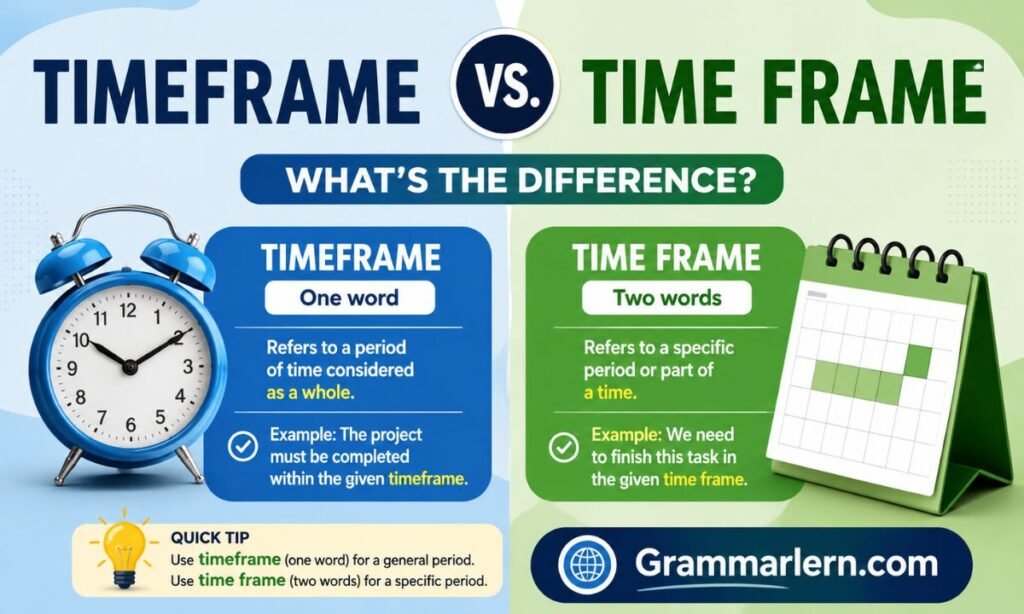
“Timeframe” or “time frame” both forms are used in English, but only one fits a given context correctly. This is a confusion that thousands of writers, students, and professionals face every day when writing emails, reports, or essays.
The good news is that the answer is simpler than it looks. In this guide, we will explain the clear rule, real examples, and the difference between formal and informal usage in a simple way, so you never feel confused again.
Timeframe or Time Frame: Quick Answer ✅⚡
✔ Main Difference
Time frame (two words) is the traditional and more formal spelling. Timeframe (one word) is the modern version, widely accepted in business and everyday writing. Both are grammatically correct, and the choice usually comes down to tone and style rather than accuracy.
📌 Examples
We need a time frame for the project. We need a timeframe for the project. The time frame is two weeks.
Definitions with Examples 📖✍️
🟢 Time Frame (Definition)
Time frame means a period of time during which something happens, is planned, or is expected to be completed.
📌 Examples
The time frame for the exam is two hours. We will decide the time frame tomorrow. The project has a short time frame.
🔵 Timeframe (Definition)
Timeframe is the single word version of time frame, carrying the exact same meaning. It is commonly used in modern business communication.
📌 Examples
The project has a tight timeframe. We need a clear timeframe for delivery. This timeframe is too short.
🟡 Simple Meaning
Time frame refers to a formal, two word period of time. Timeframe refers to the same idea, written as one modern word. Neither spelling changes the meaning of the phrase.
The Origin of Time Frame 📜⏳
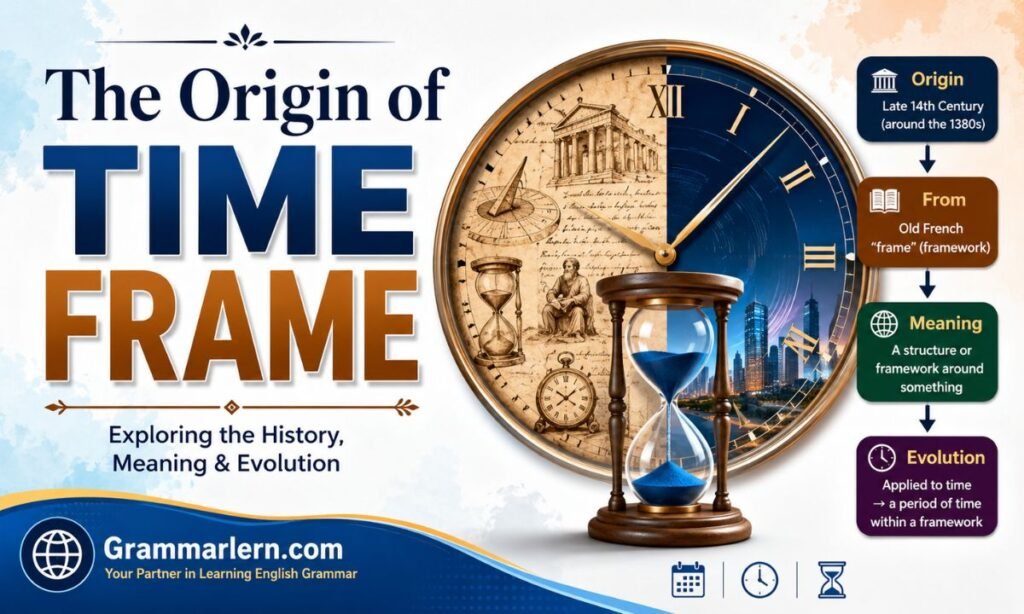
The phrase comes from two separate words joined by meaning rather than spelling.
📚 Meaning Together
Time refers to duration, while frame refers to a structure or a limit placed around something. Together, they describe a structured period of time set for an action or event.
📌 Example
We need a time frame for completion.
Over the years, English has a natural tendency to merge common two word phrases into a single word, which explains why timeframe has slowly gained popularity alongside time frame.
British English vs American English Spelling 🌍🇬🇧🇺🇸
📌 Key Point
Both spellings are used in the UK and the US, but each region shows a slight preference.
📊 Comparison Table
| Region | Preferred Form | Acceptable Form |
| UK | time frame | timeframe |
| USA | timeframe | time frame |
| Pakistan | both | both |
| Global | both | both |
Timeframe vs Time Frame: Key Difference Explained 📊⚖️
📊 Comparison Table
| Feature | Time Frame | Timeframe |
| Spelling | Two words | One word |
| Style | Formal, traditional | Modern, business |
| Common Use | Academic writing | Work and business writing |
| Meaning | Same | Same |
📌 Example
We need a time frame for delivery. We need a timeframe for delivery.
Which One Should You Use? 🎯📝
✔ Use Time Frame When
You are writing formal essays, academic papers, or exam answers where traditional grammar style is expected.
✔ Use Timeframe When
You are writing business emails, reports, or any modern, casual form of communication.
⚖️ Easy Tip
Two words usually signal a formal tone. One word usually signals a modern, business tone.
📌 Usage Tip (Very Important) 🧠✨
Both spellings are correct, so the real decision comes down to tone rather than grammar rules.
📌 Examples
The time frame is short. (formal) The timeframe is short. (modern) We need a clear time frame.
Common Mistakes with Timeframe or Time Frame ❌⚠️
1. Thinking One Is Wrong
Many people assume only one spelling is correct. In reality, both are accepted by major dictionaries.
2. Mixing Styles in One Document
Using time frame in one paragraph and timeframe in another looks inconsistent. Pick one style and stay with it throughout your document.
3. Using Wrong Context
Formal writing calls for time frame, while business or casual writing works better with timeframe.
4. Spelling Confusion
Some writers add a hyphen and write the phrase incorrectly. The accepted forms are only the open version and the closed version, without a hyphen.
Time Frame in Everyday Examples 💬📱

🏠 Daily Life
I have a short time frame today. What is the time frame for this task?
📧 Work
Please confirm the time frame. The project timeframe is one month.
📚 School
The exam time frame is three hours.
💼 Business
We agreed on a delivery timeframe.
Timeframe or Time Frame in Research & Formal Writing 🔬📄
Academic & Scientific Usage
In academic papers, research studies, and scientific writing, time frame (two words) is the standard choice. Most style guides and journals follow this traditional spelling to keep formal documents consistent.
Business & Legal Documents
In business proposals, contracts, and legal documents, both forms appear, though timeframe has become increasingly common due to its shorter, modern feel in professional communication.
Related Confused Words (Timeframe vs Timeline, Timespan, Duration) 🔄
Timeframe vs Timeline
A timeframe is a period set aside for something to happen. A timeline is a visual or chronological sequence showing the order in which events take place.
Timeframe vs Timescale
A timescale refers to the broader length of time in which something can be measured. A timeframe is usually more specific and tied to a particular task or project.
Timeframe vs Duration
Duration is the total length of time something lasts from start to finish. A timeframe is the window set for something to happen, which may not always match the full duration.
Time Frame vs Deadline
A deadline is the final point by which something must be finished. A time frame covers the entire period leading up to that deadline.
Timeframe: Google Trends & Usage Data 📊📈
🌍 Trends
Timeframe is more common in business writing, while time frame remains more common in academic writing.
📊 Region Table
| Region | Common Form |
| USA | timeframe |
| UK | time frame |
| Pakistan | both |
| India | both |
| Global | both |
🔥 Top 10 Searches
Timeframe or time frame which is correct Is timeframe one word Time frame meaning in English Difference between timeframe and time frame How to use timeframe in a sentence Correct spelling of time frame Time frame vs schedule difference Why is timeframe one word Time frame examples sentences Easy rule for timeframe usage
Comparison Table 📋⚖️
| Feature | Time Frame | Timeframe |
| Correct | Yes | Yes |
| Style | Formal | Modern |
| Common Use | Academic | Business |
| Meaning | Same | Same |
Quick Quiz: Test Your Understanding 🧠✅
Test what you have learned so far.
- Which spelling is more traditional? a) Timeframe b) Time frame
- Which form is more common in American business writing? a) Timeframe b) Time frame
- True or False: Mixing both spellings in the same document is acceptable.
Answers: 1) b, 2) a, 3) False
Frquently Asked Questions
Is it “timeframe” or “time frame”?
Both are correct. Time frame (two words) is the traditional, formal form. Timeframe (one word) is the modern version used in business writing.
What does “time frame” mean?
A specific period during which something is expected to happen, be completed, or take place.
How do you use “timeframe” in a sentence?
Example: “We need to confirm the timeframe for this project before moving forward.”
Is “timeframe” American English and “time frame” British English?
Not strictly. Both are used in the UK and the US, but timeframe leans American, while time frame leans British.
Does Merriam Webster prefer “time frame” or “timeframe”?
Merriam Webster lists time frame as the primary spelling, with timeframe as a less common but growing variant.
Can “timeframe” be used in formal or academic writing?
Time frame (two words) is generally preferred in academic and research writing.
Final Thoughts
Both timeframe and time frame are correct. The real difference lies in tone, not accuracy. Use time frame for formal or academic writing, and timeframe for modern, business, or casual writing.
The key rule is consistency. Pick one style per document and stick with it throughout.
Now that you know the difference, you can write with confidence in any setting, formal or casual.