

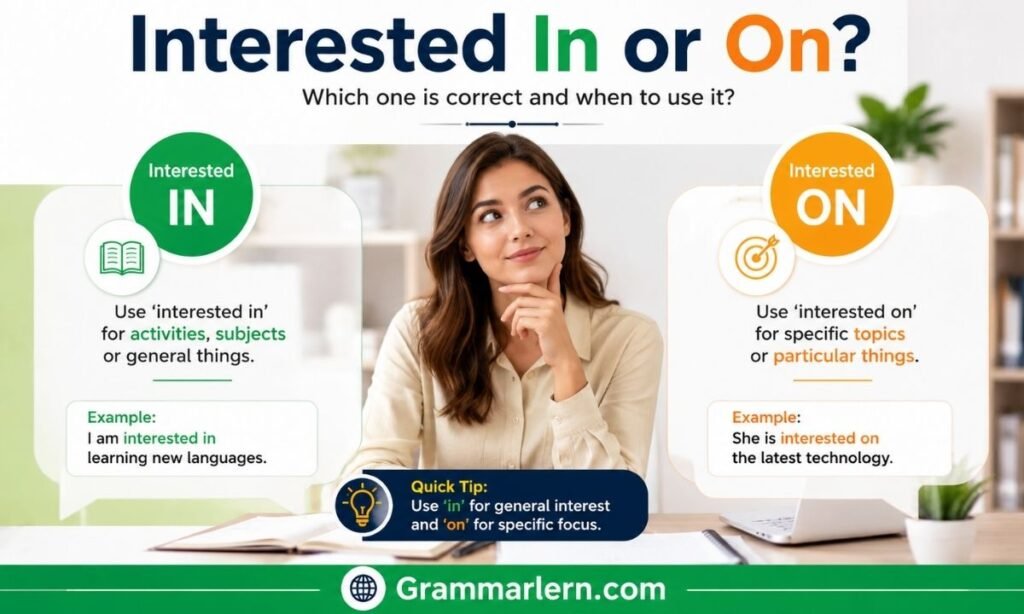
Are you unsure whether to say interested in or interested on? This tiny preposition mistake trips up even confident English speakers. The correct phrase is always interested in, and knowing the reason behind it instantly improves your writing.
Interested on feels right if you’re translating from another language, but it breaks standard English grammar rules. In this guide, you’ll learn the correct usage, see clear examples, and never make this mistake again.
Quick Answer
The correct phrase is interested in, not interested on.
- Correct: I am interested in photography.
- Incorrect: I am interested on photography.
English pairs the adjective interested with the preposition in because it expresses curiosity, attention, or involvement – not location or surface. There is no context in standard English where “interested on” is acceptable.
What Does “Interested In” Mean?
Interested in describes a feeling of curiosity, attraction, or enthusiasm toward a subject, activity, or person. It signals that something has captured your attention and you want to explore it further.
The phrase is typically followed by:
- A noun (interested in music)
- A pronoun (interested in you)
- A gerund, or -ing verb form (interested in learning)
Examples
- I am interested in psychology.
- She’s interested in learning Spanish.
- Are you interested in this project?
- They’re interested in joining the club.
- He is interested in her.
In each sentence, “in” shows engagement or focus – which is exactly the job this preposition does in English.
Why “Interested On” Is Incorrect
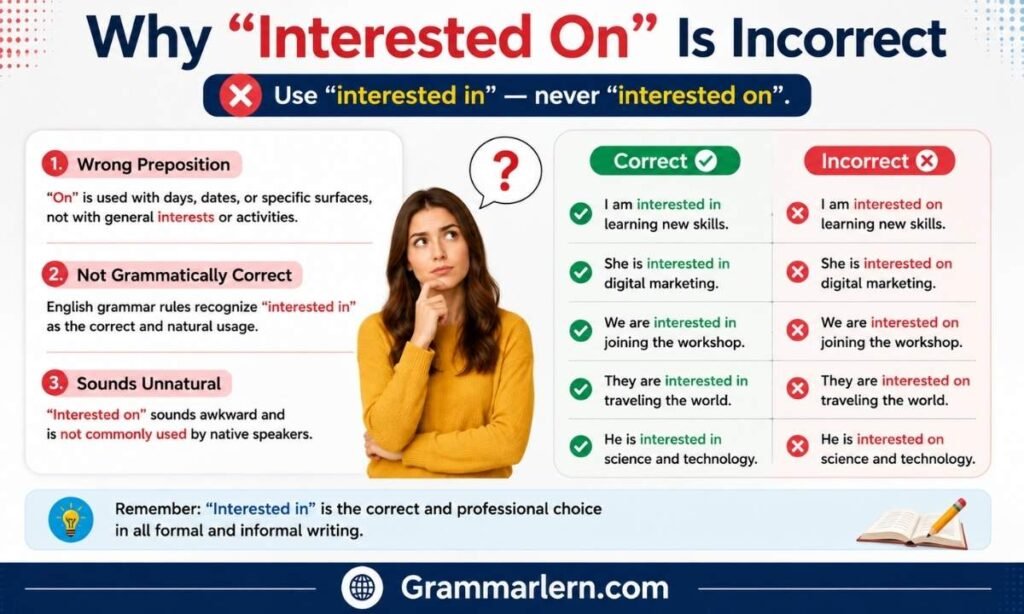
The adjective interested collocates with in, not on. A collocation is simply a word pairing that native speakers use automatically, without thinking about the grammar behind it.
The preposition on usually describes surfaces, specific days, devices, or subjects of reference material – not personal curiosity. For example:
- On the table (surface)
- On Monday (day)
- On TV (device)
- A book on history (subject matter)
None of these uses apply when you’re expressing interest, so “on” simply does not fit after “interested.”
- Incorrect: I am interested on sports.
- Incorrect: She is interested on your idea.
- Incorrect: We are interested on applying.
Grammar Rule Behind “Interested In”
Interested is an adjective describing a feeling, and in English, feeling-adjectives often pair with one fixed preposition. This is not unique to “interested” – it’s a pattern you’ll recognize elsewhere:
- Good at
- Afraid of
- Excited about
- Responsible for
- Interested in
Prepositions in English rarely follow strict logic. They follow usage convention, and the convention here is fixed: interested + in.
Comparison Table
| Phrase | Correct? | Why |
| Interested in | Yes | Standard English collocation |
| Interested on | No | Not a recognized grammatical pairing |
| Interested about | Usually no | Rarely used in standard English |
| Interested to | Sometimes | Used before a reaction verb, e.g., “interested to hear” |
Common Contexts Where “Interested In” Is Used
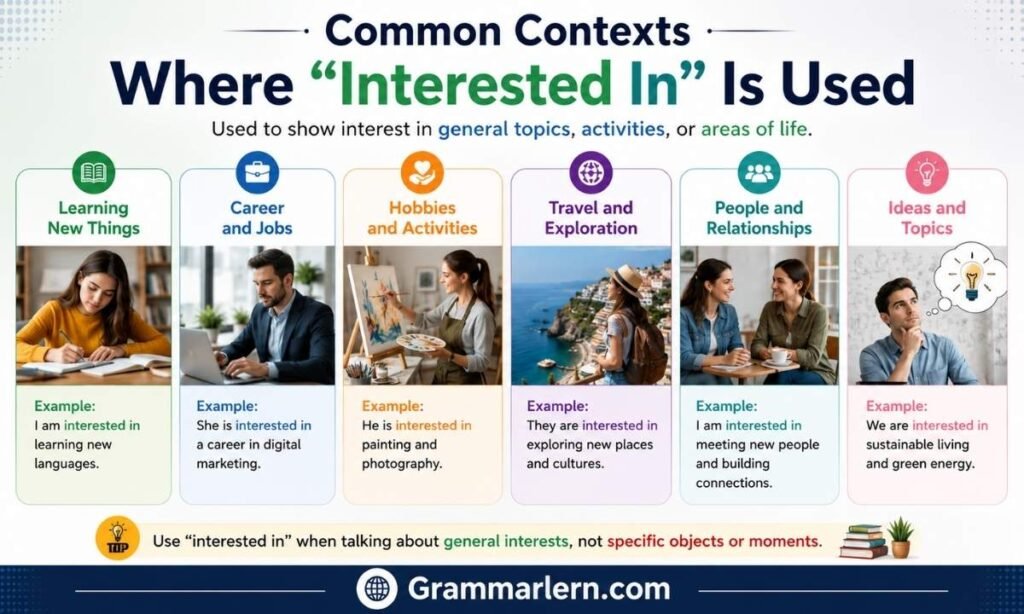
Interested in works across nearly every setting – formal, informal, academic, and professional. Here’s how it plays out in real situations.
1. Academic Interest
- She is interested in biology.
- He’s interested in studying abroad.
2. Career & Job Applications
- I am interested in the marketing position.
- We are interested in working with your company.
3. Romantic Interest
- He seems interested in her.
- Are you interested in someone right now?
4. Hobbies & Activities
- I’m interested in photography.
- They’re interested in playing football.
5. Business & Professional Communication
- We are interested in your proposal.
- The client is interested in expanding the partnership.
Common Mistakes to Avoid
Mistake 1: Translating Directly From Another Language
Many languages use a preposition closer to “on” when expressing interest, and direct translation causes the error.
- Incorrect: I am interested on this matter.
- Correct: I am interested in this matter.
Whenever you’re translating a thought into English, remember the fixed rule: interested + in.
Mistake 2: Confusing With “Information On”
People often mix up “interested in” with phrases like “information on” or “a book on,” where “on” correctly refers to a subject.
- Correct: Information on climate change.
- Correct: A book on economics.
- Incorrect: I am interested on climate change.
- Correct: I am interested in climate change.
The subject can be “on” something, but your personal interest is always “in” something.
Mistake 3: Using “Interest On”
A related error swaps the noun form incorrectly.
- Incorrect: I have interest on science.
- Correct: I have an interest in science.
Notice the structural shift – “have an interest in” is the correct noun form, matching the same preposition rule.
Similar Expressions (LSI Keywords & Synonyms)
If you want to diversify your writing while keeping the same general meaning, these related expressions work well:
- Keen on
- Curious about
- Passionate about
- Fascinated by
- Drawn to
- Engaged in
- Concerned with
Examples: She is keen on music. He is fascinated by space exploration.
Interested In vs Similar Prepositional Phrases (To/By/About)
“Interested” doesn’t only pair with “in.” A few other prepositions appear in specific situations, and each carries a slightly different meaning.
- Interested in – curiosity toward a topic or activity: I am interested in design.
- Interested to – a reaction to new information, usually followed by a verb: I was interested to hear the news.
- Interested by – less common, but correct when describing what intrigued you: She was interested by the documentary.
- Interested about – not standard English and should generally be avoided.
Knowing these distinctions helps you choose the right preposition instead of defaulting to “in” everywhere.
American vs British English: Any Difference?
There is no difference. Both American and British English use interested in, and “interested on” is incorrect in every English-speaking region, including Canada and Australia. Whatever audience you’re writing for, this rule stays consistent.
Advanced Usage: Interested In + Gerund
When “interested in” is followed by a verb, that verb must take the -ing form (a gerund), never the base form.
- Correct: I’m interested in learning French.
- Incorrect: I’m interested in learn French.
Structure: interested in + verb + ing
More examples:
- She’s interested in starting a business.
- They’re interested in moving abroad.
- Are you interested in investing?
This pattern shows up constantly in professional emails, interviews, and formal writing.
Quick Tip to Remember the Correct Preposition
Think of interest as something that grows inside you – and “inside” shares the same “in” as “interested in.” Whenever you’re unsure, ask yourself what naturally follows “interested,” and the answer is always “in.” The same pattern appears in other common verbs, like believe in, participate in, and succeed in – learning them as full phrases, not single words, makes the grammar stick.
Frequently Asked Questions
Is it “interested in” or “interested on”?
Interested in is correct. “Interested on” does not follow standard English grammar and should be avoided in all writing and speech.
Are you interested in me or on me?
The correct phrasing is “interested in you,” not “interested on you.” This applies to romantic or personal interest just as it does to any other subject.
Is it correct to say “I am interested” without adding “in”?
“I am interested” is grammatically complete on its own, but it sounds vague without an object. For clarity, always follow it with “in” plus the subject, such as “I am interested in music.”
Which is correct: “interested for” or “interested in”?
Interested in is correct. “Interested for” is not a recognized English collocation and should not be used.
Is “interested about” correct English?
No. While it appears occasionally in casual speech, “interested about” is not considered standard English. Stick with “interested in” for correct usage.
What word usually follows “interested in”?
“Interested in” is typically followed by a noun, a pronoun, or a verb in its -ing form (gerund), such as “interested in music,” “interested in you,” or “interested in learning.”
Final Thoughts
Getting prepositions right is one of the fastest ways to sound more natural in English, and interested in is a perfect example of a small fix with a big impact. Whether you’re writing a job application, a casual message, or an academic paper, remembering this one rule instantly improves how polished your English sounds.
The next time you’re about to type “interested on,” pause and swap it for “interested in.” It’s a simple habit, but it’s one that makes your writing clearer, more confident, and more professional every single time.