

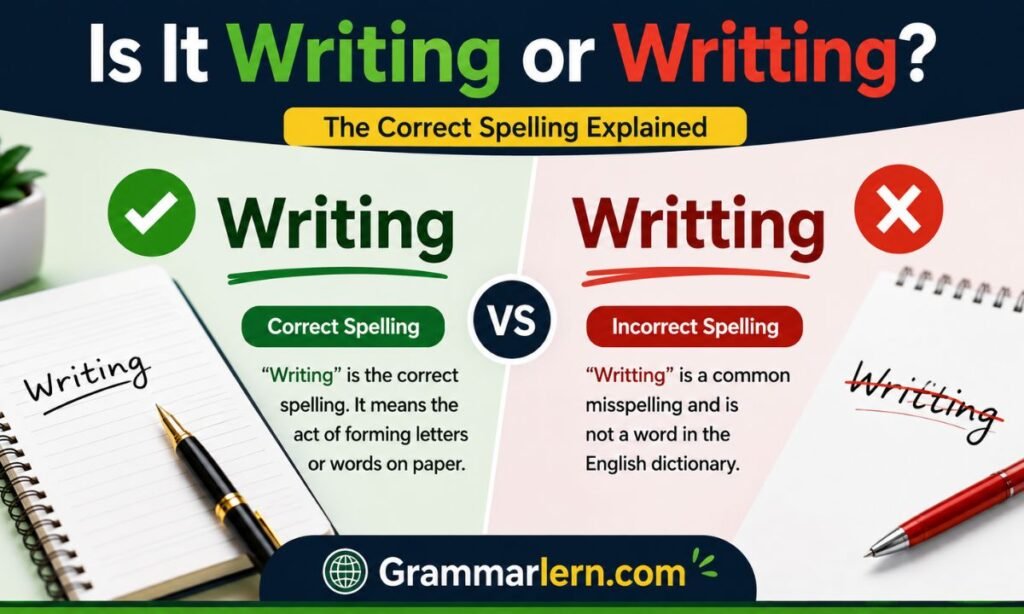
You typed a sentence, then paused. Is it “writing” or “writting”? This tiny spelling mix-up trips up students, professionals, and even native speakers every single day.
The correct spelling is “writing” — with just one “t.” “Writting” is a common misspelling that breaks a simple English rule: drop the silent “e” before adding “-ing.” In this guide, you’ll learn the exact rule, see real examples, and never second-guess this spelling again.
Quick Answer
Writing is the correct spelling. Writting is always incorrect — it does not exist in any English dictionary, formal or informal.
The word comes from the base verb write. When you add -ing, you drop the silent “e” and simply attach -ing, giving you writing. There is no doubling of the letter “t,” no exception, and no regional variation between British and American English.
| Spelling | Status |
| Writing | ✅ Correct |
| Writting | ❌ Incorrect |
Understanding the Word “Writing”

“Writing” plays two roles in English. As a verb, it describes the ongoing action of putting words on paper or typing them. As a noun (a gerund), it refers to the result or the activity itself — as in “her writing is clear and direct.”
Writing as a Verb vs Writing as a Noun
When used as a verb, “writing” always pairs with a form of “to be”: “She is writing a report.” When used as a noun, it stands on its own: “Writing is a skill that improves with practice.” Recognizing which role it plays helps you use it correctly in a sentence.
Forms of the Verb “Write” (Write, Wrote, Written, Writing)
The verb “write” has four main forms, each tied to a different tense:
- Write — base form (“I write every morning.”)
- Wrote — simple past (“She wrote a letter yesterday.”)
- Written — past participle (“The report has been written.”)
- Writing — present participle (“They are writing now.”)
Knowing these forms prevents confusion not just with “writting,” but with related mix-ups like “writing or written.”
Why “Writting” is Incorrect (The Grammar Rule Explained)
The mistake happens because English has two competing spelling rules, and people often apply the wrong one to “write.”
The Silent “E” Dropping Rule
“Write” ends in a silent “e.” When you add -ing to a verb that ends in a silent “e,” you drop the “e” first. That gives you writing, not “writeing” and not “writting.” The same pattern applies to other silent-e verbs: make → making, hope → hoping, use → using.
Why People Confuse It With the Consonant-Doubling Rule
Many common verbs double their final consonant before “-ing” — run → running, sit → sitting, stop → stopping. Because these patterns are so frequent, people unconsciously assume “write” should follow suit, producing “writting.” It doesn’t, because “write” follows a different rule entirely.
Short Vowel vs Long Vowel — Why “Write” Doesn’t Double
Consonant doubling only applies to verbs with a short vowel sound in a stressed syllable, like the short “i” in “sit” or the short “u” in “run.” “Write” has a long “i” sound (it rhymes with “kite”), so the doubling rule never applies to it. This single distinction explains the entire spelling puzzle.
Writing or Written — What’s the Difference?
Both words come from the same verb, but they mark different points in time.
When to Use “Writing” (Ongoing Action)
Use “writing” for actions that are happening now or continuing: “I am writing an email,” “She has been writing for three hours.”
When to Use “Written” (Completed Action)
Use “written” for actions that are already finished, usually with “has,” “have,” or “had”: “The email has been written,” “He had written the report before the deadline.”
A simple check: if the sentence includes “am/is/are” plus the verb, use writing. If it includes “has/have/had” plus the verb, use written.
Writing or Writings — Is There a Difference?
Yes — and the difference comes down to countability.
“Writing” as an Uncountable Noun
In most contexts, “writing” refers to the general skill or activity and has no plural: “Her writing has improved this year.” You wouldn’t say “her writings have improved,” because here it means the activity, not individual pieces.
When “Writings” (Plural) Is Correct
“Writings” becomes correct when referring to specific, countable pieces of work: “The professor studied the writings of Jane Austen.” Here, “writings” means multiple distinct essays, letters, or texts — not the general skill.
Synonyms and Related Words for Writing
Depending on context, you can substitute “writing” with words like composition, text, script, authorship, or document. Using synonyms naturally keeps your sentences varied and avoids repeating “writing” too many times in the same paragraph — useful in essays, articles, or professional emails.
Real-Life Examples of Writing in English

Seeing “writing” used correctly across different settings makes the rule easier to remember.
Academic Writing Examples
- “I am writing my thesis on renewable energy.”
- “Clear writing helps readers follow complex arguments.”
Business and Email Writing Examples
- “I am writing to confirm our meeting tomorrow.”
- “Our team specializes in writing detailed market reports.”
Creative and Social Media Writing Examples
- “She is writing her first novel this year.”
- “Just started writing a new blog post!”
In every case, it’s always writing with one “t” — never “writting.”
Exercises and Tips for Avoiding Spelling Errors
A few minutes of practice is enough to make this spelling automatic.
Quick Practice Sentences
Fill in the blank with the correct form:
- She is ______ a letter to her manager. (writing)
- He has ______ three chapters so far. (written)
- They enjoy ______ short stories together. (writing)
Memory Tricks to Never Misspell “Writing” Again
Try this shortcut: “Drop the E, add -ING.” Picture the word “write,” mentally cross out the silent “e,” then attach “-ing.” Because the vowel sound is long, your brain won’t need to double anything — one “t” is always enough.
Other Commonly Confused Spelling Words (Similar to Writing)
“Writing” isn’t the only word caught between these two rules. Recognizing the pattern helps with similar spellings too.
Words That Drop the Silent “E” (Make → Making, Hope → Hoping)
- Make → Making
- Hope → Hoping
- Write → Writing
- Come → Coming
Words That Double the Consonant (Run → Running, Sit → Sitting)
- Run → Running
- Sit → Sitting
- Stop → Stopping
- Get → Getting
Related word pairs also cause similar confusion — for example, writer vs. writter and wrote vs. wrotte follow the same underlying logic: the correct form never adds an extra consonant to a long-vowel word.
Frequently Asked Questions
Which is correct, writer or writter?
Writer is correct. “Writter” is a common misspelling, following the same mistaken doubling pattern seen in “writting.” The correct form simply adds “-er” to “write” without changing the spelling.
How do you spell writing?
Writing is spelled w-r-i-t-i-n-g, with one “t.” It comes from “write” with the silent “e” dropped and “-ing” added.
Is it writing or written?
It depends on the tense. Use writing for an action happening now (“I am writing”), and written for a completed action (“It has been written”). Both are correct spellings, but they aren’t interchangeable.
Which one is correct, writen or written?
Written is correct. “Writen” is a misspelling that drops one of the two “t”s required in this particular past participle form.
Is writing a noun or a verb?
Both. As a verb, it describes the act of putting words down (“She is writing”). As a noun, it refers to the activity or its result (“Good writing takes practice”).
What is the past tense of write?
The simple past tense of “write” is wrote (“I wrote a letter”). The past participle, used with “has/have/had,” is written (“I have written a letter”).
Final Thoughts
Writing is always the correct spelling, and writting is never acceptable in any form of English. The rule behind it is simple: drop the silent “e” from “write,” then add “-ing” — no doubling required, because “write” has a long vowel sound rather than a short one.
Keep the related forms straight too. Use writing for actions happening now, written for completed actions, and reserve writings (plural) only for specific, countable pieces of work rather than the general skill.
Once you’ve internalized the “drop the e, add -ing” rule, you’ll apply it correctly not just to “writing,” but to every similar verb you come across — no more hesitation, no more guessing.