

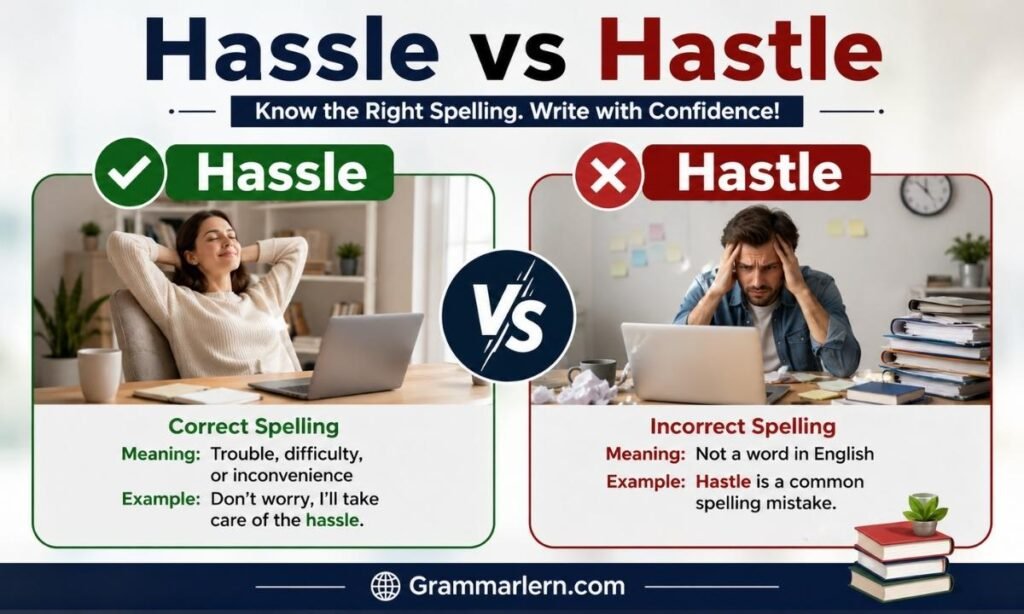
Wondering if it’s hassle or hastle? You’re not alone — this is one of the most commonly misspelled words in English. The correct spelling is hassle, and hastle isn’t a real word at all.
This confusion happens because hassle sounds like words ending in “-stle,” such as hustle and castle. In this guide, you’ll learn the exact meaning, correct usage, pronunciation, and simple memory tricks so you never misspell it again.
What Is the Correct Spelling: Hassle vs Hastle?
The correct spelling is hassle. The word hastle does not exist in any standard English dictionary — not Merriam-Webster, not Oxford, not Cambridge. It is purely a misspelling caused by how the word sounds when spoken quickly, and it has no recognized definition, grammatical function, or entry in any authoritative reference.
If you remember one rule, remember this: hassle has a double “s” and no “t.” Any time you see “hastle” written in an email, a text, a caption, or a blog post, treat it as a spelling error, not an alternate or regional spelling.
| Word | Correct? | Meaning |
| Hassle | Yes | Trouble, inconvenience, annoyance, or the act of bothering someone |
| Hastle | No | Not a word — always a misspelling |
Why People Misspell “Hassle” as “Hastle”
Even confident writers slip up here, and it usually comes down to a handful of predictable habits in pronunciation, typing, and word association rather than a lack of vocabulary.
1. Phonetic Confusion & Similar Word Patterns
Hassle is often confused with words that genuinely end in “-stle,” like whistle, wrestle, and castle. In those words, the “t” is silent but still present in spelling. Writers mentally borrow that pattern and apply it to hassle, even though hassle was never built the same way linguistically.
2. Double-Letter Mistakes
English spelling has inconsistent rules around doubled consonants. Some writers, unsure whether a word needs one letter or two, guess wrong and replace the second “s” with a “t,” producing “hastle” instead of “hassle.”
3. Typing Errors
Fast typing on a phone or keyboard is a simple, common cause of this typo. A stray keystroke swaps the letters, and if no one proofreads the text, “hastle” slips through unnoticed.
4. Auto-Correct Interference
Not every spell-checker flags “hastle” as incorrect, especially on devices where the word has been typed and silently accepted before. This gives writers false confidence that the spelling is fine.
5. Bad Online Examples
Because so many people already write “hastle” online, in comments, forums, and social captions, others see the misspelling repeated and assume it must be correct. Frequency on the internet does not equal accuracy in a dictionary.
6. Memory Errors
Sometimes the mistake is simply about memory recall. If someone has seen “hastle” more often than “hassle” in casual writing, their brain defaults to the more familiar-looking version, even though it’s incorrect.
What the Word “Hassle” Actually Means
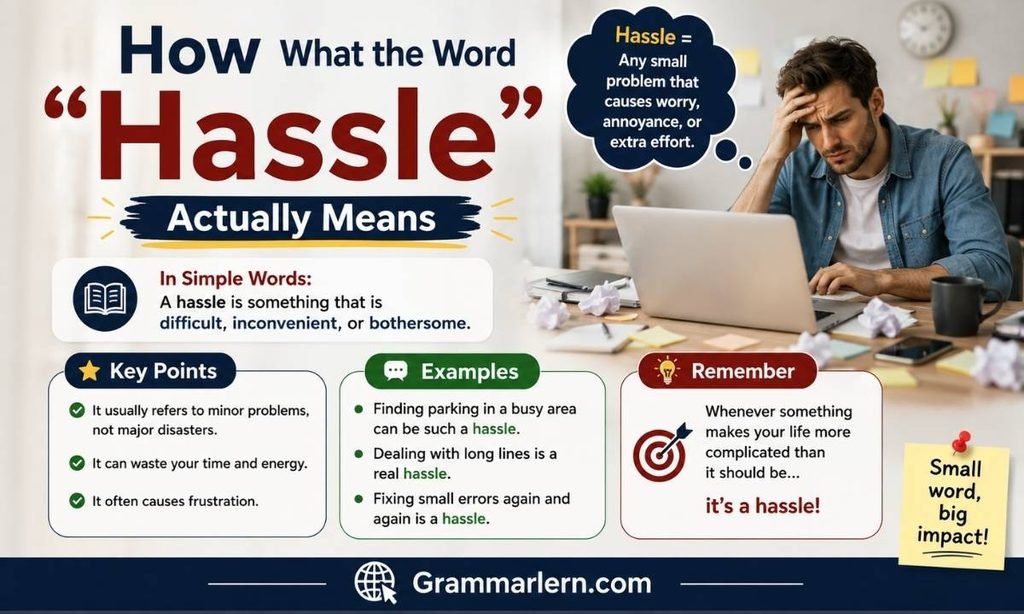
Hassle is a real English word that functions as both a noun and a verb. At its core, it describes something that creates unnecessary trouble, effort, friction, or annoyance, or the act of repeatedly bothering someone. It’s an everyday, informal word, common in conversation, customer service language, marketing copy, and casual writing across both American and British English.
Hassle as a Noun: Meaning + Examples
Definition
As a noun, a hassle is a problem, inconvenience, or troublesome situation: something that takes more time, energy, or effort than it reasonably should.
Examples
- Getting a refund turned into a real hassle.
- I don’t want the hassle of returning this item.
- Renewing my passport was such a hassle.
Also Read This Pre vs Post: What’s the Real Difference? (With 100+ Examples)
Hassle as a Verb: Meaning + Examples
Definition
As a verb, to hassle someone means to bother, pressure, or repeatedly annoy them.
Examples
- Stop hassling me — I’ll finish it soon.
- The manager kept hassling the team about deadlines.
- Please don’t hassle your sister while she’s studying.
Hassle vs Hustle: What’s the Difference?
These two words look and sound similar, but their meanings don’t overlap at all. Mixing them up is a separate, equally common mistake.
Hassle means trouble, inconvenience, or bothering someone. Hustle means energetic effort, hard work, or moving quickly, as in “side hustle” or “hustle to get the job done.”
| Word | Meaning | Example |
| Hassle | Inconvenience or bother | “Parking downtown is a hassle.” |
| Hustle | Hard work or fast movement | “She’s building a side hustle on weekends.” |
They share a similar rhythm, but context — not sound — should always guide which word you choose.
Pronunciation of “Hassle”
Hassle is pronounced HAS-uhl (/ˈhæsəl/), with stress on the first syllable. There is no “t” sound anywhere in the word. The second syllable is soft, almost swallowed in fast speech, which is exactly why it gets misheard and later misspelled as “hastle.”
How “Hassle” Is Used in Daily Life
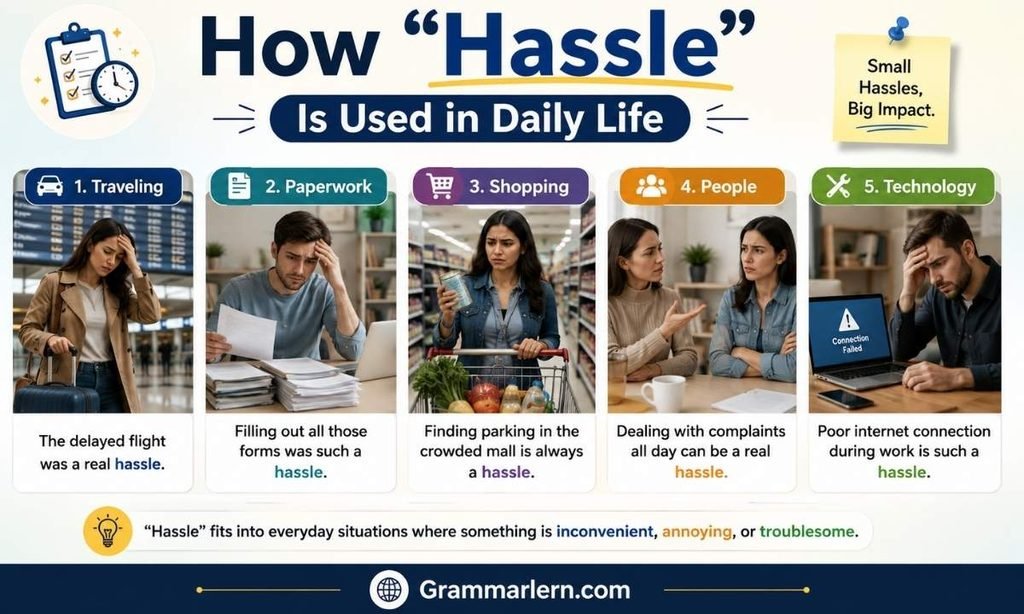
Common Daily Uses
- Traffic turned the short drive into a hassle.
- Fixing the Wi-Fi was more of a hassle than expected.
- I don’t want to hassle you, but the deadline is tomorrow.
Business & Professional Uses
- Our company offers hassle-free returns.
- We’ve reduced customer hassle through automation.
- The new system removed a lot of administrative hassle.
Casual Conversational Uses
- Don’t hassle me about it right now.
- What a hassle that was.
- Let’s skip the hassle and just order in.
What Does “Hassle-Free” Mean?
Hassle-free is an adjective describing something easy, smooth, and free of unnecessary complications. It’s one of the most common expressions built from this word, especially in marketing, advertising, and customer service — think “hassle-free returns” or “hassle-free checkout.” The phrase works because it promises the opposite of everything “hassle” implies: no delays, no extra effort, no friction.
Etymology: Where the Word “Hassle” Comes From
Possible Origins
The exact origin of “hassle” isn’t fully settled, but most language references trace it to American English in the early-to-mid 20th century. Some linguists connect it to words like “haggle” or “hustle,” while others link it to slang describing pushing, fighting, or bothering someone.
Meaning Evolution
Early uses leaned toward physical struggle or heated argument. Over the decades, the meaning softened into its modern sense: everyday inconvenience and minor annoyance, rather than actual conflict or confrontation.
Interesting Fact
By the 1970s, “hassle” had become common in film, television, and everyday speech, cementing its place as standard vocabulary rather than niche slang.
Also Read This Pre vs Post: What’s the Real Difference? (With 100+ Examples)
How to Remember the Correct Spelling of “Hassle”
1. Think of “Less Hassle = Less Stress”
Both words share a double “s,” pairing them in your head reinforces the correct pattern every time you write either one.
2. Remember the Pair
Think of “hassle” and “hassling” together. Neither has a “t,” and both keep the double “s” intact.
3. Visual Trick
Picture the wrong version, then cross out the “t”: H-A-S-T-L-E → remove the T → H-A-S-S-L-E.
4. Use a Quick Mnemonic
Try: “Hassle has a solid double S.” The repetition helps the correct spelling pattern stick in memory.
5. Think of Customer Service Phrases
Businesses always advertise “hassle-free service,” never “hastle-free.” If you remember the marketing phrase, you’ll automatically remember the correct spelling.
Hassle in Pop Culture & Media
Common Pop-Culture Uses
Phrases like “Why are you hassling me?” and “What a hassle!” appear constantly in sitcoms, movies, and everyday dialogue across English-speaking media.
Why It’s Popular
The word is short, easy to say, and instantly communicates mild frustration, which is exactly why writers, speakers, and advertisers reach for it so often in both casual conversation and scripted dialogue.
Case Studies: Real-Life Examples of When “Hassle” Applies
Case Study 1: Customer Service Hassle
A customer’s laptop arrived damaged. Returning it required several emails, a phone call, and a week of waiting. She later described the entire experience as “such a hassle,” summing up the frustration in one word.
Case Study 2: Travel Hassle
A traveler faced long security lines, a gate change, and a delayed flight, all before even boarding. He told friends the whole trip “was a hassle from start to finish,” a phrase that captured several small inconveniences at once.
Case Study 3: Workplace Hassle
An employee needed sign-off from five departments for a small budget request, chasing signatures for days. She told HR the approval process “is a hassle” that slows everything down, a common workplace complaint.
Also Read This Pre vs Post: What’s the Real Difference? (With 100+ Examples)
Sentence Examples Using “Hassle” Correctly
Noun Examples
- Getting a visa was a huge hassle.
- Don’t make a hassle out of this.
- Traffic turned the short drive into a hassle.
Verb Examples
- Stop hassling me — it’ll get done.
- They kept hassling customers to sign up.
- The manager hassled employees over small mistakes.
Common Mistakes People Make With “Hassle”
| Wrong Usage | Why It’s Wrong | Corrected Version |
| “No hastle returns” | Hastle isn’t a word | “No hassle returns” |
| “Don’t hassel me” | Wrong vowel order | “Don’t hassle me” |
| “It’s a hassel to fix” | Missing double S | “It’s a hassle to fix” |
Hassle Synonyms and Antonyms
Synonyms: inconvenience, trouble, bother, annoyance, nuisance, headache, difficulty
Antonyms: ease, convenience, simplicity, comfort
Choosing between these depends on tone and context. “Hassle” is casual and conversational, while “inconvenience” or “difficulty” fits more formal or professional writing.
According to Dictionaries: Is “Hassle” the Only Correct Spelling?
Yes. Major English dictionaries, including Merriam-Webster, Cambridge Dictionary, and Oxford Learner’s Dictionaries, list only “hassle” as a valid entry. None of them recognize “hastle” as an alternate spelling, a regional variant, or an accepted informal form; it simply doesn’t appear as a word in any of them. This consistency across every major reference is the clearest proof that “hassle” is the only correct choice, in both British and American English.
Hassle: Quick Facts
- Part of Speech: Noun and verb
- Origin: American English, early-to-mid 20th century
- Pronunciation: HAS-uhl
- Synonyms: inconvenience, trouble, bother, annoyance
- Antonyms: ease, convenience, simplicity
- Incorrect Spelling: hastle
Frequently Asked Questions
What does “hastle” mean?
Nothing — “hastle” isn’t a recognized English word. It’s simply a common misspelling of “hassle.”
What does “hassle” mean?
It means trouble, inconvenience, or annoyance, and it can also work as a verb meaning to bother or pressure someone.
Are hassle and hustle the same word?
No. Hassle means inconvenience or bother, while hustle means hard work, effort, or fast movement. They sound similar but carry completely different meanings.
What is a better word for hassle?
Depending on tone, alternatives include inconvenience, trouble, difficulty, bother, or nuisance, with “inconvenience” being the most common formal substitute.
Is “hassle” formal or informal?
“Hassle” is informal. It works well in everyday speech, blogs, and casual business writing, but formal or academic writing usually favors “inconvenience” or “difficulty” instead.
How can I remember the correct spelling of hassle?
Focus on the double “s” and the absence of any “t.” A simple trick is remembering the phrase “hassle-free,” which is never spelled “hastle-free.”
Final Thoughts
The difference between hassle and hastle comes down to one simple rule: only “hassle” is correct, and no dictionary recognizes any other spelling. Once you remember the double “s” and drop the “t” entirely, this mix-up becomes easy to avoid for good.
Whether you’re writing a quick text or a professional email, using hassle correctly signals attention to detail and strengthens your credibility as a writer. Keep the tricks from this guide in mind, and you’ll never second-guess this spelling again.