


Do you ever pause mid-sentence, unsure whether to write “openned” or “opened”? You are not alone. This mix-up happens because English spelling rules can feel inconsistent at first glance.
The good news is that this confusion has a simple fix. Once you understand one small rule about word stress, you will never second-guess this spelling again.
By the end of this guide, you will know exactly which spelling is correct, why the mistake happens, and how to use the word confidently in any type of writing.
Quick Answer — Is It “Openned” or “Opened”?
The correct spelling is opened. It is the past tense and past participle of the verb open.
Openned is incorrect. It does not appear in any standard English dictionary and is considered a spelling error.
Whether you are writing an email, an essay, or a social media caption, opened is the only accepted form.
Meaning of “Opened”
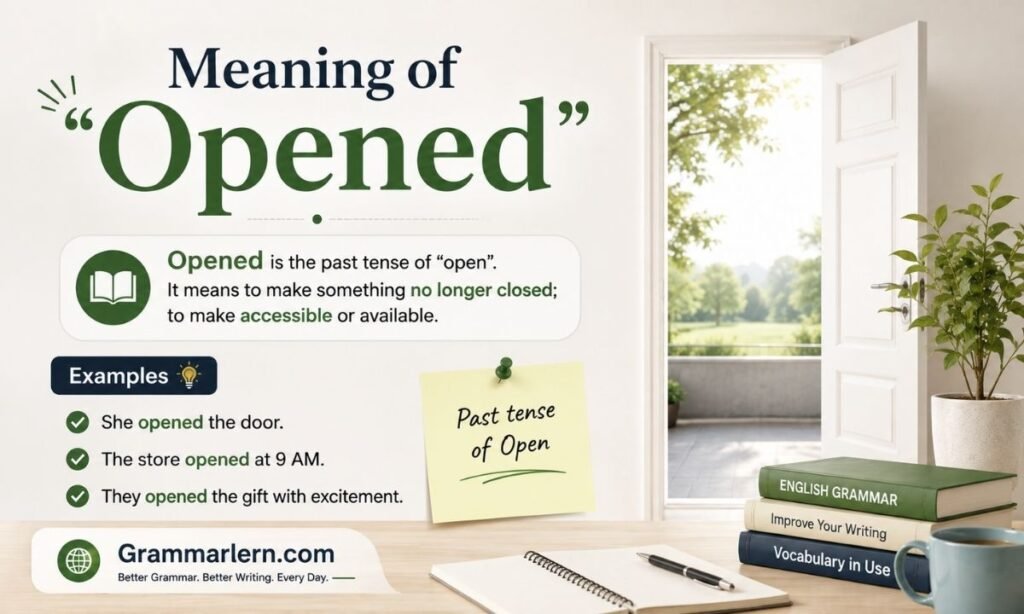
Opened describes an action that has already happened. It refers to making something accessible, unlocked, or no longer closed.
It can also work as an adjective describing a state, such as an opened box or an opened letter.
Examples:
- She opened the window to let in fresh air.
- The team opened the new store on Monday.
- He opened his laptop and began working.
Open vs Opened: Adjective or Verb?
Many writers confuse these two words because they look related but serve different grammatical roles.
Open usually functions as an adjective meaning “not closed,” or as the base form of the verb. Opened is strictly the past tense or past participle form, used for a completed action.
For example:
- “The store is open” describes a current state.
- “The store opened at 9 a.m.” describes a completed action.
A simple way to remember it: open sets the scene, while opened tells you something already happened.
Why People Mistakenly Write “Openned”
This mistake is common because English has many verbs that double their final consonant before adding -ed, such as stop → stopped and plan → planned.
Writers sometimes apply that same pattern to open, assuming every verb follows the same rule. However, English only doubles the final consonant under specific conditions, and open does not meet them.
Autocorrect habits and quick typing also contribute to the error, since an extra letter can slip in without notice.
Simple Rule to Remember (Consonant-Doubling Explained)
The consonant-doubling rule applies when a word ends in a single vowel followed by a single consonant, and the stress falls on the final syllable.
Words like refer (re-FER) and admit (ad-MIT) follow this pattern, which is why they become referred and admitted.
Open, however, is pronounced OH-pen, with the stress on the first syllable. Since the final syllable is unstressed, the consonant is never doubled.
So the rule is simple: open + ed = opened, with just one N.
Other Verbs That Follow the Same Spelling Rule
Open is not the only verb that skips consonant doubling because of its stress pattern. Several common verbs follow the exact same logic.
- listen → listened
- happen → happened
- visit → visited
- offer → offered
- enter → entered
In each case, the stress sits on the first syllable, so the final consonant stays single. Recognizing this pattern helps you spell dozens of similar verbs correctly, not just “opened.”
Comparison Table: Openned vs Opened
| Word | Correct? | Meaning | Example |
| Opened | Yes | Past tense of open | She opened the door. |
| Openned | No | Not a real word | Incorrect spelling |
Examples in Sentences
Daily Conversation
- I opened the fridge to grab a snack.
- He opened the umbrella before it started raining.
Professional Writing
- The company opened a new office last quarter.
- She opened the meeting with a brief update.
Academic Writing
- The study opened with a review of existing research.
- The professor opened the lecture with a real-world example.
Digital Communication
- I opened your message but haven’t replied yet.
- They opened the shared document and left comments.
Common Mistakes to Avoid
- Writing “openned” because it visually resembles words like planned or stopped
- Typing quickly and accidentally adding an extra N
- Assuming all past-tense verbs double their final consonant
- Copying incorrect spelling seen in casual online posts
A quick trick: if you’re unsure, say the word out loud. Since the stress is on “OH,” not “pen,” you’ll remember not to double the N.
American vs British English Differences
Unlike words such as colour/color or travelled/traveled, opened does not change between American and British English.
Both dialects use the same spelling: open → opened.
This makes it one of the more reliable words in English, since you don’t need to adjust it based on your audience.
Related Forms of “Open”
Understanding related forms reinforces correct spelling across the board.
- Verb forms: open, opened, opening
- Adjective uses: open door, open mind, open road
- Noun uses: the open, grand opening
Notice that every form keeps a single N, which further confirms why openned is never correct.
Synonyms for “Opened”
Using synonyms can add variety to your writing. Depending on context, you can replace opened with:
- started
- began
- launched
- unlocked
- revealed
- initiated
Example: She opened the event → She launched the event.
Mini Spelling Test (Try Yourself)
Which sentence is correct?
- She openned the letter carefully.
- She opened the letter carefully.
Answer: Sentence 2 is correct. If you picked it, you’ve got the rule down.
Why Correct Spelling Matters
Small spelling errors like “openned” can make writing look rushed, even if the rest of the message is well-written.
Correct spelling builds reader trust, supports clarity, and reflects attention to detail, especially in professional or academic settings.
Getting a common word like opened right is a small habit that quietly strengthens your overall writing quality.
Frequently Asked Questions
Which is correct: “opened” or “openned”?
“Opened” is correct. “Openned” is a misspelling and is not recognized in any standard dictionary.
Is “openned” a real word?
No. It does not appear in English dictionaries and is considered an incorrect spelling in all contexts.
Why isn’t the “N” doubled in “opened”?
Because the stress in “open” falls on the first syllable, not the last. Consonant doubling only applies when the final syllable is stressed.
What is the difference between “open” and “opened”?
“Open” is typically an adjective or the base verb form describing a current state. “Opened” is the past tense, describing a completed action.
Is “opened” correct in both British and American English?
Yes. Unlike many words that change by region, “opened” stays the same in both British and American English.
What are other common misspellings of “opened”?
Besides “openned,” some writers also mistakenly write “opend,” “oppened,” or “oppenned.” All of these are incorrect.
Final Thoughts
Choosing between openned and opened comes down to one simple rule: consonant doubling only happens when the stress falls on the final syllable, and open doesn’t meet that condition.
Once you remember that open is stressed on its first syllable, the correct spelling becomes easy to recall every time you write it.
Small details like this add up. Getting opened right, along with similar words like listened and happened, helps your writing come across as clear, accurate, and professional.