

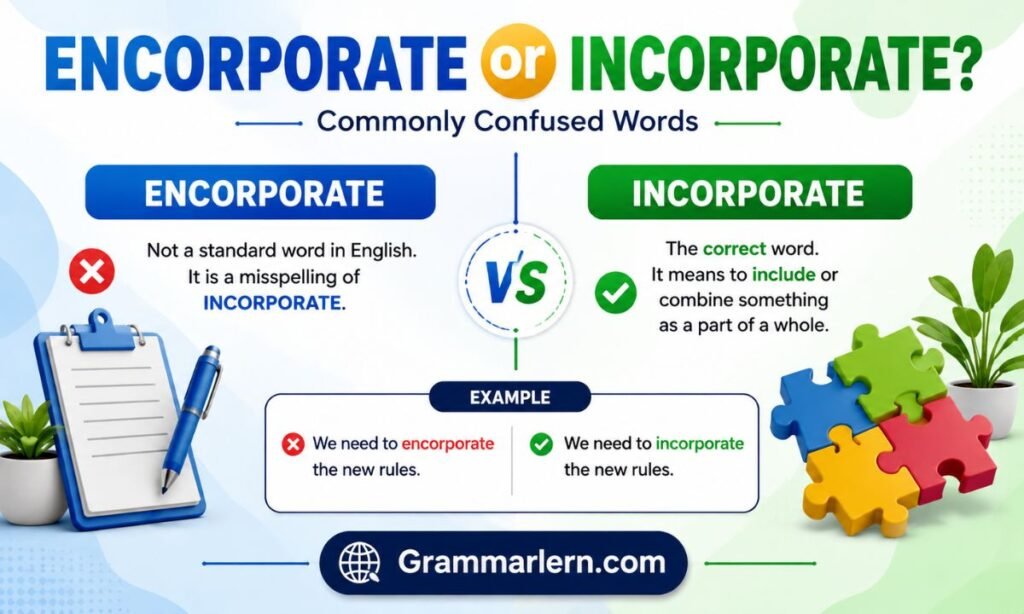
Confused about encorporate or incorporate? You’re not alone thousands search this every month. The correct spelling is “incorporate,” while “encorporate” is simply a common misspelling.
This mix-up usually happens because of pronunciation and confusion with words like encourage or enable. In this guide, you’ll learn the correct usage, meaning, and real examples so you never make this mistake again.
Encorporate or Incorporate: Quick Answer
The short answer is simple: “incorporate” is the only correct spelling in standard English. “Encorporate” doesn’t appear in any major dictionary and should be avoided in all writing.
Encorporate
“Encorporate” is not a real word. It’s a misspelling that happens when people mishear the “in-” prefix as “en-,” especially in fast speech or casual typing.
Incorporate
“Incorporate” is a verb meaning to include, combine, or blend something into a larger whole. It also means to form a business into a legal corporation. Both meanings are widely used across business, writing, and everyday communication.
The Origin of Encorporate/Incorporate
“Incorporate” comes from the Latin word incorporare, formed from in- (meaning “into”) and corpus (meaning “body”). Together, the word literally means “to form into a body.” It entered English in the 14th century, mostly through legal and formal writing.
The confusion with “encorporate” likely comes from English words that genuinely start with “en-,” such as encircle, enable, and encourage. Because these words are common, people sometimes assume “incorporate” follows the same pattern but its root is firmly “in-,” not “en-.”
British English vs American English Spelling
Unlike words such as colour/color or organise/organize, “incorporate” has no regional spelling difference. Both British and American English use the exact same spelling.
| Feature | British English | American English |
| Correct Spelling | incorporate | incorporate |
| Incorrect Spelling | encorporate | encorporate |
| Usage in Business/Legal Writing | Common | Common |
This makes the rule easy to remember: no matter where you’re writing from, “incorporate” is always right, and “encorporate” is always wrong.
Which Spelling Should You Use?
Always use “incorporate.” It’s correct in every English-speaking region and every type of writing formal, academic, business, or casual.
- United States: Incorporate
- United Kingdom & Commonwealth countries: Incorporate
- Global business and legal writing: Incorporate
Using “encorporate” in professional or academic writing can hurt your credibility, since readers may see it as a careless mistake.
Incorporate or Encorporate: Spelling Variations & Common Errors
People search for this word in many different (and often misspelled) ways. Here are common variations and what they mean:
- incorporate spelling → correct form is incorporate
- incorporate or encorporate → only incorporate is correct
- encorporate vs incorporate → encorporate is incorrect
- incorporate meaning vs encorporate meaning → only incorporate carries a real, dictionary-recognized meaning
Other common misspellings to avoid:
- incoperate ❌
- encorperate ❌
- encorprate ❌
- incorporrate ❌
- in-corporate ❌
Whenever you see any of these forms, simply replace them with the correct spelling: incorporate.
Common Mistakes with Encorporate/Incorporate
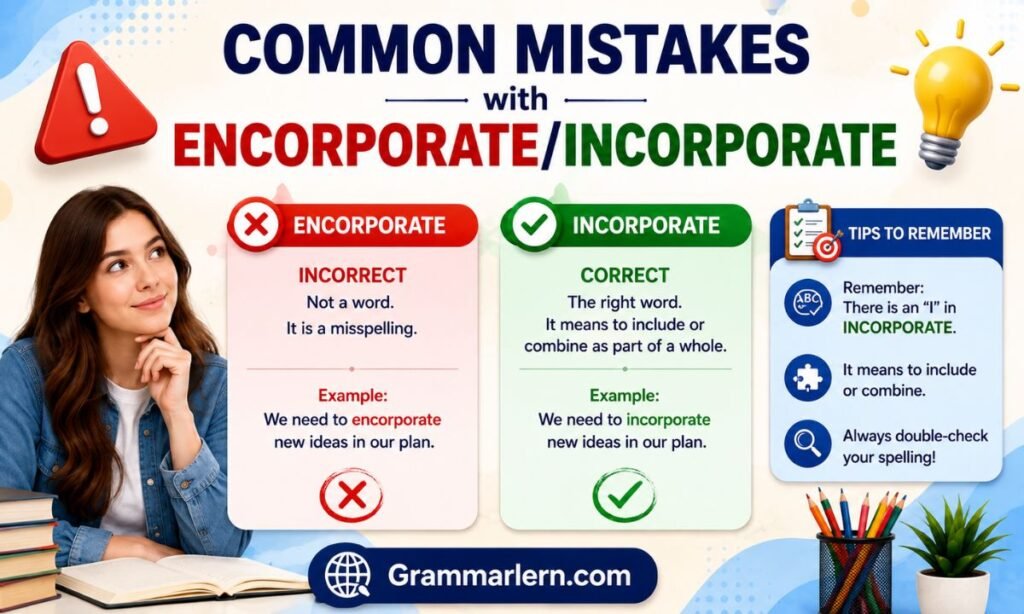
Most errors with this word come down to a handful of predictable patterns:
- Writing “encorporate” instead of “incorporate” the most frequent mistake, usually from typing quickly or mishearing the word.
- Relying on pronunciation since “in-” can sound like “en-” when spoken casually, writers copy that sound instead of the correct spelling.
- Confusing it with other “en-” words words like encourage and enable create a false pattern that doesn’t apply here.
- Overusing capitalization “Incorporate” only needs a capital letter at the start of a sentence or in a title, not mid-sentence.
A quick proofread or read-aloud check is usually enough to catch these mistakes before they reach a final draft.
Incorporating, Incorporated & Other Forms Explained
Like most verbs, “incorporate” changes form depending on tense and usage:
- Incorporate base form (“We will incorporate your feedback.”)
- Incorporating present participle (“The team is incorporating new data.”)
- Incorporated past tense or adjective (“The company was incorporated in 2024.”)
Incorrect versions to avoid: encorporating ❌, encorporated ❌, encorporates ❌, encorporation ❌
No matter the tense, the root spelling stays “incorporate” only the ending changes.
Grammar Rules & Prepositions (Incorporate Into/With/In)
“Incorporate” works as a transitive verb and is usually paired with a specific preposition depending on the sentence:
- Incorporate into “The designer incorporated new colors into the layout.”
- Incorporate with “The app incorporates security features with automation.”
- Incorporate in “The changes were incorporated in the final report.”
“Into” is the most common and natural choice in everyday writing, while “with” and “in” appear more often in technical or formal contexts.
Incorporate vs Integrate: What’s the Difference?
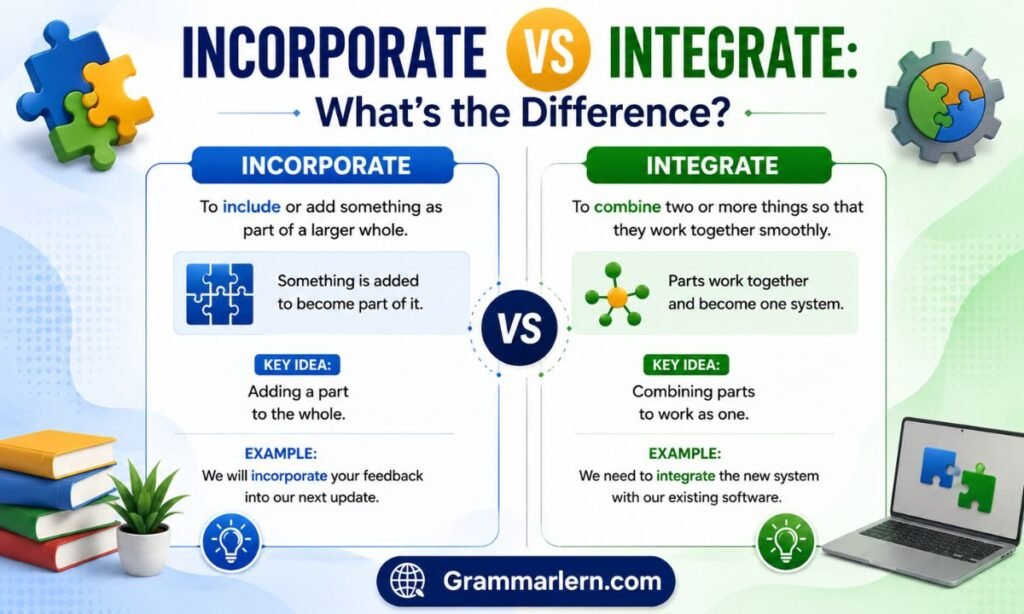
These two words are often used interchangeably, but they carry a subtle difference:
- Incorporate means adding something into a larger whole. Example: “The teacher incorporated videos into the lesson.”
- Integrate means combining parts so they work together as one connected system. Example: “The school integrated its grading system with the learning app.”
In short: incorporation is about inclusion, while integration is about connection. Both are correct the right choice depends on whether you’re simply adding something or making systems work together.
Synonyms of Incorporate
Repeating the same word too often can weaken your writing. Here are useful alternatives, depending on context:
| Synonm | Best Used For |
| Include | General, everyday writing |
| Combine | Simple explanations |
| Merge | Business or data contexts |
| Blend | Creative or descriptive writing |
| Integrate | Technology and systems |
| Unite | Teams or groups |
Choosing the right synonym keeps your writing natural instead of repetitive.
Incorporate in Business & Legal Context
One of the most important uses of “incorporate” is in business law. When a company incorporates, it becomes a separate legal entity from its owners, which offers liability protection and added credibility.
The process typically involves:
- Filing legal paperwork with the government
- Choosing a business structure (e.g., C-Corp, S-Corp, nonprofit)
- Registering the company officially
- Assigning ownership and issuing shares
This is also where the abbreviation “Inc.” comes from short for Incorporated, as seen in company names like Apple Inc. It’s worth noting that incorporation and simple business registration aren’t the same thing: registration just records a business, while incorporation legally forms a corporation with its own identity.
Encorporate/Incorporate in Everyday Examples
Seeing “incorporate” used across different types of writing makes it easier to apply correctly in your own.
Emails
- ✅ Please incorporate the latest feedback into the report.
- ✅ Let’s incorporate these changes before the final submission.
News Articles
- ✅ The city plans to incorporate new safety measures in schools.
- ✅ Tech companies increasingly incorporate AI into their products.
Social Media
- ✅ How do you incorporate mindfulness into your daily routine?
- ✅ Brands should incorporate customer feedback into their products.
Formal Writing
- ✅ The organization decided to incorporate sustainability into its policies.
- ✅ The study aims to incorporate previous research findings.
Encorporate/Incorporate: Google Trends & Usage Data
Search data consistently shows a massive gap between the two spellings:
| Keyword | Approx. Monthly Searches | Common Regions |
| incorporate | Tens of thousands | US, UK, Canada, Australia, India |
| encorporate | Under 500 | Rare, mostly typing errors |
This confirms what dictionaries already tell us: “incorporate” is the globally recognized spelling, while “encorporate” is a minor, easily corrected mistake.
Comparison Table: Encorporate vs Incorporate
| Feature | Encorporate | Incorporate |
| Correct Spelling | ❌ | ✅ |
| Found in Dictionaries | ❌ | ✅ |
| Acceptable in British English | ❌ | ✅ |
| Acceptable in American English | ❌ | ✅ |
| Suitable for Professional Writing | ❌ | ✅ |
| Origin | Mispronunciation | Latin (“incorporare”) |
Frequently Asked Questions
Is “encorporate” a word?
No. “Encorporate” is not recognized in standard English dictionaries. It’s a common misspelling of “incorporate.”
What is meant by incorporate?
“Incorporate” means to include or combine something into a larger whole. It can also mean to legally form a business into a corporation.
What is the difference between “incorporated” and “encorporate”?
“Incorporated” is a valid past-tense/adjective form of the correct word “incorporate.” “Encorporate” isn’t a real word at all it’s simply a spelling mistake, not an alternate form.
Is “incorporate” or “encorporate” the correct spelling in the UK?
“Incorporate” is correct in both British and American English. There’s no regional variation “encorporate” is incorrect everywhere.
How can I remember the correct spelling of “incorporate”?
Think of it as IN + CORPORATE. The word starts with “in-,” not “en-,” which matches its Latin root “incorporare.”
Can “incorporate” be used in legal or business writing?
Yes. “Incorporate” is the standard term in legal and business contexts, especially when referring to forming a company for example, “the business was incorporated in 2024.”
Final Thoughts
The confusion between encorporate or incorporate comes down to one simple fact: only “incorporate” is correct. “Encorporate” is a common misspelling, usually caused by pronunciation habits and confusion with other “en-” words.
Whether you’re writing an email, a legal document, or a business report, sticking to “incorporate” ensures your writing stays clear and professional. Its meaning to include, combine, or legally form a corporation makes it a versatile word across many contexts.
Next time you’re unsure, just remember: IN + CORPORATE. Getting this small detail right can make a big difference in how polished and credible your writing looks.