


Wondering whether it’s refer or reffer? You’re not alone. This spelling trips up thousands of writers every day. The correct answer is simple: “refer” is always correct, spelled with a single “f,” while “reffer” is a common misspelling with no dictionary support at all.
In this guide, you’ll learn the correct spelling, simple grammar rules, and real world examples to use it confidently. By the end, you’ll never second guess refer, referred, or referring again. Let’s clear up this confusion for good.
Refer or Reffer: Quick Answer
The correct spelling is “refer.” It is spelled with one “f” and used the same way in both British and American English. “Reffer” is not a recognized word in any dictionary or style guide.
Refer
Refer is a verb that means to direct someone’s attention to something, mention a source, or send a person to another place for help or information. It has been part of standard English since the late Middle Ages.
Reffer
Reffer is simply a misspelling. It has no meaning, no dictionary entry, and no accepted use in formal or informal writing. Most people write it this way because of how the word sounds when spoken.
The Origin of Refer or Reffer

The word refer comes from the Latin verb referre, formed from re, meaning “back,” and ferre, meaning “to carry.” Together they describe the idea of carrying attention or information back to a source.
English adopted this word during the late Middle Ages, and its single f spelling has remained consistent ever since. The confusion with “reffer” is a modern typing habit, not a spelling that ever existed historically.
British English vs American English Spelling
Refer is one of the rare English words where British and American spelling agree completely. There is no regional variation the way there is with words like colour and color.
| Form | British English | American English |
| Base | refer | refer |
| Past tense | referred | referred |
| Present participle | referring | referring |
| Third person singular | refers | refers |
No version of English recognizes “reffer” as correct.
Which Spelling Should You Use?
Always use refer. Whether you’re writing a formal email, a school assignment, or a quick text message, refer is the only spelling that reads correctly.
United States: use refer. United Kingdom and Commonwealth countries: use refer. International or global English: use refer. There is no context where “reffer” becomes acceptable.
Refer or Reffer: Meaning
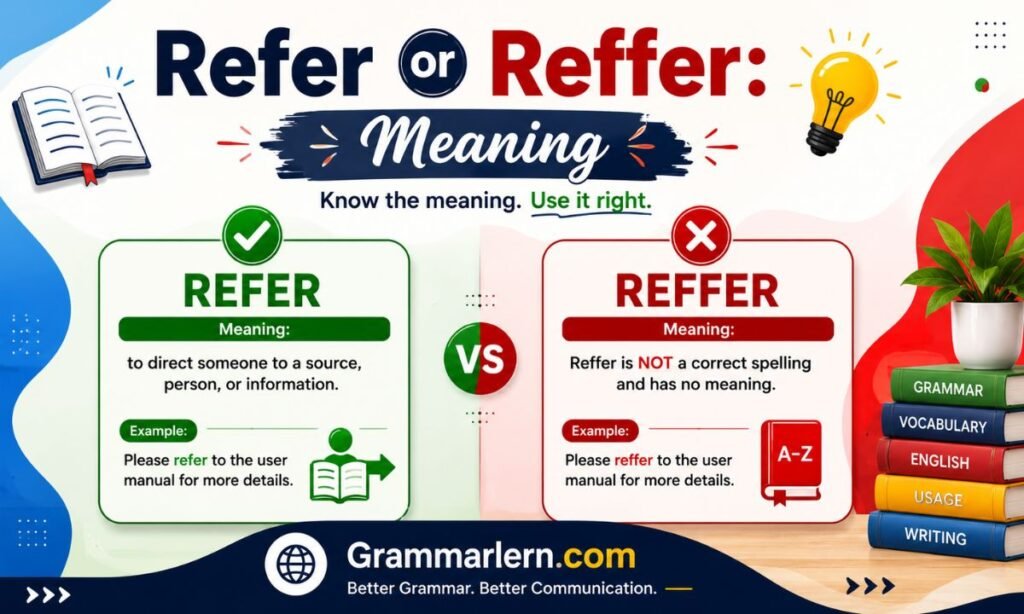
Refer Means
To refer means to direct attention toward something, mention a source, or send someone elsewhere for help. The exact meaning depends on context, but the core idea always involves pointing to or connecting with something else.
Refer as a Noun
Refer is a verb, not a noun. When people need a noun form, they use reference, meaning a source or citation, or referral, meaning the act of directing someone elsewhere.
Referral vs Refer
Referral and refer are related but different. Refer describes the action itself, as in “I will refer you to a specialist.” Referral describes the result of that action, as in “Your referral has been received.”
Refer Slang
Refer does not carry a widely used slang meaning of its own. People sometimes shorten related words casually, such as using “ref” for referee, but refer itself stays close to its formal meaning.
I Will Refer, Meaning
“I will refer” means the speaker intends to direct someone toward a resource or send them to another person for help. A common example is a doctor saying, “I will refer you to a specialist.”
How to Spell “Refer” Correctly (Common Search Questions)
Many people search phrases like how do you spell refer, is it refer or reffer, and what is the correct spelling of refer. The answer to all of them is the same. Refer has one f and one r in its base form, with no doubled letters anywhere.
What about “Refers”?
Refers is the third person singular form of refer, used with he, she, or it. For example, “She refers to her notes often.” It follows the same single f spelling as the base word, with only an added s.
Common Mistakes with Refer

Writers commonly misspell refer in a few predictable ways.
Reffer instead of refer
Refering instead of referring
Refered instead of referred
The fix is simple. Remember that the base word keeps a single f, while the r doubles only in past tense and gerund forms.
Refer in Everyday Examples
Refer fits naturally into many types of writing.
Emails: “Please refer to the attached schedule for details.”
Academic writing: “As mentioned, Smith refers to several studies on this topic.”
Business writing: “The manager referred the client to our support team.”
Everyday conversation: “I referred him to this great restaurant downtown.”
These examples show how refer works smoothly across formal and informal contexts alike.
Synonyms of Refer
Common synonyms for refer include mention, cite, direct, consult, and point to. Since reffer is not a real word, it has no synonyms of its own.
Refer or Reefer: Not the Same Word
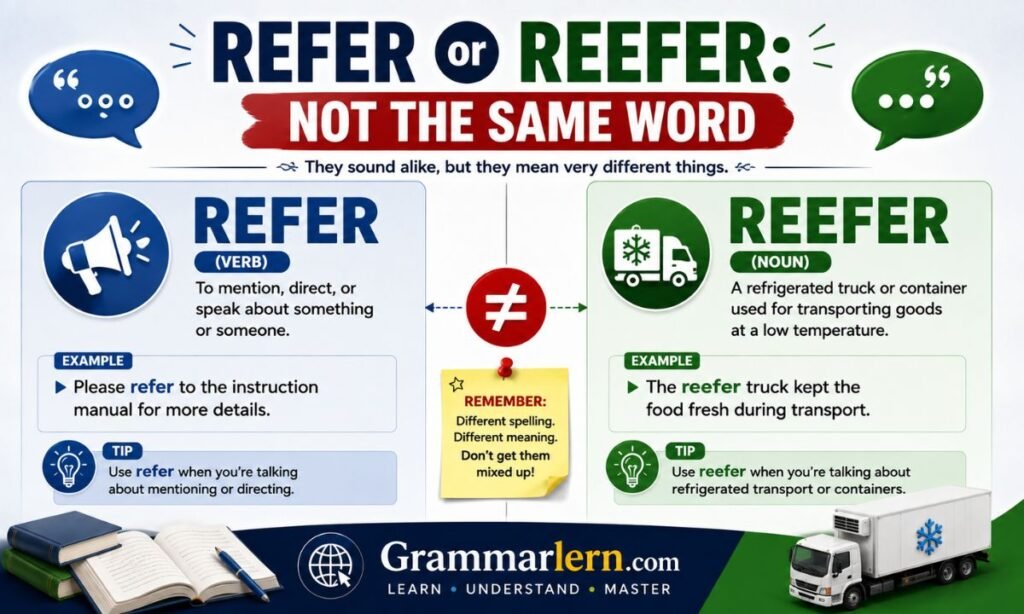
Refer is sometimes confused with reefer, a completely different word spelled with a double e. Reefer can mean a short thick jacket, a refrigerated shipping container, or informal slang for marijuana. Despite sounding similar, reefer has no grammatical connection to the verb refer.
Refer: Google Trends & Usage Data
Search interest in refer or reffer tends to rise when people are writing professional documents, emails, or referral related content. Usage data consistently shows the same pattern. Far more people search to confirm that reffer is wrong than to confirm that it’s right, which suggests most writers already sense the double f version looks incorrect before checking.
Keyword Variations Comparison Table
| Word Form | Correct Spelling | Incorrect Spelling |
| Base form | refer | reffer |
| Past tense | referred | reffered |
| Present participle | referring | reffering |
| Third person | refers | reffers |
| Noun form | referral | refferal |
Refer, Referring, or Referred: Spelling Rules Explained
English doubles a final consonant when a short word ends in a single vowel followed by a single consonant, and the stress falls on that final syllable. Refer follows this pattern exactly, which is why the r doubles in referred and referring, while the f never changes.
Correct Forms
refer, refers, referred, referring, referral, reference
Incorrect Forms
reffer, reffered, reffering, refered, refering
Why Does the Spelling Change?
The doubled r preserves the correct pronunciation of the second syllable. Without it, a word like “refering” would visually suggest a different sound than the one English speakers actually use.
Common Search Variations Covered
People often search phrases like referring or refering, referred or reffered, and is reffer a word. Each of these follows the same underlying rule: double the r, never the f.
Frequently Askesd Questions
What does “refer” mean?
Refer means to direct someone’s attention to something, mention a source, or send a person to another place for help or information.
What does “reffer” mean?
Reffer has no meaning at all. It is simply a misspelling of refer and does not appear in any dictionary.
What is the difference between “refer” and “refers”?
Refer is the base verb form, while refers is the third person singular form used with he, she, or it. For example, “I refer” versus “she refers.”
Is it “referral” or “refferal”?
Referral is correct, spelled with two r’s and one f. Refferal is incorrect and follows the same mistaken doubling pattern as reffer.
Is “refer” spelled the same in British and American English?
Yes. Both British and American English use the identical spelling refer. There is no regional variation for this word.
What is a synonym for “refer”?
Common synonyms for refer include mention, cite, consult, and direct. Reffer has no synonym since it is not a real word.
Final Thoughts
The answer to refer or reffer is simple and consistent across every English dialect. Refer is always correct, spelled with a single f, while reffer is nothing more than a common misspelling with no dictionary support.
Remembering the core rule makes this easy going forward. The base word keeps one f, and only the r doubles in forms like referred and referring.
Once this small rule sticks, you will never second guess how to spell refer again. Use it with confidence in emails, academic writing, and everyday conversation.