

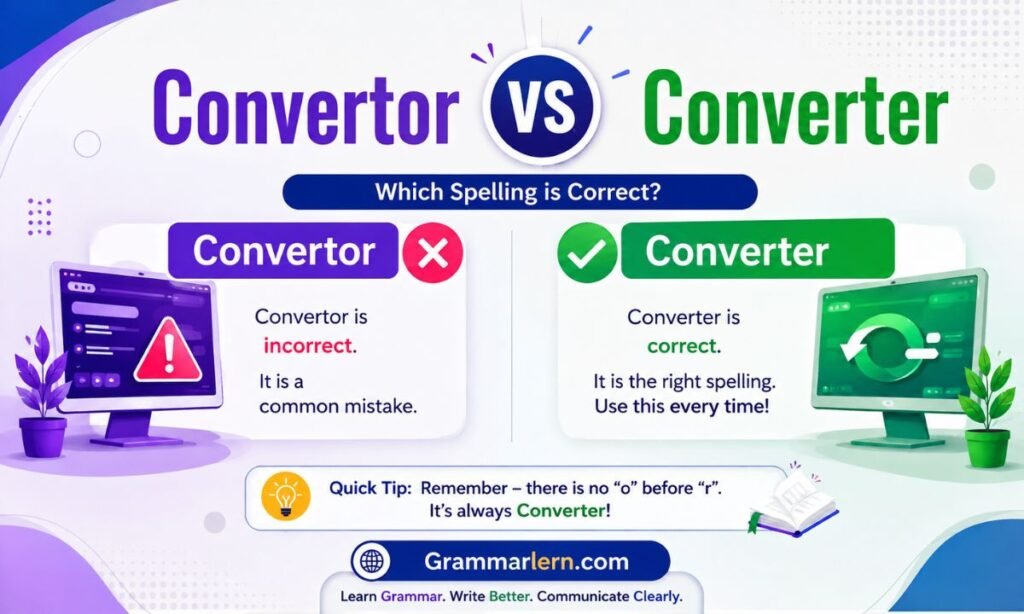
Confused between convertor and converter? You are not alone. Millions of people search this exact question every month, and only one spelling is actually correct.
Converter is the standard, dictionary approved spelling used in modern English. Convertor still exists, but it is rare and limited to specific technical cases. This guide gives you the correct answer, clear examples, and simple rules you can use with confidence.
Convertor or Converter: Quick Answer ✅⚡
✔ Main Difference
Converter is the correct and standard spelling used in modern English. Convertor is a rare variant that appears mostly in older texts and specific technical fields.
📌 Examples
- I used a file converter to change the document format.
- The car has a catalytic converter.
- Some old manuals still use the word convertor.
Definitions with Examples 📖✍️
🟢 Converter (Definition)
A converter is a person, tool, or device that changes something from one form into another.
📌 Examples
- This app is a video converter.
- Use a currency converter before you travel.
- He installed a power converter at home.
🔵 Convertor (Definition)
Convertor is a variant spelling of converter. It carries the same basic meaning but appears far less often in modern writing.
📌 Examples
- Some engineering manuals refer to a rotary convertor.
- Older texts occasionally used the word convertor instead of converter.
🟡 Simple Meaning
Converter is the common, everyday spelling. Convertor is the uncommon spelling you may see in technical or historical material.
The Origin of Converter 📜⏳
📚 Formation Rule
The word comes from the verb convert. Adding the suffix “er” creates the noun converter, meaning a thing that converts.
📌 Meaning
Converter simply means something that performs the action of converting, changing one form, format, or state into another.
📖 What Dictionaries Say (Oxford, Merriam Webster, OED)
Major dictionaries such as Merriam Webster and Oxford list converter as the standard entry. Convertor is not recognized as a proper headword in the Oxford English Dictionary. It appears only in older quotations, usually treated as a variant or an occasional misspelling rather than an accepted standard form.
British English vs American English Spelling 🌍🇬🇧🇺🇸
📌 Key Point
Both British and American English prefer converter. There is no true regional split where one country favors convertor over converter as the standard form.
📊 Comparison Table
| Region | Preferred Spelling | Rarely Used |
| United States | Converter | Convertor |
| United Kingdom | Converter | Convertor |
| Global English | Converter | Convertor |
Convertor vs Converter: Key Difference Explained 📊⚖️
📊 Comparison Table
| Feature | Converter | Convertor |
| Spelling status | Standard | Variant |
| Everyday usage | Very common | Rare |
| Dictionary listing | Primary entry | Not a standard headword |
| Typical context | All fields | Older or technical texts |
📌 Example
A PDF converter changes file formats every day for millions of users, while the spelling convertor might only appear in an old engineering document describing a similar tool.
Which Spelling Should You Use? 🎯📝
✔ Always Prefer
Converter. It is the safe, modern, and widely accepted choice in almost every situation.
⚠️ When You May See Convertor
You may come across convertor in older books, historical documents, or certain fixed product and brand names that intentionally kept the original spelling.
⚙️ Technical & Engineering Use of Convertor
In some electrical and mechanical engineering contexts, convertor has traditionally described devices that change energy or signals, such as a rotary convertor or a frequency convertor. Even in these fields, converter is now becoming the more common choice, but convertor still appears in legacy documentation and specialized terminology.
📚 In Exams
Always write converter. It is the spelling accepted in academic writing, exams, and formal documents.
⚖️ Easy Tip
Think of the word teacher. Just as teacher ends in “er,” converter follows the same familiar pattern, making it easy to remember.
📌 Examples
- Use converter in emails, reports, and everyday writing.
- Use convertor only when quoting an older source or an official technical term.
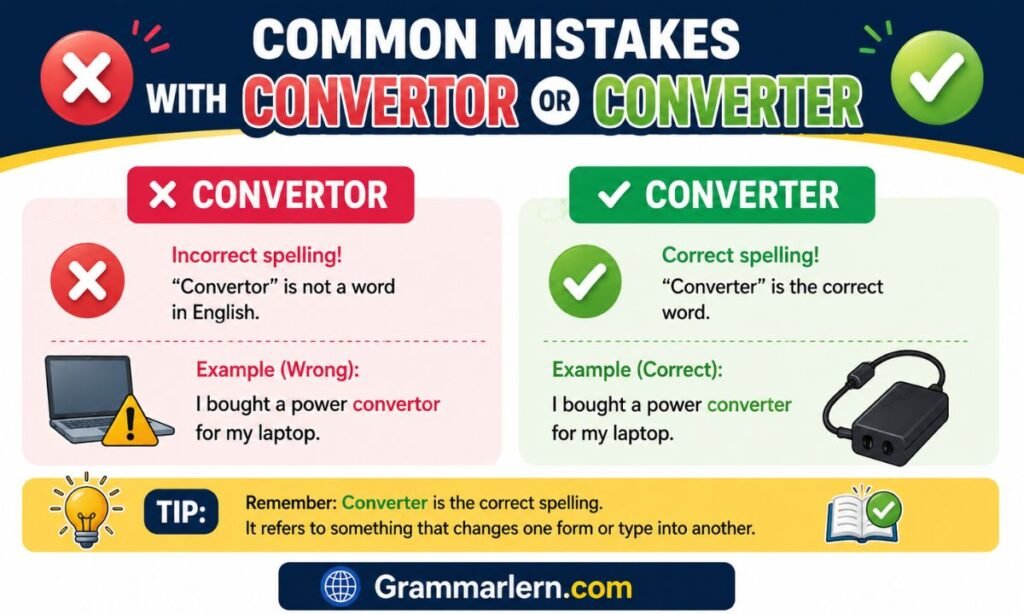
Common Mistakes with Convertor or Converter ❌⚠️
1. Using Convertor Everywhere
Many writers mistakenly use convertor in general writing. The correct everyday choice is converter.
2. Thinking Both Are Equal
Convertor and converter share a meaning, but they are not equally accepted. Converter is the preferred standard spelling.
3. Copying Old Text
Some writers copy convertor from outdated sources without realizing modern English has moved toward converter.
4. Spelling Confusion
Mixing both spellings in the same piece of writing creates inconsistency. Choose converter and stay consistent throughout your content.
Converter in Everyday Examples 💬📱
💻 Technology
- I downloaded a video converter for my laptop.
- This tool works as a file converter for documents.
🚗 Vehicles
- The mechanic replaced the car’s catalytic converter.
- A torque converter helps the engine perform smoothly.
📱 Apps
- This app includes a built in currency converter.
- The converter calculator updates exchange rates instantly.
📧 Work
- Please use the document converter before sending the file.
- Our team relies on a unit converter for daily calculations.
🏠 Daily Use
- I need an electric converter for my travel adapter.
- A simple unit converter helps with cooking measurements.
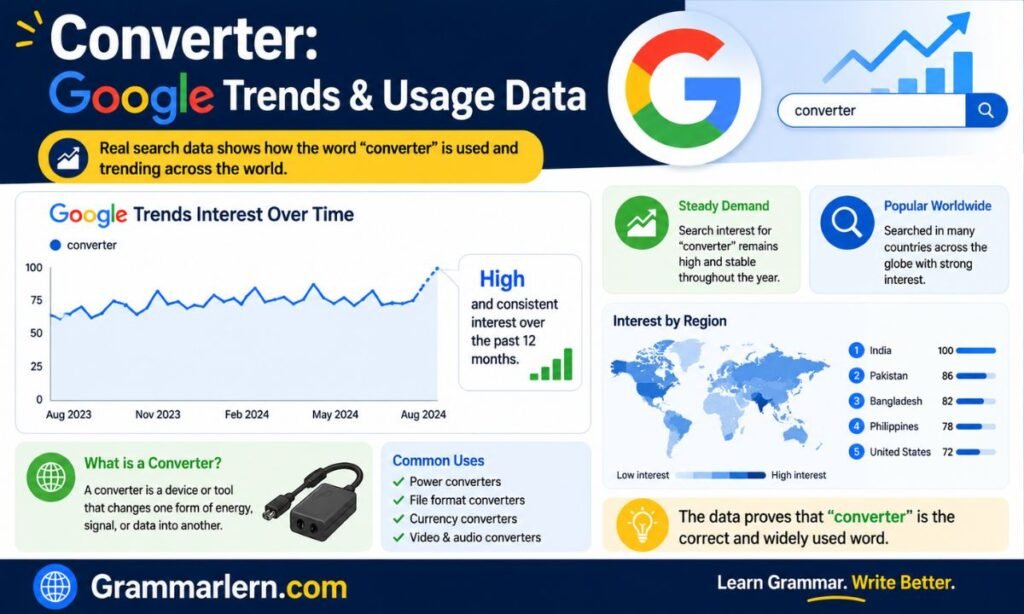
Converter: Google Trends & Usage Data 📊📈
🌍 Trends
Search data consistently shows that converter is searched far more often than convertor across every major region and language market.
📊 Region Table
| Region | Common Form |
| United States | Converter |
| United Kingdom | Converter |
| Pakistan | Converter |
| India | Converter |
| Global | Converter |
🔥 Top 10 Searches
- Convertor or converter which is correct
- Is convertor a real word
- Converter meaning in English
- Convertor vs converter difference
- How to spell converter correctly
- Currency converter online
- Catalytic converter meaning
- Electric converter for travel
- Converter calculator
- Convertor or converter unit
Comparison Table 📋⚖️
| Feature | Converter | Convertor |
| Correct spelling | Yes | Rarely accepted |
| Common meaning | Same | Same |
| Everyday use | Extremely common | Very rare |
| Dictionary status | Standard entry | Not a standard headword |
| Best for | All writing | Historical or technical quotes only |
Frequently Asked Questions
Is it a convertor or converter?
Converter is the correct and standard spelling in modern English. Convertor is a rare variant, mostly limited to technical or historical use.
What is a convertor?
A convertor is a device or tool that changes one form of energy or signal into another, most often used in electrical or mechanical engineering contexts.
Is convertor a real word?
Yes, convertor is a real word, but it is not listed as a standard headword in most major dictionaries. It appears mainly as a variant spelling in technical or older texts.
Why is converter more common than convertor?
Converter follows the natural “er” pattern used in English agent nouns like teacher, reader, and printer. This familiar pattern makes converter easier to read and more widely accepted.
Is “converter” or “convertor” the correct spelling in the UK?
Both British and American English prefer converter. Convertor is not the standard spelling in either variety, though it occasionally appears in technical documentation.
When should I use convertor instead of converter?
Use convertor only when quoting historical material, referencing older engineering documents, or following an official product or brand name that uses that spelling.
Final Thoughts
Converter is the correct, modern, and widely accepted spelling. Convertor still exists, but its use is limited to specific technical and historical situations.
Remember the simple “er” pattern, just like teacher, reader, and printer, and you will always choose correctly. Now you can use converter or convertor with complete confidence.