

Confused between “itself” and “its self”? You’re not the only one — this tiny space trips up even confident writers. The good news: the rule is simple once you see it clearly.
In this guide, you’ll learn why “itself” is the correct form in almost every sentence, and the rare cases where “its self” actually works. With clear examples, common mistakes, and a quick-reference table, you’ll never second-guess this again.
Understanding “Its Self or Itself” — Why People Mix Them Up
If you’ve ever paused mid-sentence wondering whether to write its self or itself, you’re in good company. Both forms start with “its,” and “self” looks like it should attach to form a reflexive pronoun — so the mix-up feels logical.
The confusion usually comes down to a few habits:
- Writers assume “self” behaves the same way it does in myself or yourself
- The apostrophe in its versus it’s adds a second layer of doubt
- Older or literary texts occasionally use “its self,” which makes the form feel more acceptable than it actually is
Once you understand how reflexive and possessive pronouns work, the confusion disappears for good.
What “Itself” Actually Means (And Why It’s the Standard Form)
In modern English, itself is the reflexive pronoun that pairs with “it.” It’s the word you’ll reach for close to 100% of the time when a subject and object refer to the same thing.
Itself does two jobs: it shows an action reflecting back onto its subject, and it adds emphasis to a noun already mentioned. Both uses are grammatically correct and extremely common in everyday, academic, and professional writing.
What Are Reflexive Pronouns?
A reflexive pronoun refers back to the subject of a sentence. English has one reflexive form for every subject pronoun:
| Subject | Reflexive Pronoun |
| I | myself |
| You | yourself |
| He | himself |
| She | herself |
| It | itself |
| We | ourselves |
| They | themselves |
You’ll use a reflexive pronoun whenever:
- The subject and the object of the sentence are the same
- You want to add emphasis to the subject
Example: The cat groomed itself. Here, the cat is both the one performing the action and the one receiving it — a textbook reflexive construction.
Key Features of “Itself”
You reach for “itself” when:
- Something acts on its own, without outside help
- An action returns to the same subject that performed it
- You want to emphasize a noun already introduced
- The subject is non-human, an object, or a concept
Examples:
- The door closed itself.
- The business rebuilt itself after a difficult year.
- The app updates itself automatically.
These sentences show how naturally “itself” fits — because English standardized it as one fused word centuries ago.
How “Itself” Works in Real Sentences
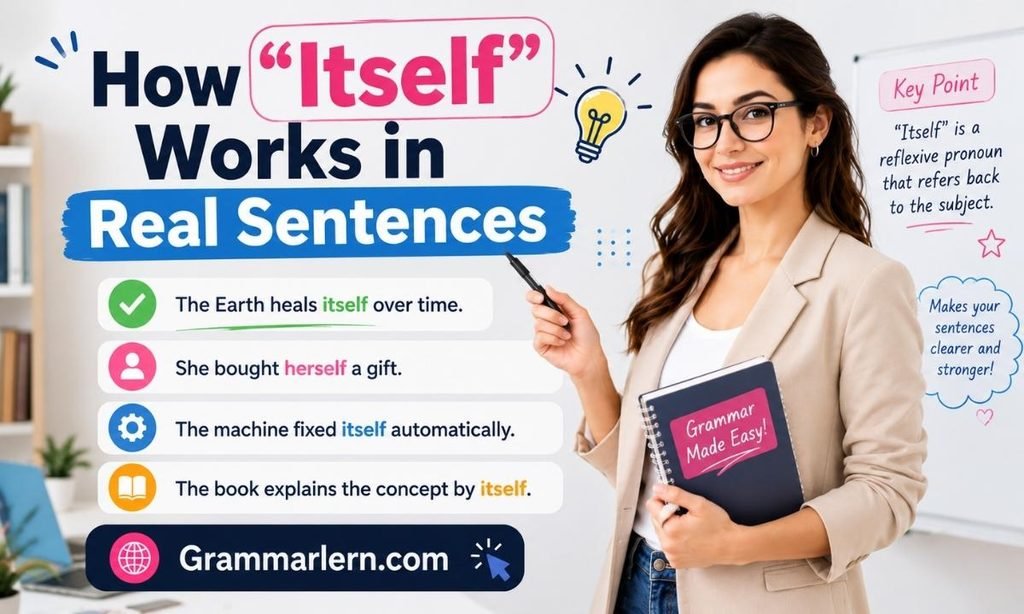
Reflexive pronouns show up differently depending on context. Here’s how “itself” behaves across common writing styles.
Everyday Usage
- The baby bird pushed itself out of the shell.
- The system restarted itself after the update.
Formal Usage
- The committee will review the proposal by itself.
- The organization positioned itself as an industry leader.
Emphatic Usage
- The painting itself is a masterpiece, even without the frame.
- The idea itself was never the problem — the execution was.
In each case, “itself” reads naturally because it’s doing exactly what English grammar expects of a reflexive or emphatic pronoun.
Also Read This Emasculate vs Demasculate: The Real Meaning Behind the Confusion
Why “Its Self” Is Not Standard in Modern Grammar
“Its self” looks like it should be the reflexive form of “it” — but it isn’t. Modern English recognizes only one reflexive form for “it”: itself, written as a single word.
The two-word version breaks down grammatically because:
- Reflexive pronouns in English are compound words, not phrases
- “Its” functions as a possessive pronoun, not a reflexive base
- “Self” isn’t meant to trail a possessive pronoun to create a reflexive form
Using “its self” in ordinary writing — emails, essays, business reports — will almost always read as a mistake, and most editors and grammar checkers will flag it.
When “Its Self” Does Appear (Rare but Valid Situations)
“Its self” isn’t completely without a place in English — it just isn’t reflexive grammar. In specific contexts, “self” functions as a standalone noun meaning identity, essence, or being. In that structure, “its” is simply a possessive pronoun modifying the noun “self.”
Examples from Philosophical, Psychological, or Religious Writing
- The mind seeks to understand its self, not just the world around it.
- Every system evolves toward its self, its purpose, and its identity.
- The soul returns to its self, free from external influence.
Here, “self” carries a deeper meaning than reflexive grammar — it stands for identity or consciousness as a concept.
Historical Examples
Older English once separated reflexive pronouns into two words:
- him self
- her self
- your self
- my self
Over time, these merged into single words — “itself” followed the same path of standardization.
Clear Examples of Correct “Its Self” Usage
When “self” is used as a standalone noun for identity or inner being, these sentences are grammatically valid:
- The machine has lost its self, operating without purpose.
- The creature became aware of its self for the first time.
- The brand is reinventing its self as a modern lifestyle company.
Outside of this specific philosophical or conceptual use, always default to “itself.”
Clearing Up a Related Confusion: “Its” vs. “It’s”
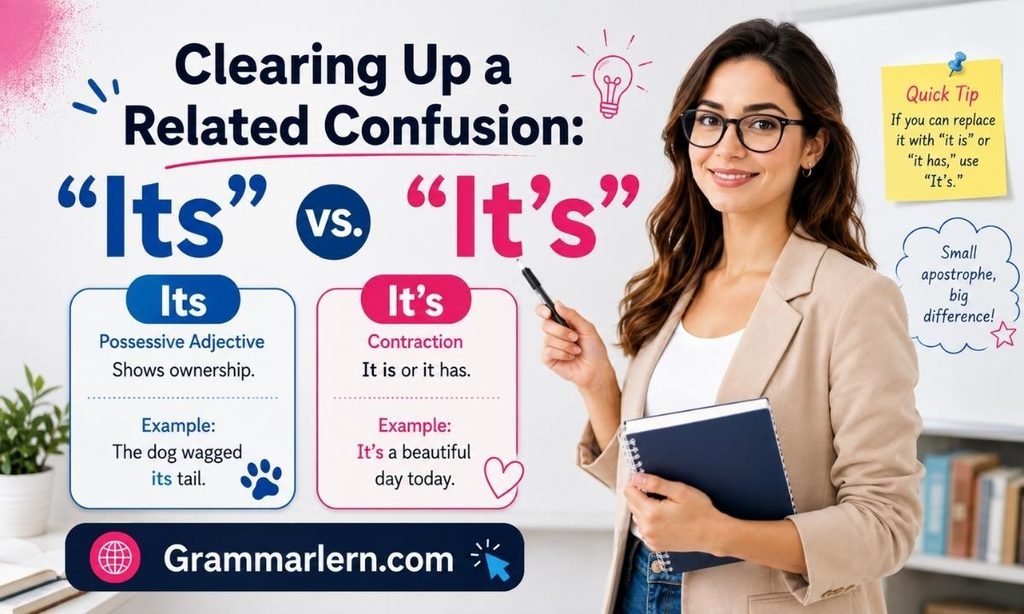
People often mix up “its” and “it’s” simply because of the apostrophe. They mean completely different things.
“Its” = Possessive Pronoun
“Its” shows ownership — something belonging to “it.”
- The dog wagged its tail.
- The company increased its revenue.
“It’s” = Contraction
“It’s” is short for “it is” or “it has.”
- It’s raining. → It is raining.
- It’s been two years. → It has been two years.
If you can replace the word with “it is” or “it has” and the sentence still makes sense, use “it’s.”
Common Mistakes
Wrong:
- Its going to rain.
- The cat drank it’s milk.
Correct:
- It’s going to rain.
- The cat drank its milk.
Also Read This Emasculate vs Demasculate: The Real Meaning Behind the Confusion
Why “Its” Has No Apostrophe in Possession
English possessive pronouns never take an apostrophe:
| Pronoun | Possessive | Reflexive |
| he | his | himself |
| she | her | herself |
| they | their | themselves |
| it | its | itself |
“Its” follows the exact same pattern as “his” and “her” — both show possession without an apostrophe. Once you see this pattern, the rule becomes automatic.
Quick Tests to Avoid Errors
Use these three mental shortcuts whenever you’re unsure which form fits.
Substitution Test
Replace “it’s” with “it is.” If the sentence still makes sense, keep the apostrophe. If not, remove it.
Ownership Test
If something belongs to “it,” use “its” — no apostrophe, no exceptions.
Reflexive Test
If the subject is acting on or referring back to itself, use “itself.”
These three checks cover nearly every situation you’ll run into.
Also Read This Emasculate vs Demasculate: The Real Meaning Behind the Confusion
Examples to Strengthen Your Grammar with “Itself”
Correct sentences:
- The project completed itself thanks to smart automation.
- The mirror reflects itself infinitely.
Incorrect sentences:
- The project completed its self. (wrong)
- The mirror reflects it’s self. (wrong)
Seeing correct and incorrect versions side by side makes the difference easy to spot.
Practice Exercises
Try these to lock the rule in.
Choose the Right Word: Its, It’s, or Itself
- The computer restarted ______.
- I think ______ time for dinner.
- The tree lost ______ leaves early this year.
- The device protects ______ by shutting down.
- The company changed ______ strategy.
Answers
- itself
- it’s
- its
- itself
- its
Case Study: How One Misused Word Changed a Brand Message
A tech startup once launched a campaign titled “Reinventing Its Self for the Future.”
Customers noticed immediately. Some assumed the company had made a careless grammar error; others felt the message came across as unpolished or rushed.
After the copy was corrected to “Reinventing Itself for the Future,” engagement improved. The message read as confident and intentional — proof that a single misplaced space can change how professional your writing feels.
Expert Grammar Tip
“If you’re not discussing identity, essence, or being, don’t use ‘its self.’ Use ‘itself.'”
This one rule alone will keep your writing clean, correct, and consistent.
Frequently Asked Questions
Which is correct, itself or its self?
“Itself” is correct in nearly all writing. “Its self” only appears in rare philosophical or psychological contexts where “self” is used as a standalone noun meaning identity or essence.
How do you use itself in a sentence?
Use “itself” when the subject performs an action on or refers back to the same thing: The system updates itself automatically. It also works for emphasis: The idea itself was brilliant.
Which is correct, himself or his self?
“Himself” is the correct reflexive pronoun for a male subject. “His self” is nonstandard in everyday English and follows the same pattern as the “its self” mistake — separating a possessive pronoun from “self” instead of using the fused reflexive form.
Which is correct, their self or themselves?
“Themselves” is the correct reflexive pronoun for plural subjects. “Their self” is grammatically incorrect because “their” is plural while “self” is singular — the mismatch alone makes the phrase invalid.
What’s the difference between its and it’s?
“Its” shows possession (belonging to something), while “it’s” is a contraction for “it is” or “it has.” Try replacing “it’s” with “it is” — if the sentence still makes sense, the apostrophe is correct.
Does itself have a plural form?
No. “Itself” pairs with singular, non-human subjects. For plural subjects, English uses “themselves” instead.
What does “in itself” mean?
“In itself” means considered alone, without connection to anything else: The idea, in itself, wasn’t bad — the timing was the problem.
Final Thoughts
Getting “itself” and “its self” right comes down to one simple habit: default to itself unless you’re specifically discussing identity, essence, or being as a concept. That single distinction covers nearly every sentence you’ll ever write.
With reflexive pronouns, possessive forms, and the its-versus-it’s rule now clear, your writing will read cleaner and more confident from here on. Keep this guide close, and you’ll never second-guess its self or itself again.