


Ever typed “focusses” in an email and then paused, wondering if you’d just made a spelling mistake? You’re not alone. This is one of the most searched spelling confusions in English today.
The truth is simple. Both spellings exist, but they aren’t used equally. One is the modern, globally accepted form, while the other is a rarer variant tied to older British writing.
In this guide, you’ll learn exactly which spelling to use, why the confusion exists in the first place, and how to apply the correct form confidently in your everyday writing.
Focusses or Focuses: Quick Answer
Focusses
Focusses is the older, less common spelling of the word. It follows a British pattern of doubling the final consonant before adding a suffix. You’ll still see it occasionally in older British texts, but it has largely fallen out of everyday use.
Focuses
Focuses is the standard, modern spelling used in both American and British English. It’s the third person singular form of the verb focus, and it’s the form recommended by most dictionaries and style guides today.
Key Takeaways: Focuses vs Focusses at a Glance
Focuses is the correct and preferred spelling in both American and British English. Focusses is a rare British variant that is now considered outdated. When you’re unsure which one to use, choose focuses. It works correctly in almost every context, from casual writing to formal documents.
The Origin of Focusses or Focuses
The word focus comes from Latin, where it originally meant hearth or fireplace. Over time, it evolved into a term describing a central point of attention, a meaning it kept as it entered English.
Scientists in the 17th century, including astronomer Johannes Kepler, began using focus in the context of optics to describe where light converges. From there, the word spread into everyday language to describe concentration and attention.
As English developed its own spelling conventions, two versions of the verb form emerged: focuses and focusses. Over the centuries, focuses became the dominant spelling worldwide, while focusses remained a minor variant used mostly in older British writing.
Why the Confusion Exists: The Consonant-Doubling Rule
English has a general rule about doubling a final consonant before adding a suffix like ed or ing. The rule usually applies when a word has one syllable, or when its final syllable is stressed, and it ends in a single vowel followed by a single consonant. Words like stop and begin follow this pattern, becoming stopped and beginning.
Focus doesn’t fit neatly into this rule. Its final syllable isn’t strongly stressed, so by the standard rule, the consonant shouldn’t double. This is exactly why usage has been inconsistent for so long.
British English has historically been more willing to double the final consonant in cases like this, even when the stress rule doesn’t strictly apply. American English tends to follow the stricter version of the rule more consistently. This is the root of the entire focuses versus focusses debate.
British English vs American English Spelling
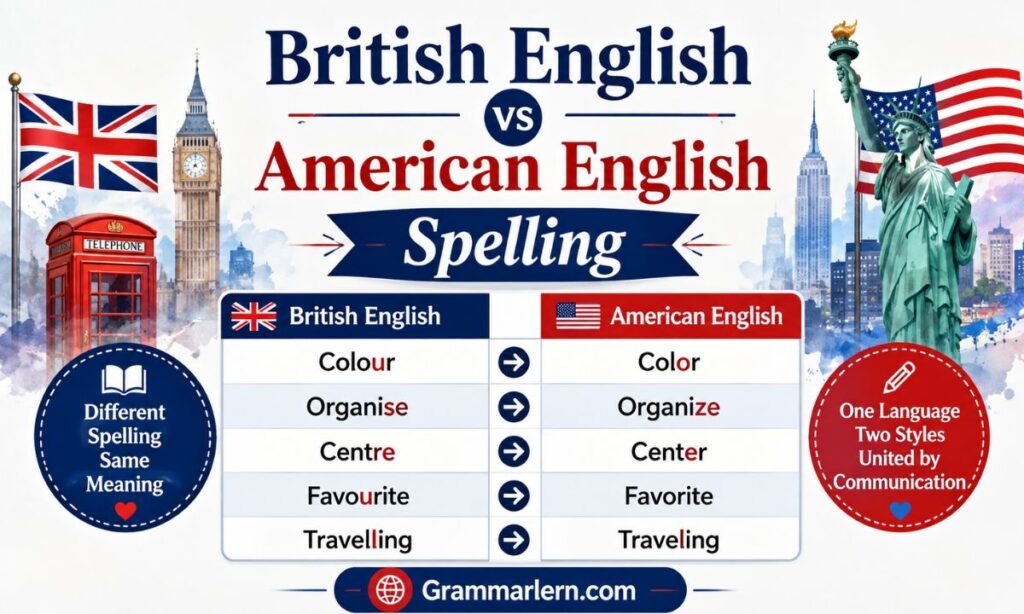
In American English, focuses is the only spelling used. Style guides and dictionaries in the US don’t recognize focusses as a standard alternative.
In British English, both focuses and focusses have historically been accepted. However, modern British usage has shifted heavily toward focuses as well. Major UK publications, including the BBC, now use focuses far more often than focusses.
Canada and Australia generally align with American usage here, favoring focuses in nearly all writing. Focussed, focussing, and focusses do still appear occasionally in older British texts, but they read as dated to most modern readers.
What Do Dictionaries & Style Guides Say? (Oxford, Collins, Merriam-Webster)
Collins English Dictionary lists the third person singular present tense of focus as focuses, with focusing or focussing as accepted present participle forms, and focused or focussed as accepted past tense forms. This confirms that both spellings are technically valid, but focuses is listed first as the primary form.
Merriam-Webster, the leading American dictionary, lists focuses as the standard spelling and doesn’t include focusses as an alternative at all, reflecting its absence from American usage.
Style guides used by professional publications, including the Associated Press and the Chicago Manual of Style, consistently recommend focuses over focusses. This preference for the single s spelling reflects the broader trend across nearly all modern English style authorities, both American and British.
Which Spelling Should You Use?
If you want a spelling that works correctly everywhere, in the US, the UK, Canada, or Australia, choose focuses. It’s accepted as standard in every major English speaking region and won’t look out of place in any type of writing.
Focusses is not incorrect, but it’s uncommon enough that many readers may assume it’s a typo. Unless you have a specific reason to use it, such as matching an older British text, focuses is the safer and more professional choice.
For consistency, pick one spelling and stick with it throughout your document. Most professional and academic writing today, including in the UK, defaults to focuses.
📌 Focuses vs Focusses and Related Forms (Complete Usage Guide)
Focusing or Focussing
The same pattern applies to the present participle form. Focusing, with a single s, is by far the more common spelling in both American and British English. Focussing still appears occasionally in British writing, but it’s increasingly rare.
Focused or Focussed
Focused is the standard spelling for the past tense and past participle in American English. In British English, both focused and focussed are technically accepted, but focused remains the more frequently used form, even in the UK.
Plural of Focus: Focuses or Foci?
When focus is used as a noun, it has two accepted plural forms. Focuses is the everyday plural used in general writing, such as “the report has several focuses.” Foci, the Latin derived plural, is more common in academic, scientific, or technical writing, such as in discussions of optics or medical research.
Synonyms of Focuses/Focussed
Common synonyms for focuses include concentrates, centers on, and zeroes in on. For focused, alternatives include concentrated, attentive, and dedicated. These synonyms can be useful when you want to vary your word choice in longer pieces of writing.
Comparison Table: Focusses vs Focuses
| Form | Preferred Spelling | Rare Variant | Region |
| Present tense (he/she/it) | Focuses | Focusses | Global, especially US |
| Present participle | Focusing | Focussing | Global, especially US |
| Past tense / past participle | Focused | Focussed | Global, especially US |
| Noun (plural, general use) | Focuses | Foci (formal/academic) | Global |
Focusses or Focuses in Everyday Examples
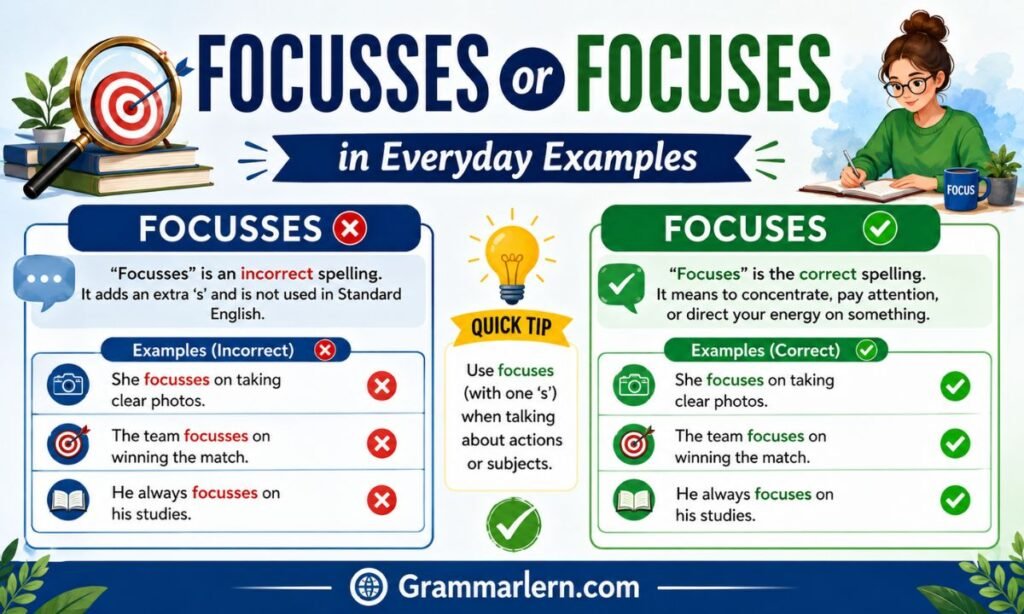
Our marketing team focuses on social media growth this quarter.
The documentary focuses on climate change and its effects on coastal cities.
She focussed her attention on finishing the project before the deadline. (older British style)
The research paper focuses heavily on renewable energy solutions.
His presentation focused on three key strategies for improving customer service.
Common Mistakes with Focusses or Focuses
One common mistake is assuming that British English requires the double s spelling in every case. In reality, modern British writing overwhelmingly favors focuses, focusing, and focused, just like American English.
Another mistake is mixing both spellings within the same document. Even though both forms are technically accepted, switching between focuses and focusses in one piece of writing looks inconsistent and unpolished.
Some writers also confuse focuses, the verb form, with foci, the formal plural noun form. These serve different grammatical purposes and aren’t interchangeable.
Focusses or Focuses: Google Trends & Usage Data
Search and usage data consistently show focuses far outpacing focusses across nearly every English speaking region, including the UK. Modern British publications such as the BBC use focuses in the significant majority of cases, with focusses appearing only occasionally, often in older archived content.
This trend has strengthened over the past few decades, as global English usage continues to standardize around the single s spelling. Focusses hasn’t disappeared entirely, but its use is now largely confined to older texts and a small number of traditional British writers.
⚠️ Common Search Confusions About Focuses and Focusses
Many people search for this topic assuming there’s a strict American versus British divide, similar to color and colour. In reality, the split isn’t that clean. Modern British English has moved toward focuses as well, making this more of an old versus new usage pattern than a strict regional one.
Others confuse this spelling question with unrelated word pairs, like traveled and travelled, assuming the same doubling rule always applies. As explained earlier, focus doesn’t follow the typical stress based doubling rule, which is exactly why its spelling history looks different from words like travel or cancel.
Frequently Asked Questions
Is focusses a correct spelling?
Yes, focusses is technically correct in British English, but it’s now considered a rare, older style variant. Focuses is the standard spelling used across both American and British English today.
Is it correct to say “focuses”?
Yes. Focuses is the standard, widely accepted spelling in both American and British English. It’s the safest choice for any formal or professional writing.
How do you spell focuses in the UK?
British English accepts both focuses and focusses, but modern UK dictionaries, including Oxford, list focuses as the more common and preferred form today.
What is the difference between focus and focused?
Focus is the base verb, used in the present tense, as in “I focus on my work.” Focused is its past tense and past participle form, as in “I focused on my work yesterday.”
Is it focusing or focussing?
Both spellings exist, but focusing, with a single s, is far more common in modern English, following the same pattern as focuses over focusses.
What is the plural of focus, focuses or foci?
Both are correct. Focuses is the everyday plural used in general writing, while foci is the more formal, Latin derived plural often used in academic or scientific contexts.
Final Thoughts
At the end of the day, the choice between focuses and focusses comes down to one simple fact: focuses is the modern, globally accepted spelling, while focusses is a rare variant that’s fading even in British English.
Understanding this small difference helps your writing look polished and consistent, whether you’re drafting an email, an essay, or professional content. The rules aren’t complicated once you see the pattern behind them.
So the next time you’re unsure, remember: focuses is the safe, correct choice almost everywhere. Stick with it, stay consistent, and your writing will always read clearly and confidently.