

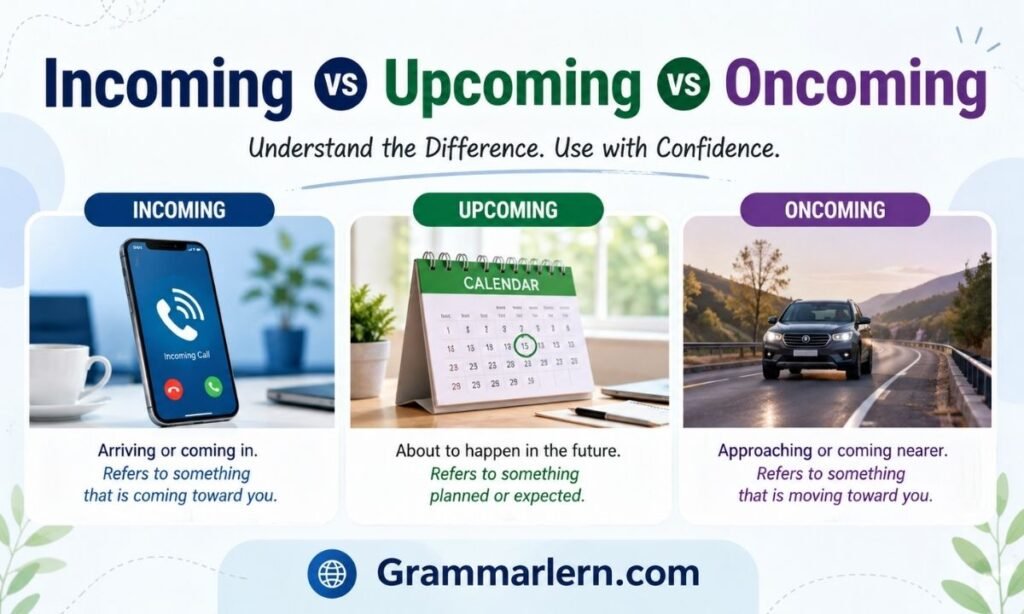
Ever typed “upcoming traffic” or “incoming meeting” and instantly felt something was off? You’re not alone — these three words trip up even confident English speakers every single day.
Incoming, upcoming, and oncoming all sound like cousins in grammar and vocabulary, but each one plays a completely different role in a sentence, changes the part of speech context slightly, and shifts the meaning based on timing and direction.
This guide breaks down the exact difference between all three, with simple examples, a quick comparison table, and the common mistakes most people don’t even realize they’re making, so both native speakers and English learners can use these words with full confidence.
Understanding “Incoming”, “Upcoming”, and “Oncoming”
All three words are adjectives that describe something that hasn’t fully happened yet, but each one answers a different question. One is about arrival, one is about timing, and one is about physical direction, and recognizing this pattern is a useful vocabulary and grammar skill for everyday communication.
Once you separate those three ideas, the confusion disappears for good.
Word Origins: Why These Prefixes Matter
Each word is built from the same root, “coming,” joined to a different prefix, and that small prefix carries the entire meaning.
| Prefix | Core Idea | Word |
| In | Movement into a space or system | Incoming |
| Up | Movement forward in time | Upcoming |
| On | Movement toward a person or point | Oncoming |
Once you see the prefix as the key, guessing the right word becomes far easier.
Incoming vs Upcoming vs Oncoming: Quick Answer
Incoming means something is arriving now or very soon, such as a call, an email, or a shipment. Upcoming means something is scheduled for the future, such as an event or a deadline. Oncoming means something is physically moving toward you, such as traffic or a storm.
What “Incoming” Really Means
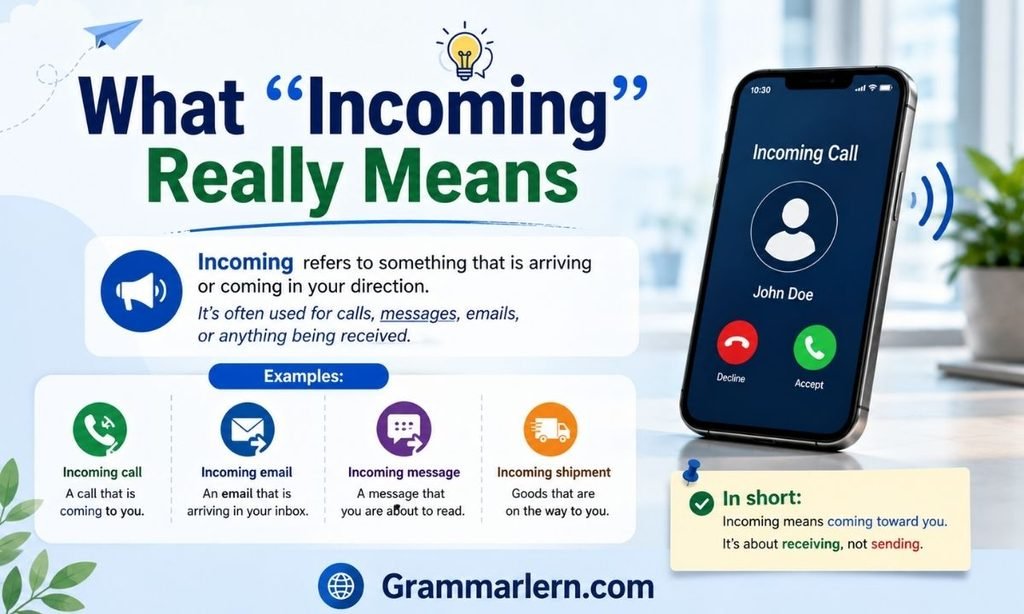
Definition of Incoming
Incoming describes something that is actively arriving, entering, or being received right now or in the very near future. As an adjective, it focuses on arrival and receipt, not on scheduling or physical direction, which is what sets its meaning apart from the other two words.
When You Use “Incoming”
Use incoming when:
- Something is about to reach your device or inbox
- Someone is contacting you
- A physical shipment or delivery is on its way
- A system is receiving data or a signal
Tech & Communication
- Incoming call
- Incoming message
- Incoming email
- Incoming data request
Every notification your phone shows you follows this exact pattern.
Deliveries & Logistics
- Incoming shipment
- Incoming order
- Incoming inventory
Warehouse teams rely on this word to track what is arriving each day.
Weather & Natural Forces
- Incoming storm
- Incoming heatwave
- Incoming tide
These uses describe natural forces that are actively approaching a location.
Emergencies & Warnings
- Incoming danger
- Incoming fire
- Incoming missile
In urgent situations, the word signals something moving toward a target quickly.
Examples of Incoming
- I couldn’t answer the incoming call because I was driving.
- We’re expecting an incoming shipment at 4 PM.
- The radar picked up an incoming storm heading this way.
Key Insight
Incoming means something is arriving at your location, device, or system, right now or very soon.
What “Upcoming” Really Means
Definition of Upcoming
Upcoming describes something scheduled or expected in the near future. There is no arrival and no physical movement involved, just timing, which makes it the natural word choice for calendars, plans, and announcements.
Practical Uses of “Upcoming”
You use upcoming when talking about:
- Events and meetings
- Deadlines and appointments
- Product launches and releases
- Holidays and announcements
Examples of Upcoming
- I have an upcoming meeting with my manager on Friday.
- Here’s a trailer for the upcoming movie.
- Don’t forget the upcoming deadline next week.
Typical Daily Uses
You’ll come across upcoming in:
- School and workplace calendars
- Event announcements
- Marketing emails
- Streaming platform previews
Key Insight
Upcoming means something is planned for the future. Nothing is moving toward you, it’s simply on the schedule.
What “Oncoming” Really Means
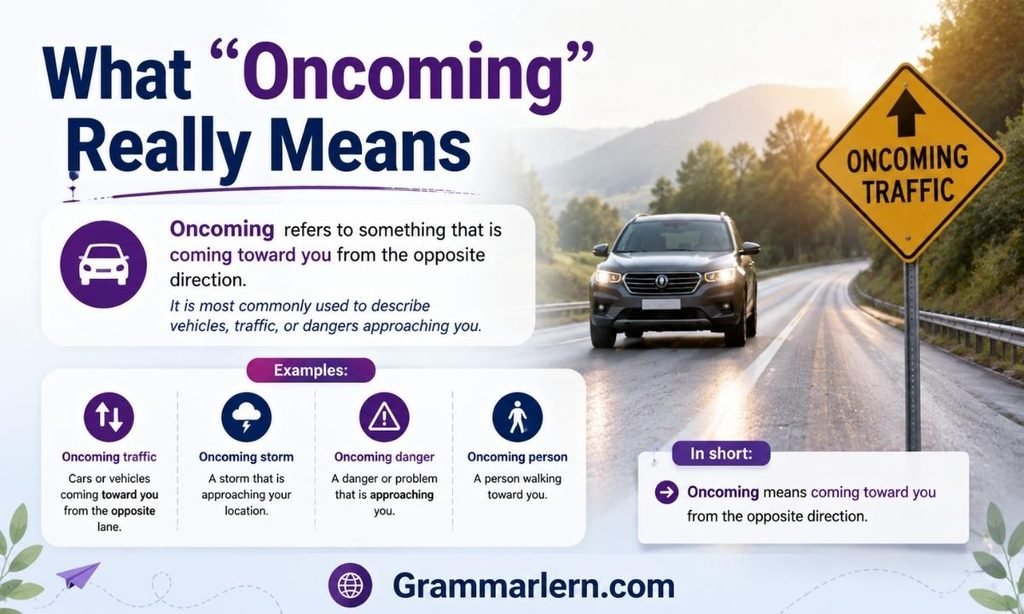
Definition of Oncoming
Oncoming describes something moving physically toward you, often quickly, and often from the opposite direction. It is almost always about real, physical motion rather than digital arrival or scheduled timing.
Common Uses of “Oncoming”
You’ll notice this word most often in situations involving direct physical movement, such as these everyday contexts.
Traffic & Vehicles
- Oncoming car
- Oncoming train
- Oncoming bus
Drivers watch for these constantly, since they signal direct physical risk.
Danger & Physical Threats
- Oncoming wave
- Oncoming crowd
- Oncoming debris
Weather
- Oncoming hail
- Oncoming winds
Examples of Oncoming
- The driver swerved to avoid an oncoming car.
- Be careful of oncoming traffic while crossing the street.
- A large oncoming wave knocked the surfer off balance.
Key Insight
Oncoming means something physical is moving directly toward you, often with speed or urgency.
Also Read This Drove vs Driven: Grammar Rules, Examples & Common Mistakes
Side-by-Side Comparison
Meaning Differences Table
| Word | Focus | Movement | Typical Use | Example |
| Incoming | Arrival or receipt | Yes, physical or digital | Calls, emails, shipments, storms | Incoming message |
| Upcoming | Future timing | No | Events, meetings, releases | Upcoming concert |
| Oncoming | Physical approach | Yes, toward you | Traffic, storms, waves | Oncoming car |
Best Word Choice by Scenario
| Scenario | Correct Word | Why |
| A car driving toward you | Oncoming | Physical movement in your direction |
| A call alert on your phone | Incoming | It’s reaching your device |
| A meeting planned for next week | Upcoming | Scheduled future event |
| A package about to arrive today | Incoming | Nearly at your location |
| A movie releasing next month | Upcoming | Planned future release |
| A storm approaching your house | Incoming or Oncoming | Depends on whether you’re focused on arrival or direction |
Why Context Matters
Picking the right word comes down to context clues and answering three simple questions in order.
1. Is it physically moving toward you?
If yes, use oncoming. If no, move to the next question.
2. Is it arriving to your device, system, or location?
If yes, use incoming.
3. Is it planned for the future?
If yes, use upcoming.
For example, “incoming exam” doesn’t work because an exam doesn’t move toward you, but “upcoming exam” does. Similarly, “upcoming train” sounds wrong because a train is moving, while “oncoming train” fits perfectly.
Examples from Everyday Life
Incoming
- I saw an incoming text from my sister.
- We have incoming orders to process this afternoon.
Upcoming
- I’m a little nervous about my upcoming surgery.
- The upcoming software update should fix the bug.
Oncoming
- He ran straight toward oncoming traffic without noticing.
- Watch out for the oncoming waves near the shore.
Common Mistakes to Avoid
Using “oncoming” for events
Incorrect: The oncoming party is tomorrow. Correct: The upcoming party is tomorrow.
Using “incoming” for scheduled things
Incorrect: I prepared for the incoming festival. Correct: I prepared for the upcoming festival.
Using “upcoming” for something happening now
Incorrect: The upcoming storm is already here. Correct: The incoming storm is hitting us right now.
Using “oncoming” for digital stuff
Incorrect: Oncoming email. Correct: Incoming email.
Using “incoming” for things that don’t move
Incorrect: Incoming exam. Correct: Upcoming exam.
Also Read This Drove vs Driven: Grammar Rules, Examples & Common Mistakes
Easy Memory Tricks
1. Incoming = In-coming
It’s literally something “coming in” toward you.
2. Upcoming = Up next
If it’s happening soon on your calendar, it’s simply up next.
3. Oncoming = On the way toward you
If it’s physically rushing at you, it’s oncoming.
4. The Car Rule
If “car” fits naturally after the word, it’s almost always oncoming, as in oncoming car.
5. The Calendar Rule
If the word fits comfortably on a calendar, it’s upcoming.
Case Studies
Case Study 1: The Weather App
A weather alert reads, “Incoming storm expected in 45 minutes.” The word “upcoming” wouldn’t work here, since the storm is actively moving and approaching right now.
Case Study 2: A Company Announcement
A company email says, “Our upcoming webinar is scheduled for Friday.” Here, “incoming” wouldn’t fit, since a webinar is a planned event, not something that arrives or moves.
Case Study 3: Traffic Incident
A news report states, “The cyclist collided with an oncoming car.” The word “incoming” wouldn’t apply, because the car was physically moving toward the cyclist on the road.
Quotes to Help You Remember
“Incoming tells you something is almost at your door.”
“Upcoming gives you time to prepare.”
“Oncoming makes you step back or move fast.”
Frequently Asked Questions
What does “oncoming” mean?
Oncoming means something is moving physically toward you, often from the opposite direction, such as oncoming traffic or an oncoming storm.
What is the difference between incoming, upcoming, and oncoming?
Incoming refers to something arriving now or soon, upcoming refers to something scheduled for the future, and oncoming refers to something physically moving toward you.
Incoming vs upcoming vs oncoming meaning in Urdu
In Urdu, incoming can be understood as “aane wala” (arriving), upcoming as “aane wala waqt” or “mustaqbil mein hone wala” (scheduled for the future), and oncoming as “samne se aane wala” (coming from the opposite direction).
Is it “incoming 3rd year” or “upcoming 3rd year”?
“Upcoming 3rd year” is correct, since a school year or academic term is scheduled on a calendar rather than something that physically arrives.
Is it “upcoming days” or “incoming days”?
“Upcoming days” is correct. Days that haven’t happened yet are part of the future timeline, so they follow the scheduling meaning of upcoming.
Is it an incoming or oncoming vehicle?
“Oncoming vehicle” is correct when the vehicle is moving toward you on the road, such as in the opposite lane. “Incoming” would only fit if the vehicle is arriving at a location, like a delivery truck reaching a warehouse.
Final Thoughts
Incoming, upcoming, and oncoming may look like close relatives, but each one answers a different question. Incoming is about arrival, upcoming is about timing, and oncoming is about physical direction moving toward you.
Once you connect each word to its core idea, and lean on the simple tricks and tables in this guide, choosing the right one becomes second nature. With a bit of practice and attention to context, your grammar, word choice, and everyday English will sound sharper and more precise almost immediately.
1 thought on “Incoming vs Upcoming vs Oncoming: Meaning, Examples & Common Mistakes”