

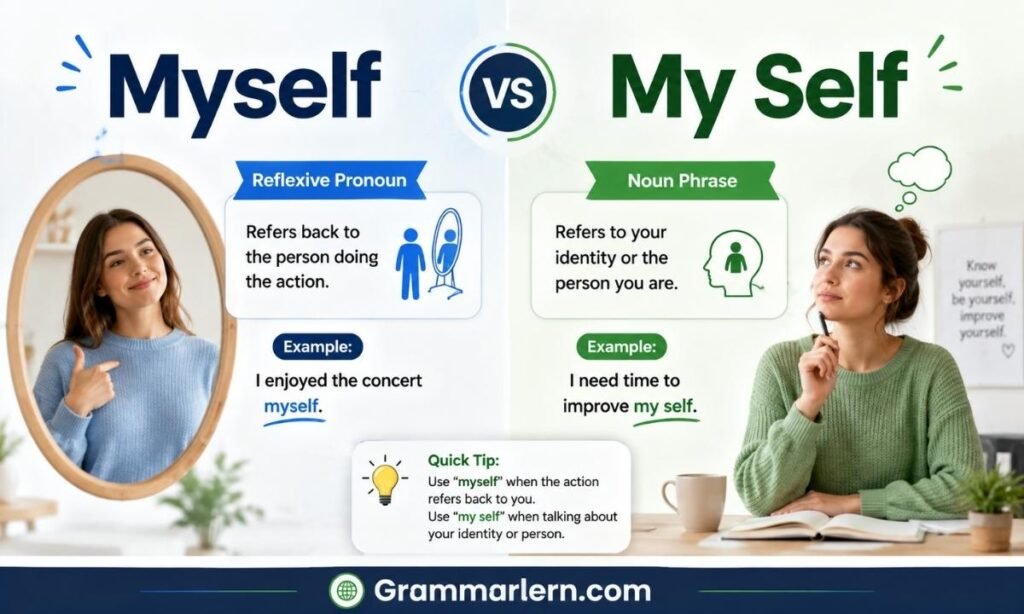
Confused between “myself” and “my self”? You’re not alone. This is one of the most common English mistakes, even among native speakers. The good news is that the difference comes down to just one simple rule.
“Myself” is a reflexive pronoun, used for actions like “I taught myself.” “My self,” written as two words, refers to your identity or inner being, and it shows up mainly in psychology and philosophy. Once you know which one fits your sentence, you will never second-guess it again.
Myself vs My Self: Quick Answer
“Myself” is the standard English word. It is a reflexive or intensive pronoun used in sentences such as “I hurt myself” or “I did it myself.” “My self,” written as two words, is not a pronoun at all. It is a possessive adjective paired with a noun, used mainly in psychology and philosophy to describe identity, as in “I’m reconnecting with my true self.” In everyday and professional writing, “myself” is almost always the correct choice.
Myself vs My Self: What’s the Real Difference?
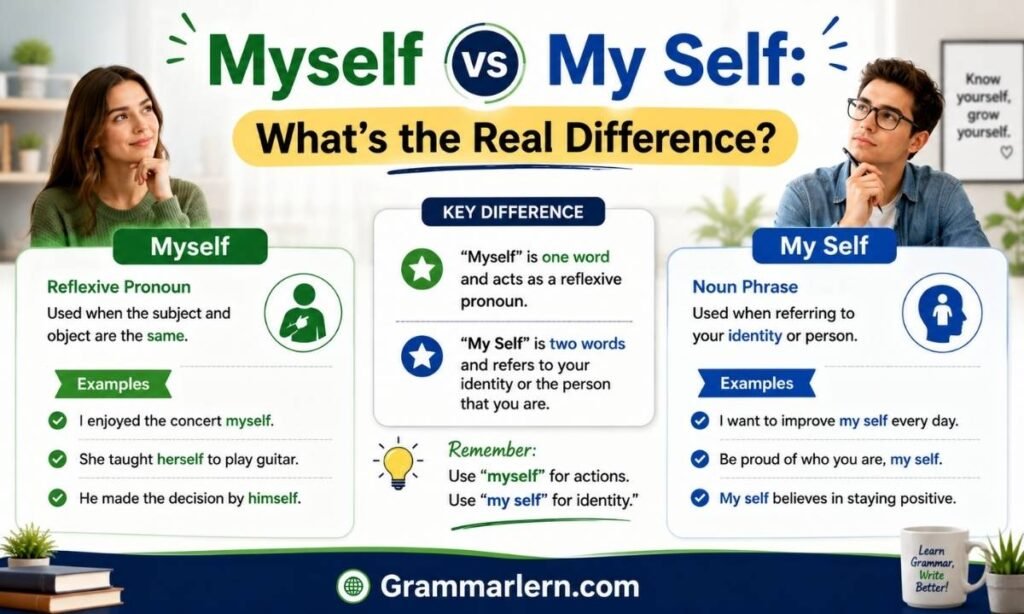
The confusion exists because both forms sound identical when spoken aloud. On paper, though, they belong to completely different parts of speech.
| Feature | Myself | My Self |
| Word count | One word | Two words |
| Part of speech | Reflexive or intensive pronoun | Possessive adjective plus noun |
| Function | Reflects an action back to “I,” or adds emphasis | Refers to identity or inner being |
| Common in | Everyday and formal writing | Psychology, philosophy, reflective writing |
| Example | I taught myself guitar. | I’m learning to accept my self. |
Here’s a quick test: try replacing the phrase with the word “identity.” If the sentence still makes sense, “my self” is correct. If it doesn’t, use “myself.”
What “Myself” Really Means in English
“Myself” is a first person reflexive and intensive pronoun. It belongs to a family of pronouns that includes yourself, himself, herself, itself, ourselves, yourselves, and themselves. Each one pairs with a matching subject and either shows that an action loops back to the same person or adds emphasis to what that person did.
“Myself” as a Reflexive & Intensive Pronoun
As a reflexive pronoun, “myself” is required when the subject and the object of a sentence refer to the same person. As an intensive pronoun, it is optional and simply stresses that the subject acted alone or personally. Both uses are grammatically correct, but they serve different purposes in a sentence.
Two Main Functions of “Myself”
- Reflexive: The action bounces back to the subject. Example: I taught myself to swim.
- Intensive: The word adds emphasis and can be removed without breaking the sentence. Example: I fixed the sink myself.
Also Read this “What Happen” vs “What Happened”: Which One Is Grammatically Correct?
Correct Examples in Everyday Sentences
Reflexive Use
- I taught myself photography.
- I reminded myself to stay calm.
- I blame myself for the delay.
Intensive Use
- I painted the fence myself.
- I heard the news myself.
- I will handle the call myself.
Incorrect Uses of “Myself” (Very Common!)
Many writers use “myself” as a formal-sounding substitute for “me” or “I,” especially in emails. This is called hypercorrection, and it is one of the most common pronoun errors in professional writing.
- Incorrect: Please contact John or myself with questions.
- Correct: Please contact John or me with questions.
- Incorrect: My colleague and myself completed the report.
- Correct: My colleague and I completed the report.
The rule is simple: “myself” can only appear in a sentence that already contains “I” as its subject. It cannot stand in for “me” or “I” on its own.
Understanding “My Self” (Two Separate Words)
Written as two words, “self” stops functioning as part of a pronoun and becomes a standalone noun. In this form, “my” works as a possessive adjective and “self” works exactly like “car” or “opinion” would in “my car” or “my opinion.” That structural shift is the clearest sign you have moved from grammar into identity language.
What “My Self” Actually Means
“My self” refers to a person’s inner identity, consciousness, or true nature, separate from the roles they play day to day. It is a noun phrase, not a pronoun, and in nearly every case it can be swapped for the word “identity” without losing meaning.
Examples
- I’m slowly reconnecting with my self after a difficult year.
- Meditation helps me understand my self more deeply.
- There is a gap between my public self and my private self.
- Therapy taught me to separate my self from my job title.
Where “My Self” Is Commonly Used
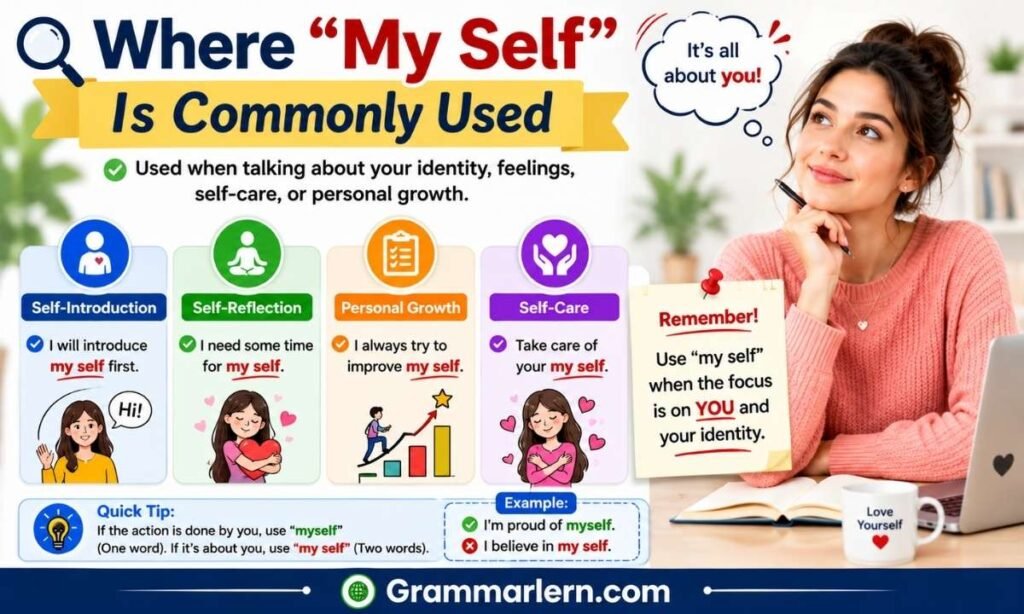
“My self” appears almost exclusively in fields that explore inner experience rather than everyday communication. Outside of these areas, the two-word form is considered nonstandard.
Psychology
Psychologists use terms like self-concept, self-esteem, and self-awareness to describe how a person understands and values their own identity. “My self” fits naturally into this kind of reflective, therapeutic language.
Philosophy
Philosophers have debated the nature of the self for centuries, asking whether it stays constant over time or constantly changes. In this context, “my self” refers to personal identity and consciousness rather than any grammatical function.
Literature
Reflective and literary writing often leans on “my self” to capture inner conflict or personal transformation. Interestingly, “my self” was standard spelling in Early Modern English, including in Shakespeare’s plays, before the two words merged into the single reflexive pronoun we use today.
Why “Myselves” Is Incorrect — Always
Some learners assume “myself” can be pluralized the same way regular nouns are, producing “myselves.” This form does not exist in standard English. Reflexive pronouns have fixed forms, and since “I” is always singular, “myself” has no plural version of its own.
- Incorrect: We introduced myselves to the panel.
- Correct: We introduced ourselves to the panel.
When a group needs a first-person reflexive pronoun, English uses “ourselves,” never “myselves.”
How “Myself” Functions in Grammar
“Myself” attaches to a verb where the subject “I” is either the receiver of the action or the point of emphasis. Its grammatical role depends entirely on context, since the word never changes form between the two uses.
Reflexive Structure: Subject = Object
In reflexive sentences, the subject performs an action that lands back on that same person. The pattern is simple: subject plus verb plus “myself,” as in “I introduced myself to the new manager.”
Intensive Structure: Adding Emphasis
In intensive sentences, “myself” is not grammatically required. It is added purely to stress that the subject acted alone or personally. Removing the word leaves the sentence fully intact, which is the fastest way to spot this use. For example, “I painted the fence myself” and “I painted the fence” both share the same core meaning, but the first version highlights that no one else was involved.
Identity & Philosophy: The Non-Reflexive “Self”
Outside of grammar, “self” stands alone as a noun describing the essence of a person’s identity, separate from any single action they take.
“Self” as a Concept
Psychologists such as Carl Rogers described a gap between the ideal self and the real self, a framework still used in therapy today. In this sense, “self” is not a grammar topic at all. It is a way of naming someone’s inner life, and “my self” is simply the possessive form of that concept.
How Spacing Changes Meaning
A single space transforms “myself” from a grammatical tool into a philosophical subject.
| Sentence | Meaning |
| I love myself. | General self-care or self-acceptance, expressed with a reflexive pronoun. |
| I love my self. | Valuing your inner identity or true nature, expressed with a noun phrase. |
Both versions are grammatically defensible, but the spacing tells the reader exactly which layer of meaning you intend.
Common Errors and How to Avoid Them
Using “Myself” Instead of “Me” or “I”
Writers often reach for “myself” believing it sounds more polite or professional. It does not. If “myself” is not reflexive or emphatic, replace it with “I” or “me” depending on its role in the sentence.
Using “My Self” When “Myself” Is Correct
Splitting the word into two out of habit or autocorrect confusion is a common mistake. If the sentence describes an action rather than identity, keep “myself” as one word.
Adding “Myself” to Sound Formal
Business writers frequently insert “myself” into emails believing it adds polish. Clarity and correct pronoun choice create formality, not an unnecessary swap to “myself.”
Confusing Identity With Grammar
Some writers reach for “my self” when they actually mean a reflexive or emphatic action. Before choosing a form, ask whether the sentence is about doing something or being someone.
“Myself” vs Other Reflexive Pairs (Yourself, Himself & More)
The same rule that applies to “myself” applies across the entire reflexive pronoun family. “Your self,” “him self,” and “her self” are just as nonstandard as “my self” outside of identity-focused writing.
| Reflexive Pronoun | Nonstandard Two-Word Form | Correct Everyday Use |
| Myself | My self | I hurt myself. |
| Yourself | Your self | Take care of yourself. |
| Himself | Him self | He introduced himself. |
| Herself | Her self | She taught herself to code. |
| Themselves | Them selves | They organized themselves. |
If you remember the rule for “myself,” you already know the rule for the rest of this pronoun family.
Quick Decision Guide to Remember the Difference
Ask Yourself: Is It About Grammar or Identity?
If the sentence describes an action performed by and on the subject, use “myself.” If it describes identity, consciousness, or inner experience, “my self” may fit instead.
Fast Test
Remove the word from the sentence. If it still makes sense, “myself” is working as an intensive pronoun. If the sentence needs it to make sense, “myself” is reflexive. If the sentence is about identity rather than action, “my self” is likely correct.
One-Line Rule
Use “myself” for actions. Use “my self” for identity. Never use “myselves” at all.
Also Read this “What Happen” vs “What Happened”: Which One Is Grammatically Correct?
Real-Life Examples & Micro Case Studies
Case Study 1: Email at Work
A project manager writes, “Please reach out to Sarah or myself with any concerns.” Editing it to “Please reach out to Sarah or me” fixes a textbook formality mistake and reads more polished, not less.
Case Study 2: Personal Journal Entry
A journaling client writes, “I need to spend more time with my self this year.” Because the sentence is about inner reflection rather than a physical action, “my self” is the correct, deliberate choice here.
Case Study 3: Classroom Grammar
An English teacher asks students to correct “He and myself finished the project early.” Applying the subject test, students rewrite it as “He and I finished the project early,” reinforcing that “myself” cannot stand in for “I.”
Case Study 4: Meditation Coaching
A mindfulness coach tells a client, “This practice will help you observe your self without judgment,” deliberately using the two-word form to point toward inner identity rather than a specific behavior.
Frequently Asked Questions
What is the difference between “myself” and “my self”?
“Myself” is a reflexive or intensive pronoun used for actions, as in “I hurt myself.” “My self,” written as two words, refers to identity or inner being and is mostly used in psychology and philosophy.
Which is correct, “my self” or “myself”?
“Myself” is correct in almost every everyday and professional sentence. “My self” is only appropriate in reflective or philosophical writing about identity.
Which is correct: “yourself” or “your self”?
“Yourself” is the standard reflexive pronoun, as in “Take care of yourself.” “Your self” follows the same rare identity-only pattern as “my self” and should be avoided in everyday writing.
Which is correct: “by myself” or “by my self”?
“By myself” is correct. It means “alone” or “without help,” as in “I finished the project by myself.” “By my self” is not standard English.
“Proud of myself” or “proud of my self”? Which is right?
“Proud of myself” is correct. This is a reflexive expression describing pride in your own actions or achievements, not a statement about identity.
Is “myself” formal or informal, and when should I avoid it?
“Myself” works in both formal and informal writing when used reflexively or for emphasis. Avoid it only when you are tempted to use it as a substitute for “I” or “me,” such as “contact John or myself.”
Final Thoughts
Getting “myself” and “my self” right comes down to one question: are you describing an action, or are you describing who you are? “Myself” handles the grammar, covering reflexive and emphatic sentences where the subject and object match. “My self” is far rarer and belongs to conversations about identity, consciousness, and personal growth.
Keep this one rule in mind and you will never second-guess yourself in an email, an essay, or a journal entry again. When in doubt, default to “myself,” and save “my self” for the rare moments when you are genuinely writing about your inner world.