

Ever typed “please response to this email” and then paused, unsure if that’s even correct? You’re not alone. This mix-up trips up even confident English speakers every single day.
The confusion happens because both words share the same root and look almost identical, yet play very different grammatical roles in a sentence.
This guide gives you the simple rule to get it right every time, with clear grammar explanations, real examples, and answers to the questions people search for most.
Respond vs. Response: Meaning at a Glance
Here is the short answer:
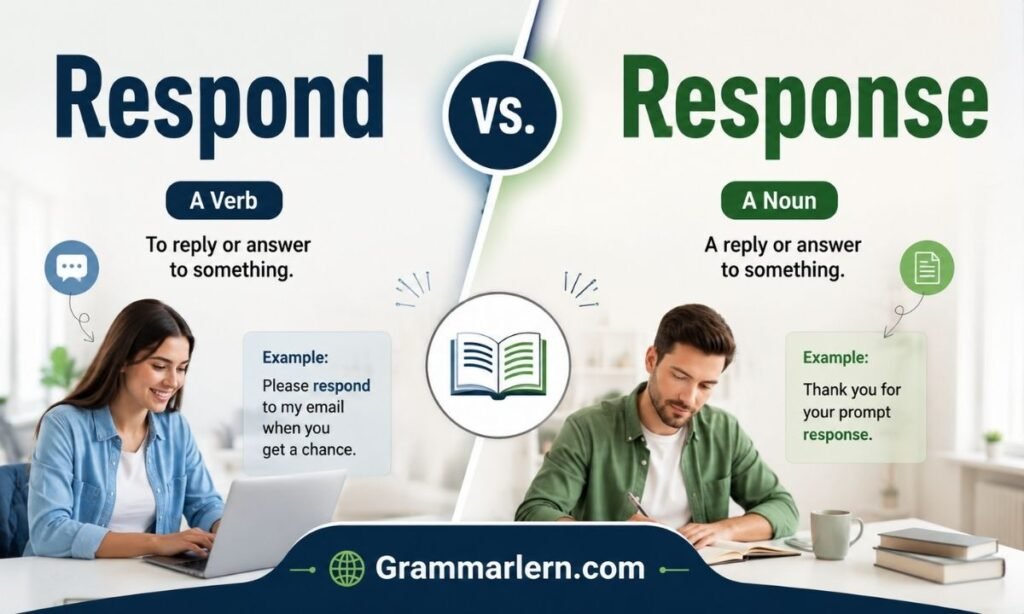
- Respond is a verb. It means to reply, react, or answer.
- Response is a noun. It is the reply, reaction, or answer itself.
- Simple rule: if someone is doing something, use respond. If you are naming a thing, use response.
Example: “I will respond to your message, and I hope you like my response.”
What “Response” Actually Means (Noun)
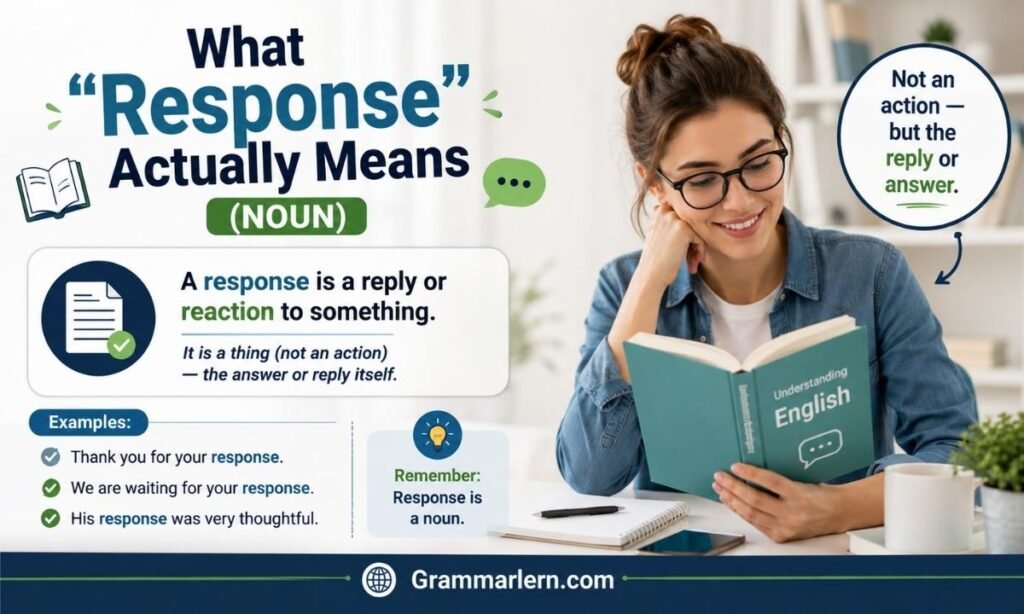
Response is a noun. It names the result of an action, not the action itself, referring to the answer, reaction, or outcome that follows a question, event, or stimulus.
Core Characteristics of “Response”
- It is always a noun, never a verb.
- It often follows articles like a, an, or the.
- It can be modified by adjectives such as quick, positive, or emotional.
- It commonly appears after prepositions, especially “in response to.”
- It can be singular or plural depending on context.
- It is often used as a synonym for reply, answer, feedback, or reaction.
Examples of Correct Usage
- Her response to the news was calm and thoughtful.
- We received a positive response from the client.
- His response surprised the entire team.
Response Plural — Singular vs Plural Usage
Response can be made plural. Use responses for more than one reply or reaction.
- Singular: The survey received one detailed response.
- Plural: The survey received over five hundred responses.
Just add an “s,” like most regular English nouns.
Quick Table: When “Response” Fits
| Situation | Correct Word |
| Naming a reply someone gave | Response |
| Describing a reaction | Response |
| Talking about feedback received | Response |
| Describing the act of replying | Respond, not response |
What “Respond” Actually Means (Verb)
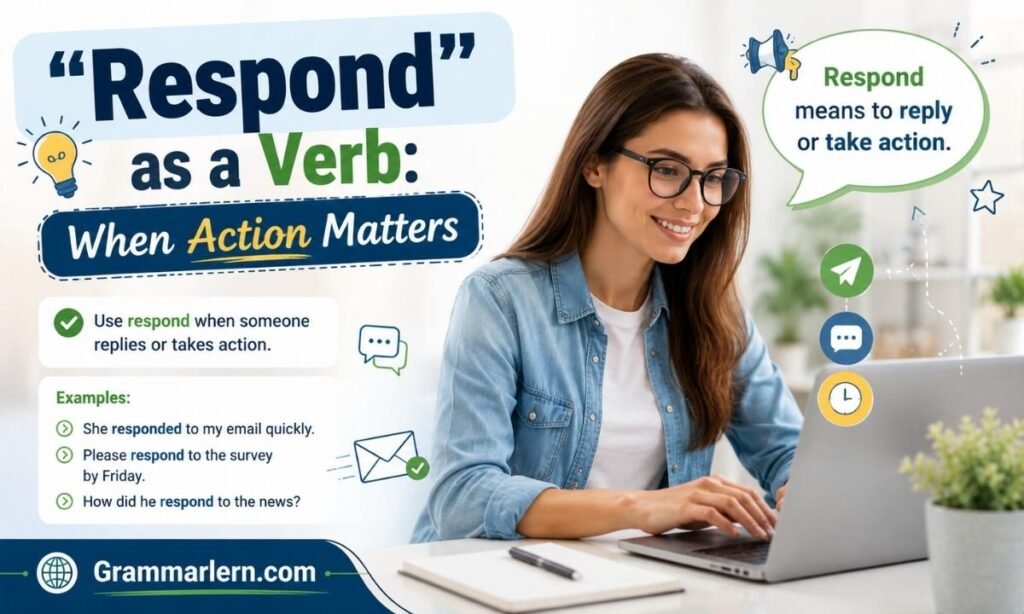
Respond is a verb describing the action of replying, reacting, or answering. Whenever someone is doing something in reply to a message, question, or event, respond is the word you need.
Core Characteristics of “Respond”
- It is always a verb, never a noun.
- It changes form based on tense: respond, responds, responded, responding.
- It is usually followed by the preposition to.
- It can describe verbal, written, emotional, or physical reactions.
- It pairs naturally with adverbs like quickly, calmly, or politely.
- It can also mean to acknowledge, react to, or answer correspondence.
Examples of Correct Usage
- Please respond to this email by Friday.
- She responded calmly to the criticism.
- The patient did not respond to the medication.
Quick Table: When “Respond” Fits
| Situation | Correct Word |
| Someone performing the act of replying | Respond |
| Reacting to an event or comment | Respond |
| Answering a question directly | Respond |
| Naming the reply itself | Response, not respond |
Etymology & Word Origin: Where “Respond” and “Response” Come From
Both words trace back to the Latin verb respondere, meaning to answer, entering English through Old French and Middle English. Over time, respond stayed a verb, and response became a noun, explaining why they look alike but behave differently.
Grammar Essentials: How to Choose the Right One
Choosing correctly becomes easy once you ask one question: is the sentence describing an action, or naming a result?
If someone is doing something, use respond. If you are pointing to what was given or received, use response.
Quick Rule: Action vs. Result
Respond equals action. Response equals result. That distinction solves almost every confusing sentence.
Examples
- I did not respond to the email. (Action)
- I did not get a response. (Result)
- She responded quickly. (Action)
- Her response was quick. (Result)
Sentence Patterns That Require “Respond”
Because respond is a verb, it fits into sentence patterns built around action.
Correct Structures
- Subject plus respond plus to plus object: They did not respond to the request.
- Subject plus will respond: We will respond tomorrow.
- Subject plus respond plus adverb: He responded politely.
Common Mistake
Incorrect: They didn’t response to the request. Correct: They didn’t respond to the request.
Sentence Patterns That Require “Response”
Since response is a noun, it fits sentence patterns built around things, not actions.
Correct Structures
- The plus response plus was plus adjective: The response was overwhelming.
- Adjective plus response: A quick response solved the problem.
- In response to plus noun: In response to the delay, the company issued an apology.
Common Mistake
Incorrect: Please give me a respond. Correct: Please give me a response.
Common Collocations with “Respond” and “Response”
Natural word pairings make your English sound fluent rather than mechanical.
- With respond: respond quickly, respond immediately, respond politely, respond to feedback.
- With response: quick response, positive response, official response, in response to.
“Response” in Real Life: How the Noun Works
Everyday Communication
People use the word response constantly, from texting to business emails to customer service calls. It always refers to something already produced, not something currently being performed.
Thank You for Your Response or Respond?
The correct phrase is “thank you for your response,” since response is the noun modified by the possessive “your.” Respond cannot follow a possessive pronoun.
Visual Guide: How “Response” Works in a Sentence
Response can act as a subject, an object, or the object of a preposition. Recognizing its position makes it easier to use correctly.
Response Placement Table
| Position | Example |
| Subject | The response impressed everyone. |
| Object | We received a fast response. |
| After a preposition | In response to your message, we made changes. |
Results & Reactions: Why “Response” Captures Outcomes
Response is the ideal word for describing feedback, survey answers, emotional reactions, and measurable outcomes. It always represents the result, the reply, or the reaction that happened after an action took place, not the action itself.
Medical, Scientific & Emergency Usage of “Response”
Medical and scientific fields rely on the word response because they focus on outcomes rather than actions.
Why “Response” Matters in Medicine
Doctors and researchers track treatment response, immune response, and reflex response to measure how effective a treatment or stimulus is.
Examples
- The patient showed a strong response to the new treatment.
- Researchers recorded the immune response during the trial.
Case Study: Medical Scenario
A patient begins a new medication for chronic pain. Week one shows no response. Day five brings a partial response. Day ten shows a strong response to a lower dose. In every stage, response describes the outcome of treatment, never the action of taking it.
“Respond” as a Verb: When Action Matters
Everyday Usage
Respond fits naturally into daily conversations, workplace communication, and customer support, describing what someone actively does.
Respond or Response to Email?
Use respond for the action: “I will respond to your email.” Use response for the reply itself: “I received your response.”
Sorry for the Late Response or Respond?
The correct phrase is “sorry for the late response,” since you are apologizing for the delay in the reply itself, which is a noun.
I Will Respond or Response — Which Is Correct?
“I will respond” is correct, since will always precedes a verb. “I will response” is incorrect, as response is a noun.
Nuanced Meanings of “Respond”
Respond is not limited to written or spoken replies. It covers a wide range of reactions.
Emotional Responding
People respond emotionally, such as feeling empathy or excitement.
Intellectual Responding
Respond can mean reasoning through something, such as students responding to a lecture with thoughtful questions.
Behavioral Responding
This refers to observable actions, like applauding after a performance or raising a hand to answer.
Environmental Responding
Living organisms respond to their surroundings, such as plants growing toward sunlight.
Physical Responding
The body physically responds to stimuli like light, touch, and temperature, such as pupils adjusting to brightness.
Interactive Scenarios: When Respond Shows Engagement
Respond signals active participation across settings like customer service, therapy, negotiations, and crisis communication. It measures what someone actually does after receiving information.
Examples from Literature, Media & News
Literature
Writers use these words to shape tone and pacing. A character’s response can reveal emotion, while the act of responding drives the story forward.
News & Journalism
Journalists describe how officials responded to a crisis, and separately, the official response that followed. This distinction keeps reporting precise.
Psychology & Human Behavior
In psychology, both words describe how people react to internal thoughts and external events, whether emotional, cognitive, or physical.
Emotional Contagion: How We Respond to Feelings
People naturally respond to the emotions of those around them, a phenomenon called emotional contagion. Smiling when someone smiles at you is a simple example.
Cognitive Responses in Decision Making
A cognitive response involves reasoning through information before acting, like investors analyzing data before deciding.
Response vs. Feedback vs. Reply — What’s the Difference?
These words are related but not identical. A response simply answers or reacts to something. Feedback includes evaluation or suggestions meant to improve something. A reply is a more casual synonym for response, common in everyday conversation. Knowing this helps you pick the most precise word for the context.
Quick Comparison Table: Respond vs. Response
| Feature | Respond | Response |
| Part of speech | Verb | Noun |
| Meaning | To reply or react | The reply or reaction |
| Focus | Action | Result |
| Example | Please respond soon. | Thank you for your response. |
Common Errors and How to Fix Them
| Incorrect | Correct |
| Please response soon. | Please respond soon. |
| He gave a quick respond. | He gave a quick response. |
| Did they response? | Did they respond? |
| I didn’t get a respond. | I didn’t get a response. |
Practice Section: Test Yourself
Try correcting these before checking the answers.
- She didn’t response to my message.
- We need a respond quickly.
- His respond wasn’t helpful.
- They won’t response until tomorrow.
Answers: 1. respond, 2. response, 3. response, 4. respond
Frequently Asked Questions
What is the main difference between respond and response?
Respond is a verb describing the action of replying or reacting. Response is a noun naming the reply or reaction itself.
How do you use “response” in a sentence?
Use response as a noun, usually after an article, adjective, or preposition, such as “Her response was thoughtful” or “We are waiting for a response.”
Is it correct to say “waiting for your response” or “waiting for your respond”?
“Waiting for your response” is correct, since response is a noun and can follow the possessive “your.”
Should I use “respond” or “response” in casual chat and texting?
The same rule applies in texting as in formal writing. Use respond for the act of replying, and response for the reply itself.
Is “respond back” correct English?
No. “Respond back” is redundant, since respond already implies replying back. Simply say “respond.”
Can “response” be plural?
Yes. The plural form is responses, used for more than one reply, such as “The survey received hundreds of responses.”
Final Thoughts
That is the simple rule to get it right: respond is an action, response is a result. Once this clicks, the mix-up disappears for good, whether you are writing a professional email or simply replying to a friend.
Keep the rule in mind: you respond to something, and what you give back is a response. With a little practice, choosing the correct word will feel completely natural.