

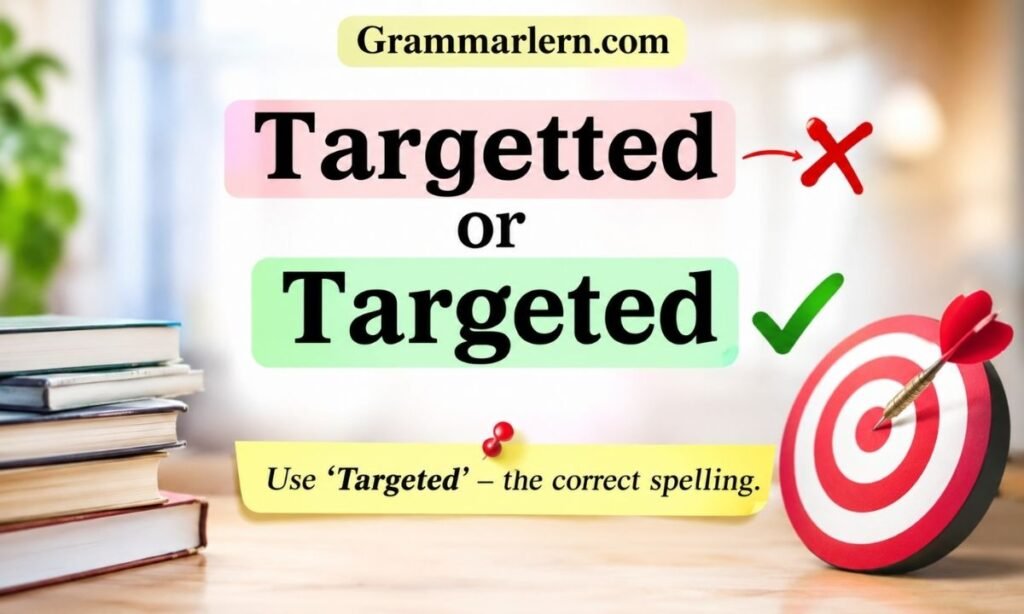
You typed targetted, then paused. Something felt off. This spelling mix-up trips up even confident writers, and you’re far from the only one searching for the answer.
Here’s the quick truth: “targeted” is the correct spelling, not targetted. This rule stays the same in both American and British English, with no regional exceptions to remember. In this guide, you’ll learn exactly why the extra “t” is wrong, and how to never second-guess it again.
Quick Answer: Is It “Targeted” or “Targetted”?
Targeted is the correct spelling. It is the past tense and past participle of the verb “target,” and every major dictionary recognizes it as the standard form.
Targetted is a common misspelling. It appears often in casual writing, but no dictionary or style guide treats it as acceptable in formal or professional content.
If you remember nothing else from this article, remember this: one T, not two.
What Does “Targeted” Mean?
“Targeted” describes something aimed at a specific person, group, or goal. It shows intention, precision, and focus rather than a general or random effort.
The word works in two ways. As a verb, it describes an action: “The campaign targeted new customers.” As an adjective, it describes a quality: “a targeted approach.”
You’ll see it constantly in marketing, healthcare, education, and business, since all of these fields rely on precise, focused efforts rather than broad, unfocused ones.
Why Is “Targetted” Considered Incorrect?
The confusion makes sense once you understand where it comes from. English does double the final consonant in many verbs before adding “-ed,” so writers naturally assume “target” should follow the same pattern.
Words like “stop,” “plan,” and “admit” double their last letter: stopped, planned, admitted. Seeing this pattern repeatedly trains your brain to expect it everywhere, including in words where it doesn’t belong.
“Target” simply isn’t one of those words. The doubling rule depends on where the stress falls in a word, and “target” breaks the pattern that “stop” and “admit” follow.
The Spelling Rule Behind “Targeted”
English grammar has a specific rule for when to double a final consonant before adding “-ed” or “-ing.” The rule applies when the last syllable of a word is stressed and ends in a single consonant after a single vowel.
Say the word “target” out loud. The stress lands on the first syllable: TAR-get, not tar-GET. Because the stressed syllable isn’t the final one, the consonant doesn’t double.
Compare that to a word like “admit,” where the stress falls on the second syllable: ad-MIT. That stress pattern is exactly why “admit” becomes “admitted,” while “target” becomes “targeted.”
Exceptions to the Doubling Rule
Not every word follows a clean pattern, and a few common ones cause extra confusion:
- Visit and open behave just like “target.” Both have first-syllable stress, so they become “visited” and “opened” without doubling.
- Prefer and occur follow the opposite pattern. Both stress the final syllable, so they become “preferred” and “occurred.”
- Focus is a genuine gray area. Both “focused” and “focussed” appear in dictionaries, though “focused” is far more common today.
Once you connect the rule to stress rather than memorizing word lists, spelling decisions like this become much easier.
Targeted vs Targetted: Quick Comparison Table
| Feature | Targeted | Targetted |
| Correct spelling | Yes | No |
| Recognized in dictionaries | Yes | No |
| Accepted in formal writing | Yes | No |
| Used in American English | Yes | No |
| Used in British English | Yes | No |
The takeaway is simple: no matter your audience or writing style, “targeted” is always the safer, correct choice.
American English vs British English: Does It Change?
Some word pairs genuinely differ between American and British spelling, like “color” versus “colour” or “traveling” versus “travelling.” This isn’t one of them.
Both American and British English use “targeted” and “targeting.” Neither region accepts “targetted” or “targetting” as a standard spelling, even though the mistake shows up in informal writing on both sides of the Atlantic.
If you’re writing for a global audience, you can use “targeted” without worrying about adjusting it for a specific region.
Targeting vs Targetting: Which Spelling Is Right?
The same rule that governs “targeted” applies to its present participle form. “Targeting” is correct, and “targetting” is not.
Writers often assume “targeting” should mirror “getting,” since both end in the same letters. But “get” and “target” carry different stress patterns, so the doubling rule that applies to “get” doesn’t carry over to “target.”
Keep both forms locked in together: target becomes targeted in the past tense, and targeting in the present participle. Neither one doubles the final T.
How Do You Pronounce “Targeted”?
“Targeted” is pronounced TAR-guh-tid, with three syllables and the stress firmly on the first one. In phonetic notation, it’s written as /ˈtɑːr.ɡɪ.tɪd/.
That first-syllable stress is exactly why the spelling rule works the way it does. Say the word slowly, and you’ll notice your voice naturally emphasizes “TAR” while “geted” comes out lighter and faster.
Practicing the pronunciation out loud can actually help you remember the spelling, since the light, unstressed ending doesn’t invite an extra consonant.
Common Mistakes to Avoid When Spelling “Targeted”
A few patterns explain most of the errors writers make with this word.
Assuming every “-et” verb doubles its T. Some do, like “regretted,” but “target” isn’t one of them.
- Incorrect: targetted campaign
- Correct: targeted campaign
Getting misled by similar-looking words. Words like “format” and “regret” do double their consonant, which makes “targetted” look more plausible than it actually is.
Trusting spellcheck blindly. Not every tool catches this error consistently, so it’s worth knowing the rule yourself rather than relying entirely on software.
Also Read This Openned or Opened? The Correct Spelling & Simple Rule
“Targeted” in a Sentence: Real Examples
Seeing the word in different contexts helps the correct spelling stick.
- The teacher designed a targeted lesson plan for struggling students.
- Our team launched a targeted advertising campaign last quarter.
- The clinic offers targeted therapy for specific conditions.
- This scholarship is targeted at first-generation college students.
- The investigation was targeted at a single suspect from the start.
- Her feedback felt targeted and genuinely useful, not generic.
Notice how the word consistently signals precision, whether the sentence is about marketing, education, healthcare, or everyday communication.
Synonyms of “Targeted” You Can Use Instead
Varying your word choice keeps writing fresh and can also help with natural keyword variation. Common alternatives include:
- Focused
- Directed
- Aimed
- Intended
- Customized
- Tailored
- Specialized
For example, instead of writing “the ad was targeted at teens,” you could write “the ad was tailored for teens” without losing the original meaning.
When Should You Use “Targeted” in Your Writing?
Reach for “targeted” whenever you want to highlight precision, intention, or a specific focus rather than a general effort.
You’ll see it fit naturally into contexts like:
- Marketing: targeted advertising, targeted outreach
- Education: targeted instruction, targeted support
- Healthcare: targeted therapy, targeted treatment
- Business: targeted strategy, targeted growth
Any time something is designed with a specific audience or goal in mind, “targeted” is the word that captures it best.
A Simple Memory Trick to Never Misspell It Again
Here’s an easy way to lock this in permanently: you aim at a target, not a targett. Since the base word ends in a single T, the past tense form keeps that same single T.
You can also think of it as a short formula: target + ed = targeted, with no doubling required. Whenever you hesitate while typing, running through that formula in your head takes only a second and settles the question for good.
Frequently Asked Questions
Is “targetted” spelled correctly in the UK?
No. British English follows the same rule as American English here. The correct spelling is “targeted,” and “targetted” is considered a misspelling in the UK as well.
Is “targeted” a real word?
Yes. “Targeted” is a real, dictionary-recognized word. It functions as both the past tense of “target” and as an adjective describing something aimed at a specific goal or audience.
How do you spell “target”?
“Target” is spelled with a single T at the end: T-A-R-G-E-T. It stays this way as a base word, a noun, and a verb.
Why do people write “targetted” instead of “targeted”?
Many writers assume the final consonant should double before adding “-ed,” since this happens in words like “stop” and “plan.” However, “target” doesn’t follow that pattern because its stress falls on the first syllable.
Is “targeting” spelled with one T or two?
One T. The correct spelling is “targeting,” not “targetting.” The same stress-based rule that applies to “targeted” applies here too.
Can “targeted” be used in formal or professional writing?
Yes. “Targeted” is fully accepted in academic, business, and professional writing. It’s the standard spelling recommended by dictionaries and style guides worldwide.
Final Thoughts
By now, the answer is clear: “targeted” is the correct spelling, and “targetted” is not, regardless of whether you’re writing in American or British English. The rule comes down to one simple fact: the stress in “target” falls on the first syllable, so the final consonant never doubles.
Next time you pause before typing this word, remember the pattern: target plus “-ed” equals targeted, one T and nothing more. Keep that rule in mind, and you’ll write with confidence every single time.