

Ever stopped mid-sentence wondering whether it’s “which of the following is” or “which of the following are”? You’re not alone — this tiny phrase confuses millions of English learners and professionals daily.
“Which of the following” introduces a list of choices in exams, quizzes, and surveys. The confusion usually comes down to verb agreement and the common mistake of saying “which of the followings.” This guide covers the exact rule, real examples, and common mistakes to fix it for good.
Quick answer
“Which of the following” is the only correct form — “which of the followings” is not standard English. Use “is” when the expected answer is singular, and “are” when it’s plural. The word “following” acts like a fixed noun phrase and never changes form, no matter how many options come after it.
What Does “Which of the Following” Mean?

“Which of the following” is a question phrase that asks someone to pick the correct answer, option, or statement from a list that comes right after it. You’ll see it constantly in multiple-choice tests, surveys, quizzes, and academic papers.
For example:
Which of the following is a fruit? A) Carrot B) Potato C) Apple D) Onion
Here, “the following” simply points to the list of options (A–D), and “which” asks the reader to choose from that list. It’s a compact way of saying “look at the choices below and pick one.”
Also Read This Also Read This Plural of Chief: Is It Chiefs or Chieves? (Answered)
How to Use “Which of the Following” Correctly
The phrase almost always sits at the start of a sentence, followed directly by a verb — usually “is” or “are” — and then the topic being asked about. It works equally well in direct questions and in indirect or embedded questions inside a longer sentence.
For example:
- Direct: Which of the following is a planet?
- Embedded: Please indicate which of the following best describes your experience.
Note that in an embedded question like the second example, no question mark is needed, since the sentence itself isn’t a direct question.
Using a Colon vs Inline Format
When you’re introducing a list of options underneath the question, add a colon at the end:
Which of the following are primary colors: a) Red b) Yellow c) Green d) Purple
When the question flows in a single line without a separate list, skip the colon:
Which of the following cities is the capital of France, Paris or Lyon?
This small formatting choice makes a real difference in readability, especially in surveys and test documents.
Is It “Which of the Following Is” or “Are”?
This is the single most common grammar question people have about this phrase — and the rule is refreshingly simple. The verb doesn’t agree with “following” itself; it agrees with the word or idea that comes right after it.
Use “is” when you’re expecting one specific answer:
Which of the following is a mammal?
Use “are” when the expected answer is plural or when you’re asking about multiple items:
Which of the following are renewable energy sources?
A quick trick: look at the noun immediately after “is” or “are.” Singular noun → “is.” Plural noun → “are.” Once you apply this test, the confusion disappears almost instantly.
Which of the Following Is Not
The negative form — “which of the following is not” — shows up constantly in standardized tests and academic assessments. It asks the reader to spot the one option that doesn’t belong with the rest.
Examples:
- Which of the following is not a prime number?
- Which of the following is not a function of the kidney?
- Which of the following is not an example of renewable energy?
Because negative questions are easy to misread, many style guides recommend bolding or capitalizing the word “NOT” so readers don’t accidentally answer the opposite question.
“Which of the Following” vs “Which of the Followings”
Only one of these is grammatically correct: “which of the following.” “Which of the followings” is a common mistake, especially among non-native speakers, but it doesn’t hold up under standard English grammar.
Here’s why: “following” in this phrase functions as an adjective used substantively — meaning it behaves like a noun, but without taking a plural “-s” ending, no matter how many items it refers to. Compare this to a real noun like “book,” which does pluralize (“which of the books”). “Following” simply doesn’t work that way.
Interestingly, “followings” does exist as a word — but it means something completely different, referring to groups of supporters or fans (e.g., “the celebrity has huge followings on social media”). That meaning has nothing to do with answer choices, which is exactly why the mix-up causes so much confusion.
| Form | Correct? | Meaning |
| Which of the following | ✅ Yes | Introduces a list of answer choices |
| Which of the followings | ❌ No | Not standard grammar in this context |
| Followings (as a noun) | ✅ Yes (different use) | Groups of fans or supporters |
“Which One of the Following” — Is There a Difference?
Sometimes writers add the word “one,” asking “which one of the following” instead of just “which of the following.” Both phrases are grammatically correct, but they carry a subtle difference in emphasis.
“Which of the following” leaves the number of correct answers open — it could be one option or several, depending on context. “Which one of the following,” on the other hand, explicitly signals that only a single answer is expected. This distinction matters most in test design: if a question allows multiple correct answers, avoid “which one,” since it misleads test-takers into picking just a single option.
Examples of “Which of the Following” in Sentences
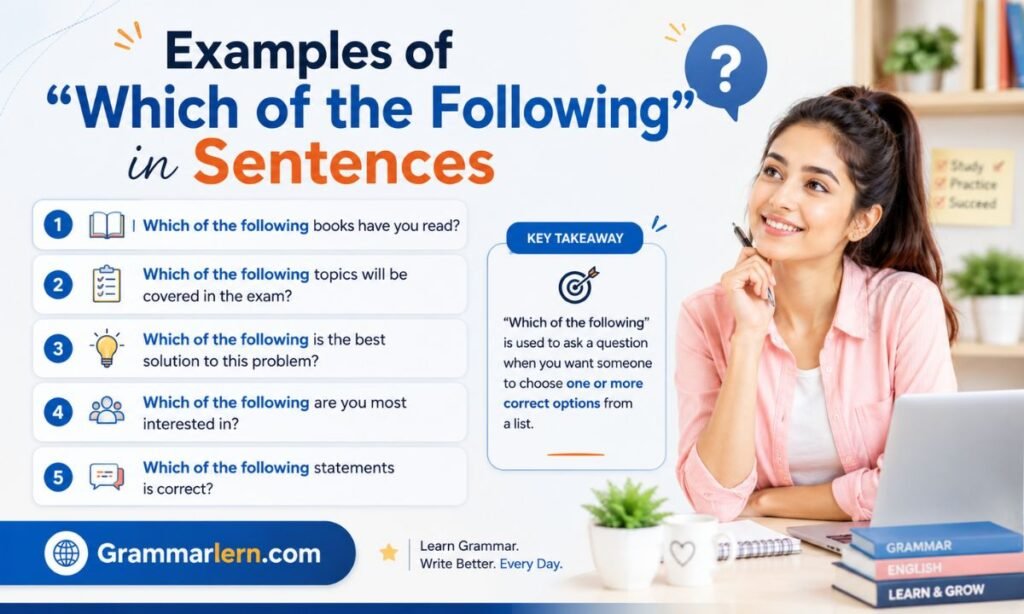
Seeing the phrase in different real-world contexts makes the grammar rule much easier to remember.
Academic Example
Which of the following best explains the process of photosynthesis?
Science Example
Which of the following are considered greenhouse gases?
Grammar Example
Which of the following sentences is grammatically correct?
Survey Example
Which of the following features do you use most often in our app?
Professional Example
Which of the following strategies would improve team productivity?
Also Read This Plural of Chief: Is It Chiefs or Chieves? (Answered)
Why Multiple-Choice Questions Use This Phrase
Teachers, test creators, and researchers rely on “which of the following” because it instantly signals that the answer is contained within the listed options — nothing outside the list is relevant. This keeps questions focused and reduces ambiguity for the reader.
The phrase also improves scoring consistency. When every question follows the same recognizable structure, test-takers spend less time figuring out what’s being asked and more time actually answering. That’s why it’s the backbone of standardized tests, classroom quizzes, market research surveys, and certification exams alike.
Common Grammar Mistakes With “Which of the Following”
A few small errors show up again and again, even among confident writers:
- Wrong pluralization: Which of the followings is correct? → Which of the following is correct?
- Dropped article: Which of following options apply? → Which of the following options apply?
- Verb mismatch: Which of the following books are your favorite? → Which of the following books is your favorite? (if only one book is expected)
- Unnecessary question mark on embedded questions: Tell me which of the following is correct? → Tell me which of the following is correct.
- Double negatives: Which of the following is not an incorrect answer? → Which of the following is the correct answer?
Quick Grammar Rules to Remember
Rule 1: Use “following,” not “followings”
The phrase never pluralizes, regardless of how many options follow it.
Rule 2: Match the verb with the answer
Use “is” for a singular expected answer and “are” for a plural one — the verb agrees with what comes after it, not with “following” itself.
Rule 3: Keep the sentence clear
Avoid overly long or complicated phrasing. A good question should be understandable on its own, before the reader even looks at the choices.
Rule 4: Use the phrase for selection questions
Reserve “which of the following” for questions where the reader must choose from a defined, visible list — not for open-ended questions.
“Which of the Following” in Academic Writing
In research papers, dissertations, and formal assessments, “which of the following” plays a precise structural role: it presents variables, survey items, or evaluation criteria in a neutral, objective tone.
For example, a research survey might ask: “Participants were asked to identify which of the following barriers most affected their study habits.” This phrasing keeps academic writing consistent, professional, and easy to standardize across large groups of respondents.
How AI and Search Engines Understand This Phrase
Search engines treat “which of the following” as a strong signal of educational, question-based search intent. That’s why pages built around this phrase often appear in featured snippets, “People Also Ask” boxes, and quick-answer panels.
AI assistants and chatbots interpret the phrase similarly — as a cue that the user wants a direct comparison or selection between listed options, rather than an open-ended explanation. For content to perform well with both traditional search engines and AI-powered answer tools, it helps to lead with a clear, concise answer before expanding into detail — exactly the structure this article follows.
Alternative Phrases You Can Use Instead
Repeating “which of the following” too often can make writing feel robotic. These alternatives carry a similar meaning with a different tone:
- Which one of these
- Choose the correct answer
- Select the correct option
- Which statement is true
- Which option best describes
Formal writing and testing environments usually call for the original phrase, while blog posts, casual surveys, and conversational content can benefit from these lighter variations.
Difference Between “Which of the Following” and Similar Phrases
“Which of the Following”
Formal and precise — best suited for exams, academic writing, and professional documentation.
“Which of These”
A shorter, more conversational version, often used in casual speech or informal writing.
“Choose the Correct Answer”
An instruction rather than a question — useful when you want to direct the reader instead of asking them something.
“Select One”
Common in digital forms and surveys, especially when only a single response is allowed.
Tips for Writing Better Multiple-Choice Questions
Keep options clear
Avoid long, wordy, or ambiguous answer choices that slow the reader down.
Use consistent grammar
Every option should follow the same grammatical pattern as the others — mixing structures creates unintended clues.
Avoid grammar clues
Don’t let the correct answer stand out simply because it “sounds” more grammatically correct than the wrong ones.
Use simple language
Readers process questions faster when the vocabulary stays approachable and jargon-free.
Remove unnecessary words
Trim anything that doesn’t add meaning — shorter questions are easier to read and answer accurately.
Frequently Asked Questions
What does “which of the following” mean?
It’s a phrase used to introduce a question that asks the reader to choose the correct answer or option from a list that follows.
Is “which of the following” singular or plural?
It can pair with either “is” or “are,” depending on whether the expected answer is singular or plural — the phrase itself never changes form.
Can you say “which of the followings”?
No. Standard English grammar only allows “which of the following.” “Followings” is a separate word that refers to groups of fans or supporters, not answer choices.
What’s the difference between “which of the following” and “which one of the following”?
“Which of the following” leaves the number of correct answers open, while “which one of the following” specifically asks for a single answer.
Why do exams and quizzes use this phrase so often?
It clearly signals that the correct answer is contained within the listed options, which keeps questions focused and easy to follow.
How do I know whether to use “is” or “are” after this phrase?
Check the noun that comes right after the verb: singular noun takes “is,” plural noun takes “are.”
Is “which of the following” too formal for everyday writing?
It works best in academic, professional, and testing contexts. For casual writing, alternatives like “which of these” or “choose the correct answer” often sound more natural.
Final Thoughts
Getting “which of the following” right comes down to two things: never pluralize it into “followings,” and always match “is” or “are” to the answer that follows.
This small phrase carries real weight in exams, surveys, and professional writing — using it correctly instantly makes your questions look more polished and credible.
Next time you write a quiz or survey question, you won’t have to pause and guess — you’ll already know the correct form.