

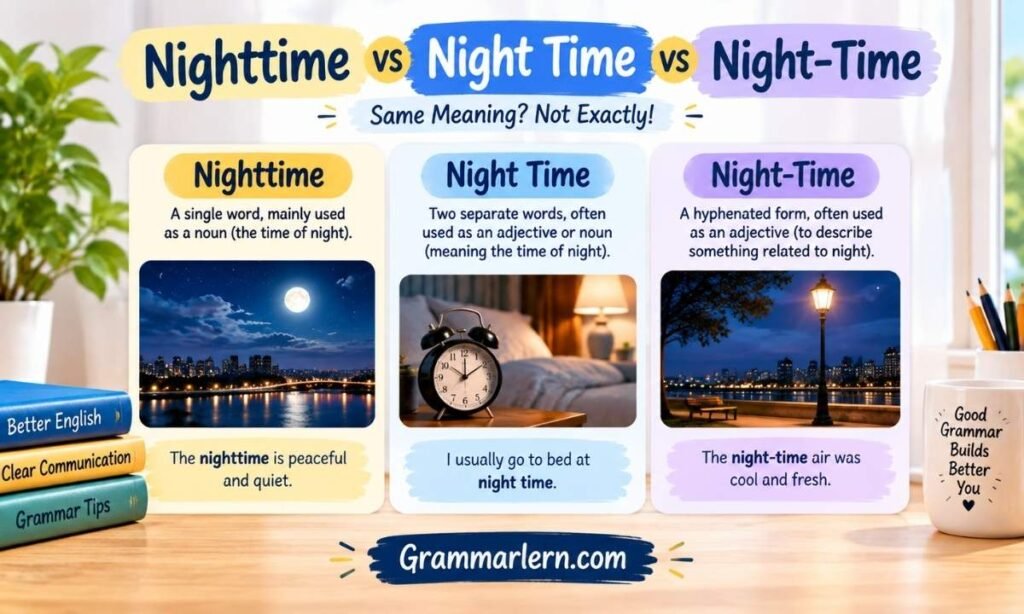
Nighttime, night time, or night-time: which one is correct? Nighttime (one word) is the standard spelling in modern American English. Night-time (hyphenated) is the common British variant.
Night time (two words) is older and used only in special cases. All three forms mean the same thing: the hours between sunset and sunrise. Here, you’ll learn the correct spelling, style guide rules, and simple examples to use each form with confidence.
🌌 Nighttime or Night Time: Which One Is Correct?
Nighttime (one word) is correct in American English. Night-time is the British form, and night time is rare. The nighttime vs night time choice is about spelling and style, not meaning.
The Correct Modern Standard
Merriam-Webster lists nighttime as one word, meaning the period between dusk and dawn. In any nighttime vs night time search, this is the answer most readers need.
Why the Confusion Happens
Older texts used two words or a hyphen, and spell check rarely flags “night time.” That is why the nighttime vs night time question keeps returning.
Nighttime vs Night Time Meaning: What Does Nighttime Mean?
Nighttime means the hours of darkness between sunset and sunrise. The nighttime vs night time meaning is identical, so only the spelling changes.
Nighttime vs Night Time vs Night-Time at a Glance
| Form | Where Used | Example |
| nighttime | American English | Nighttime driving is tiring. |
| night-time | British English | Night-time traffic was light. |
| night time | Rare, older use | Pick a night time for the call. |
Is “Night-Time” With a Hyphen Correct?
Yes, night-time is the standard British spelling. The Oxford Advanced Learner’s Dictionary lists it with a hyphen. In a nighttime vs night time decision, the hyphen is regional, not an error.
Understanding the Word Structure
English builds compounds as open words (high school), hyphenated words (mother-in-law), or closed words (daytime). Many compounds close over time, which explains the nighttime vs night time debate.
Compound Nouns
Daytime, bedtime, and lunchtime are closed compound nouns. Nighttime follows the same pattern.
Two-Word Phrases That Stay Separate
High school, real estate, and night shift stay open. Night time appears as two words only in rare phrases like “pick a night time.”
Historical Development
Merriam-Webster dates nighttime to the 14th century, when spelling was less fixed.
Early Use: “Night Time”
Early writers often used two words or a hyphen. Old books and reprinted texts still show those forms.
The Transition from “Night Time” to “Nighttime”
Today and tonight were once written to-day and to-night. Nighttime closed in the same way in American English.
Dictionaries and Style Guides
Dictionaries and style guides settle the nighttime vs night time question.
Major Dictionary Positions (Summarized)
- Merriam-Webster: nighttime, one word, often used before another noun.
- Oxford Advanced Learner’s Dictionary: night-time, hyphenated, meaning the time when it is dark.
Oxford Dictionary: Nighttime or Night Time?
Oxford titles its entry night-time, not night time. So in an Oxford context, the answer leans hyphenated.
Editorial and Publishing Standards
Publishers follow their own house style. Without one, choose a form for your audience and apply the nighttime vs night time rule consistently.
Modern Usage and Language Trends

In the nighttime vs night time debate today, all three forms are understood, but readers expect different ones.
Why the One-Word Form Became Dominant
In the nighttime vs night time debate, the one-word form is shorter, easier to read, and matches daytime and bedtime.
What Writers and Editors Actually Use Today
American editors usually choose nighttime, while British editors more often choose night-time. Consistency matters most in nighttime vs night time choices.
Also Read This Next Friday vs This Friday: The Exact Difference
American, British, and International English
American English leans toward nighttime, and British English leans toward night-time. Other varieties follow one of these patterns, so match your audience.
UK Spelling: Which Form Do British Writers Prefer?
British writers usually prefer night-time, though nighttime is understood. For a UK site, the nighttime vs night time answer is the hyphenated form.
Grammar Guide: How to Use “Nighttime” Correctly
The grammar of nighttime vs night time is simple. Nighttime can name a period, or it can describe another noun.
Nighttime as a Noun
As a noun, it names the period from dusk to dawn: Nighttime is quiet in the countryside.
Nighttime as an Adjectival Noun
It often modifies another noun, as in nighttime routine or nighttime driving. No hyphen is needed.
Prepositions With Nighttime: At, During, or In?
All three work: during the nighttime, in the nighttime, and at nighttime. At night is usually more natural.
Nighttime vs Night: What’s the Difference?
Night is broader and can mean a single evening. Nighttime means the general period of darkness.
Examples of “Nighttime” in Real Writing
Everyday Conversation
- My nighttime routine stays simple.
- Nighttime driving feels tiring after work.
Books and Literature
A nighttime hush settled over the village, and even the river seemed to whisper.
Professional Writing
- The study measured nighttime noise levels near the airport.
- The clinic offers nighttime appointments for shift workers.
Practical Usage Table
Use this nighttime vs night time table as a quick reference.
| Situation | Preferred Form |
| American audience or web content | nighttime |
| British audience | night-time |
| Rare time-slot meaning | night time |
| A required style guide | Follow the guide |
Common Nighttime vs Night Time Mistakes
Mixing Forms in the Same Article
Pick one form and use it in headings, captions, and text.
Misspelling It as “Nightime”
Nightime is a typo. Keep both Ts: night + time = nighttime.
Using “Night Time” or “Night-Time” in the Wrong Context
In any nighttime vs night time choice, match the form to your audience and style guide.
Easy Ways to Remember the Correct Spelling
- Think of daytime. Write nighttime the same way.
- Count the Ts. Night and time each keep theirs.
- Match your audience. Use nighttime for the US and night-time for the UK.
Synonyms for Nighttime
Close alternatives include after dark, night hours, hours of darkness, and the adjective nocturnal.
Frequently Asked Questions
Which is correct, nighttime or night time?
Nighttime is correct in American English. Night-time is the British form, and night time is rare. All three share one meaning.
Is night-time with a hyphen also correct?
Yes. It is standard in British English and is listed by the Oxford Advanced Learner’s Dictionary.
Does nighttime have two Ts?
Yes. It joins night and time, so it has two Ts in a row. Nightime is a misspelling.
What is the difference between “night” and “nighttime”?
Night can mean a single evening or event, such as last night. Nighttime means the general period of darkness.
Is 7 PM evening or night?
7 PM is usually evening. It counts as night once it is fully dark, which depends on the season and location.
Is nighttime a noun or an adjective?
It is mainly a noun, but it often modifies another noun, as in nighttime routine.
Final Thoughts
The nighttime vs night time question is about spelling and audience, not meaning. Nighttime is standard in American English, and night-time is the British form.
Choose the form your readers expect and keep it consistent. Now you have everything you need to write it with confidence.