

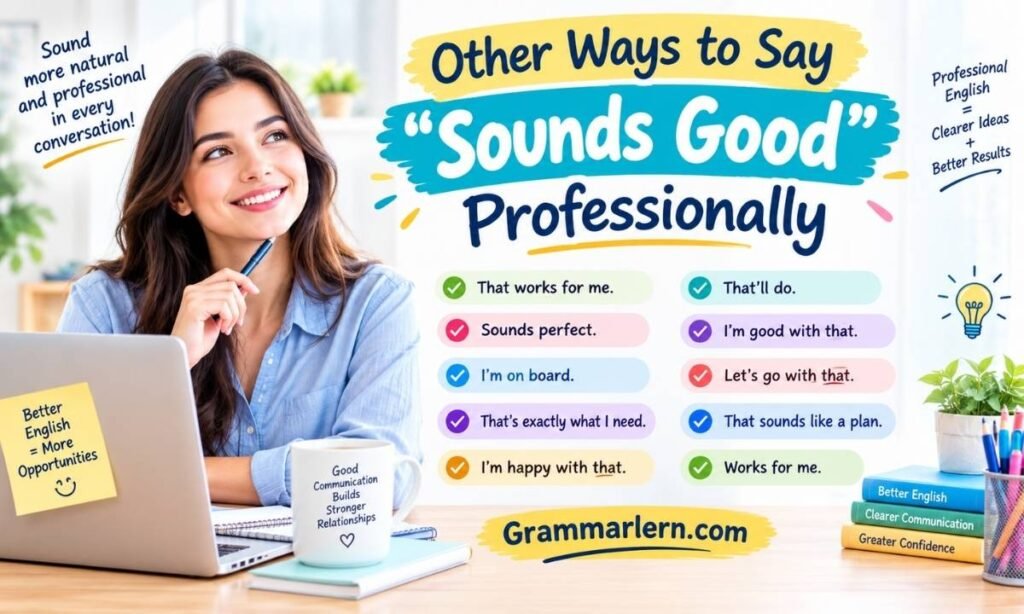
“Sounds good” is easy to say, but it gets repetitive fast. The right alternative makes you sound more polished and professional. It also helps you match the tone of any conversation.
This guide breaks down 15+ professional ways to say “sounds good.” Each phrase comes with real examples and the best situation to use it. Use this list to reply with confidence in every email, meeting, or message.
What Does “Sounds Good” Mean?
“Sounds good” is a short response used to show agreement, approval, or acceptance of an idea, plan, or suggestion. It’s one of the most common ways people confirm they’re okay with something in both casual and professional settings.
Simple Definition
In plain terms, “sounds good” means:
I agree with this, and I’m okay moving forward with it.
It’s a quick, low-effort way to signal approval without going into detail.
Grammar Explanation
“Sounds good” is an informal response phrase. It usually follows a statement, suggestion, or proposal rather than standing as its own sentence.
Example: Let’s push the deadline to Monday. Sounds good.
Here, “sounds” acts as a linking verb (similar to “seems” or “appears”), connecting the idea back to the speaker’s impression of it. Because it’s a fragment rather than a full sentence, it naturally reads as casual which is exactly why professional alternatives exist for more formal settings.
When to Use “Sounds Good”
“Sounds good” works well in many day-to-day situations, but knowing exactly when it fits and when it doesn’t helps you sound more intentional in your replies.
Common Contexts
You’ll typically hear or use “sounds good” when responding to:
- A proposed meeting time or schedule change
- A project plan or next step
- A casual suggestion from a coworker or friend
- A quick confirmation in chat or text
Examples
Let’s review the numbers tomorrow morning. Sounds good.
I’ll send the draft by end of day. Sounds good, thanks.
We can push this to next sprint. Sounds good to me.
These examples show how flexible the phrase is it fits scheduling, task confirmation, and general agreement equally well.
Is It Professional or Polite to Say “Sounds Good”?
Yes “sounds good” is generally polite and acceptable in most workplace settings, especially in emails between coworkers, Slack messages, or informal check-ins. It’s friendly without being disrespectful, and most people won’t think twice about receiving it.
That said, context matters. In formal emails, client communication, or messages to senior leadership, “sounds good” can come across as too casual. In those cases, swapping it for something like “That works for me” or “I’m happy to proceed” keeps the same meaning while sounding more intentional and polished.
A simple rule: if the message opens with “Hi,” “sounds good” usually fits fine. If it opens with “Dear,” a more formal alternative is the safer choice.
Pros and Cons of Using “Sounds Good”
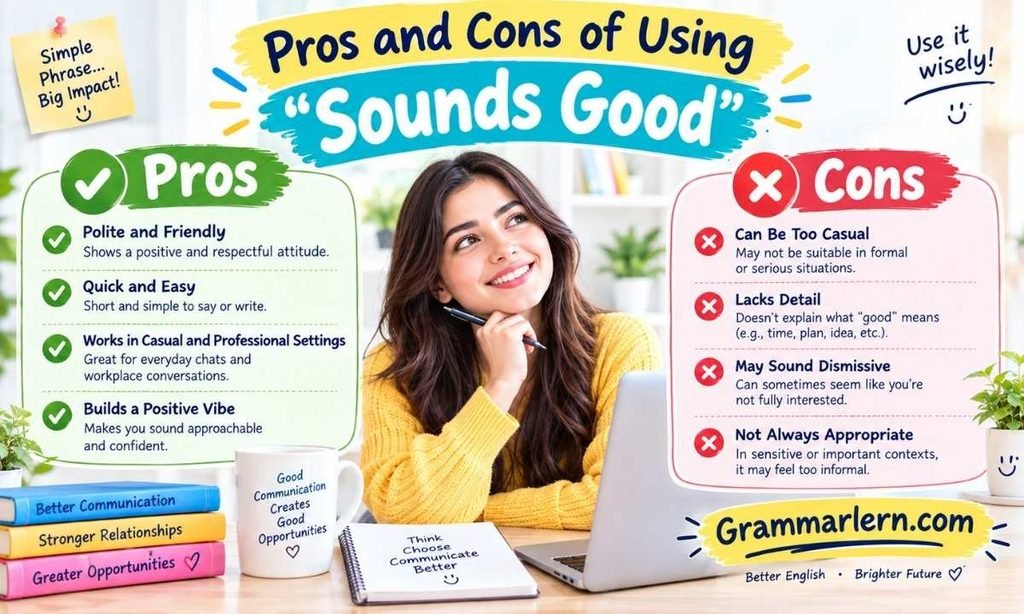
Like most everyday phrases, “sounds good” has real strengths and a few limitations worth knowing.
Pros
- Quick and easy to use in any conversation
- Friendly, approachable tone
- Universally understood across most workplaces
- Works well in emails, chat, and speech
- Clearly signals agreement without confusion
Cons
- Can feel too casual in formal or client-facing emails
- Repeating it often makes your writing feel flat
- Doesn’t convey enthusiasm or authority on its own
- Offers no detail just simple acceptance
Because of these limitations, having a set of alternatives on hand makes your communication feel more varied and more professional.
15+ Other Ways to Say “Sounds Good” Professionally
Below are the most useful alternatives to “sounds good,” each with its meaning, an example, and the best situation to use it. Together, they give you options for nearly every professional scenario from confirming a meeting to approving a finished project.
Phrase: That Works for Me
Meaning: The plan or suggestion fits your schedule or expectations.
Explanation: This is one of the safest, most neutral alternatives to “sounds good.” It confirms agreement without adding extra emotion.
Example: We can meet at 10 AM tomorrow. That works for me.
Best Use: Scheduling, meeting confirmations, general workplace replies Tone: Neutral
Phrase: That Sounds Great
Meaning: You approve of the idea and feel positive about it.
Explanation: Slightly warmer than “that works for me,” this phrase adds a touch of enthusiasm while staying professional.
Example: Let’s launch the campaign next week. That sounds great.
Best Use: Team conversations, casual professional replies Tone: Friendly
Phrase: That Sounds Perfect
Meaning: The suggestion matches exactly what you expected or hoped for.
Explanation: Use this when a plan fits your needs precisely, not just adequately.
Example: We’ll meet in Conference Room B at 3 PM. That sounds perfect.
Best Use: Confirming details you’re genuinely happy with Tone: Friendly, enthusiastic
Phrase: I Agree With This
Meaning: You share the same opinion or support the proposal.
Explanation: More direct and formal than “sounds good,” this phrase works well when your input carries some weight in a decision.
Example: We should increase the marketing budget next quarter. I agree with this.
Best Use: Professional discussions, decision-making conversations Tone: Formal
Phrase: That Seems Like a Good Plan
Meaning: The proposal appears well thought out and reasonable.
Explanation: This phrase shows measured, thoughtful agreement rather than a quick yes.
Example: Let’s prioritize customer feedback this month. That seems like a good plan.
Best Use: Team meetings, planning discussions Tone: Neutral, considered
Phrase: That Works Well
Meaning: The idea fits smoothly into the current situation or schedule.
Explanation: A slightly more polished version of “that works for me,” often used in written communication.
Example: We can complete the report by Friday. That works well.
Best Use: Business emails, project scheduling Tone: Professional
Phrase: I’m Happy With That
Meaning: You accept and feel satisfied with the decision.
Explanation: This phrase adds a personal, positive tone to your agreement, showing you’re not just accepting but genuinely pleased.
Example: We’ll finalize the design next week. I’m happy with that.
Best Use: Workplace discussions, feedback conversations Tone: Friendly, warm
Phrase: That Makes Sense
Meaning: The suggestion is logical and easy to understand.
Explanation: Often used when someone explains their reasoning and you want to confirm it’s clear and reasonable.
Example: We should review the data before deciding. That makes sense.
Best Use: Meetings, problem-solving conversations Tone: Neutral, understanding
Phrase: I Support This Idea
Meaning: You back the proposal with confidence.
Explanation: Stronger and more formal than casual agreement, this phrase works well when you want to show real backing, not just passive acceptance.
Example: The team should adopt a new onboarding process. I support this idea.
Best Use: Leadership discussions, formal approvals Tone: Formal, confident
Phrase: This Looks Good to Me
Meaning: You approve after reviewing something.
Explanation: This phrase is ideal when responding to a document, design, or draft rather than a spoken suggestion.
Example: Here’s the final version of the presentation. This looks good to me.
Best Use: Reviewing documents, providing feedback Tone: Friendly, approving
Phrase: I’m on Board With This
Meaning: You fully support the plan and are ready to move forward.
Explanation: Common in team settings, this phrase signals genuine buy-in rather than simple logistical agreement.
Example: We’re expanding into two new markets next year. I’m on board with this.
Best Use: Team collaboration, strategic discussions Tone: Casual professional
Phrase: That’s Acceptable
Meaning: The idea meets the necessary requirements.
Explanation: A neutral, slightly formal phrase, often used when confirming something meets a standard rather than expressing personal excitement.
Example: We’ll deliver the report by Monday. That’s acceptable.
Best Use: Formal workplace communication, approvals Tone: Formal, neutral
Phrase: Understood
Meaning: You’ve received and processed the information.
Explanation: This phrase confirms comprehension rather than agreement. It’s useful when someone shares instructions or updates rather than a proposal you’re evaluating.
Example: Please send the invoice by the 15th. Understood.
Best Use: Instructions, confirming receipt of information Tone: Neutral, formal
Phrase: Absolutely
Meaning: Strong, enthusiastic agreement.
Explanation: Short and confident, this word works well when you want to show clear support without over-explaining.
Example: Can you join the client call at 2 PM? Absolutely.
Best Use: Quick replies, confirming availability or support Tone: Confident, positive
Phrase: Noted, Thank You
Meaning: You’ve seen and acknowledged the message.
Explanation: This phrase confirms receipt politely, without necessarily signaling full agreement. It’s a safer alternative to a bare “Noted,” which can feel abrupt on its own.
Example: The meeting has been moved to Thursday. Noted, thank you.
Best Use: Acknowledging updates or schedule changes Tone: Formal, polite
Other Ways to Say “Sounds Good” Professionally in an Email
Email carries slightly different expectations than spoken conversation. Because there’s no tone of voice to soften a message, word choice matters more.
For confirming a plan or timeline, phrases like “That works for me” or “I’m happy to proceed” keep things clear and professional. For approving a document or deliverable, try “This looks good to me” or “You’re all set to move forward.” If you’re simply acknowledging an update without fully committing, “Thanks for the update, I’ll follow up by Friday” works better than a plain “sounds good,” since it shows you’ve actually engaged with the message.
A good habit: pair your agreement with a short next step. “That works for me I’ve blocked the time” reads as more professional than “That works for me” alone, because it shows action, not just acknowledgment.
Casual and Slang Ways to Say “Sounds Good”
In everyday chats, texts, or informal workplace messages, shorter and more relaxed alternatives fit better than formal phrasing.
- Works for me quick and easygoing
- Cool casual, common in chat
- Sure thing warm and informal
- All good relaxed confirmation
- I’m in enthusiastic, used for invitations or plans
- Bet very casual, common in younger or informal circles
- Sg a shortened text version of “sounds good”
- No problem friendly, though it can feel dismissive in formal threads
These work well with friends, close coworkers, or in quick Slack and text exchanges but they’re best avoided in client emails or formal reports.
Common Mistakes and Tone Traps to Avoid
A few alternatives to “sounds good” seem harmless but can actually send the wrong signal in professional English.
“Noted” on its own can come across as cold or dismissive, especially in client-facing threads. Adding a short follow-up, like “Noted, I’ll review this by Thursday,” fixes the issue.
“Fine” signals reluctant agreement more than genuine approval. Readers often hear “I guess” underneath it, so it’s safer to use “That works for me” instead.
“No problem” can land differently depending on the reader some see it as friendly, others read it as slightly dismissive of the original request. In formal emails, “Of course” or “Happy to help” avoids the ambiguity.
“As you wish” may sound agreeable, but in English it often reads as passive-aggressive, as if you’re going along with something reluctantly. A phrase like “Happy to go with that approach” communicates the same idea without the mixed signal.
The core lesson: match your tone to the channel. What works in a quick chat message may feel too casual or even abrupt in a formal email thread.
Comparison Table of Top Alternatives
| Phrase | Tone | Best Context |
| That works for me | Neutral | Scheduling |
| That sounds great | Friendly | Conversation |
| That sounds perfect | Friendly | Confirming details |
| I agree with this | Formal | Professional discussion |
| That seems like a good plan | Neutral | Team meetings |
| That works well | Professional | Business emails |
| I’m happy with that | Friendly | Workplace feedback |
| That makes sense | Neutral | Meetings, discussions |
| I support this idea | Formal | Business decisions |
| This looks good to me | Friendly | Reviewing work |
| I’m on board with this | Casual professional | Team collaboration |
| That’s acceptable | Formal | Formal approvals |
| Understood | Formal | Instructions |
| Absolutely | Confident | Quick confirmations |
| Noted, thank you | Formal | Acknowledging updates |
How to Reply to “Sounds Good”
If someone replies to you with “sounds good,” you don’t always need to say anything more but when a short response feels appropriate, a few options work well.
- “Great, talk soon.” casual and friendly, good for closing out a quick exchange
- “Perfect, I’ll follow up then.” useful when a next step is coming
- “Thanks, appreciate it.” polite and simple
- “Awesome, see you then.” warm, informal tone for scheduled plans
In most cases, a brief acknowledgment is all that’s needed “sounds good” is usually the end of a back-and-forth, not the start of a new one.
Frequently Asked Questions
What Does “Sounds Good” Mean?
“Sounds good” means you agree with or approve of an idea, plan, or suggestion. It’s a short, informal way of confirming acceptance.
Is “Sounds Good” Professional or Polite?
Yes, it’s generally polite and works fine in most everyday workplace communication. In formal emails or client-facing messages, though, a more polished alternative like “That works for me” is often a better fit.
What Is Another Way to Say “Sounds Good”?
Common alternatives include “That works for me,” “I agree with this,” “That makes sense,” and “This looks good to me,” depending on the tone you want.
What Is a Good Reply to “Sounds Good”?
Simple responses like “Great, talk soon,” “Perfect, I’ll follow up then,” or “Thanks, appreciate it” work well after someone replies “sounds good.”
What Is a Casual Synonym for “Sounds Good”?
Casual options include “Works for me,” “Cool,” “Sure thing,” and “I’m in” all common in texts and informal chats.
What Does “Sounds Good to Me” Mean?
“Sounds good to me” is a slightly more personal version of “sounds good,” specifically confirming that the idea fits your own preference or schedule.
Conclusion
“Sounds good” is a useful phrase, but relying on it too often can make your communication feel repetitive. With alternatives like “That works for me,” “I agree with this,” or “This looks good to me,” you can match your tone to the situation whether that’s a quick chat, a formal email, or a client-facing message.
Start swapping in one new phrase at a time, and over time, choosing the right response will feel natural. A varied vocabulary doesn’t just sound more professional it makes your communication clearer and more intentional in every conversation.