

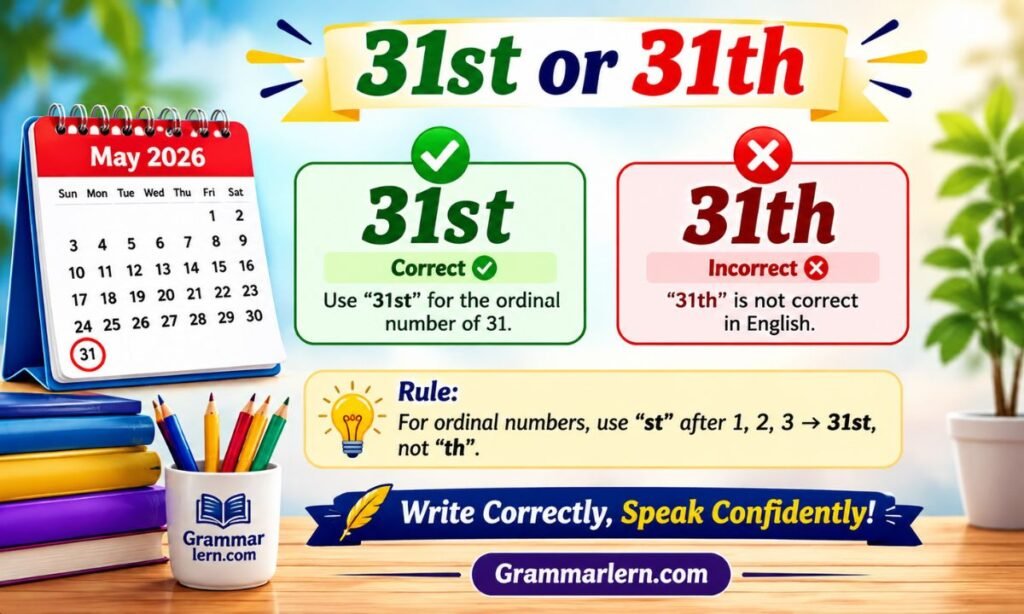
Is it 31st or 31th? Only one is correct and the confusion ends here.
Ordinal numbers follow a simple pattern, but 31 trips up even confident writers. Get it wrong in a date or invitation, and your writing looks careless.
This guide gives you the correct spelling, the exact rule behind it, and real examples so you never second-guess it again.
31st or 31th: Quick Answer
31st is correct. 31th is not a real word and should never be used.
Ordinal numbers change their ending based on the last digit of the number, not on a fixed “always add th” pattern. Since 31 ends in 1, and 1 becomes “1st,” the number 31 becomes 31st.
- ✅ My birthday is on the 31st of August.
- ❌ My birthday is on the 31th of August.
Quick rule to remember: numbers ending in 1 take st except 11, which is always 11th.
The Origin of 31st or 31th
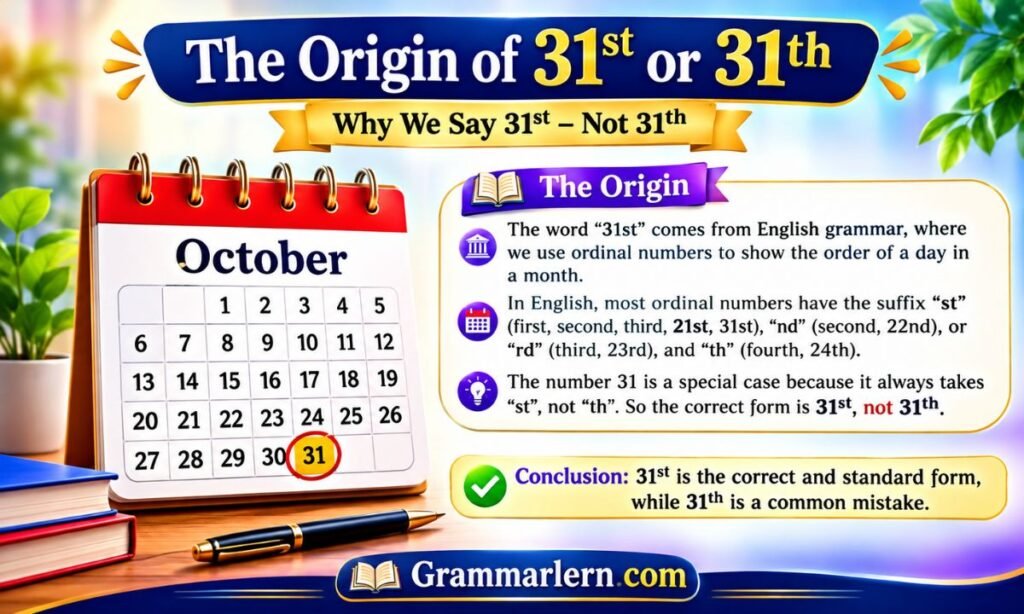
Ordinal numbers exist to show position or order first, second, third rather than quantity. English inherited this system from Old English, where certain number endings were tied directly to pronunciation rather than a single fixed rule.
That’s exactly why 31st works the way it does. The number is spoken as “thirty-first,” not “thirty-th.” Since the spoken word ends in “first,” the written abbreviation naturally follows: 31st. “31th” doesn’t match how anyone actually says the word, which is the simplest reason it’s wrong.
Pronunciation: 31st is pronounced thirty-first IPA: /ˌθɜːrti ˈfɜːrst/. Say it out loud and the correct spelling becomes obvious: nobody says “thirty-th.”
Comparison Table: Ordinal Number Endings
| Last Digit | Correct Ending | Example |
| 1 | st | 1st, 21st, 31st |
| 2 | nd | 2nd, 22nd, 32nd |
| 3 | rd | 3rd, 23rd, 33rd |
| 4–9 and 0 | th | 4th, 25th, 30th |
| 11, 12, 13 (exception) | th | 11th, 12th, 13th |
This one table covers almost every ordinal number you’ll ever need to write. Once you know it, “31st or 31th” stops being a question.
31st or 31th in Dates: Correct Usage Examples
The rule stays the same no matter which month you’re writing about. Here’s how it looks across common date formats:
- ✅ October 31st not October 31th
- ✅ August 31st not August 31th
- ✅ March 31st not March 31th
- ✅ July 31st not July 31th
- ✅ May 31st not May 31th
No matter the month, the day, or the context, 31st is always correct. If you’ve searched “October 31st or 31th” or “March 31st or 31th,” the answer is the same every time 31st.
British English vs American English Spelling
Both British and American English follow the exact same ordinal number rule the spelling of “31st” never changes. What does change is the order in which the day and month appear.
- British English: day before month → 31st August
- American English: month before day → August 31st
Comparison Table
| Style | Format | Example |
| British English | Day + Month | 31st August 2026 |
| American English | Month + Day | August 31st, 2026 |
| Formal/Legal (both) | Month + Day (no suffix) | August 31, 2026 |
So while the date order shifts between regions, the ordinal spelling itself is universal it’s always 31st, never 31th.
Which Form Should You Use?
Always use 31st there’s no context where “31th” is acceptable. Specifically, you’ll use 31st when writing:
- Dates “The deadline is the 31st of this month.”
- Lists and rankings “She finished 31st in the race.”
- Birthdays and ages “He just turned 31st… well, technically his 31st birthday.”
- Formal writing contracts, invitations, official emails, and reports.
Easy tip: If you can say the full word “thirty-first” in a sentence, you can write “31st” the ending always mirrors the pronunciation.
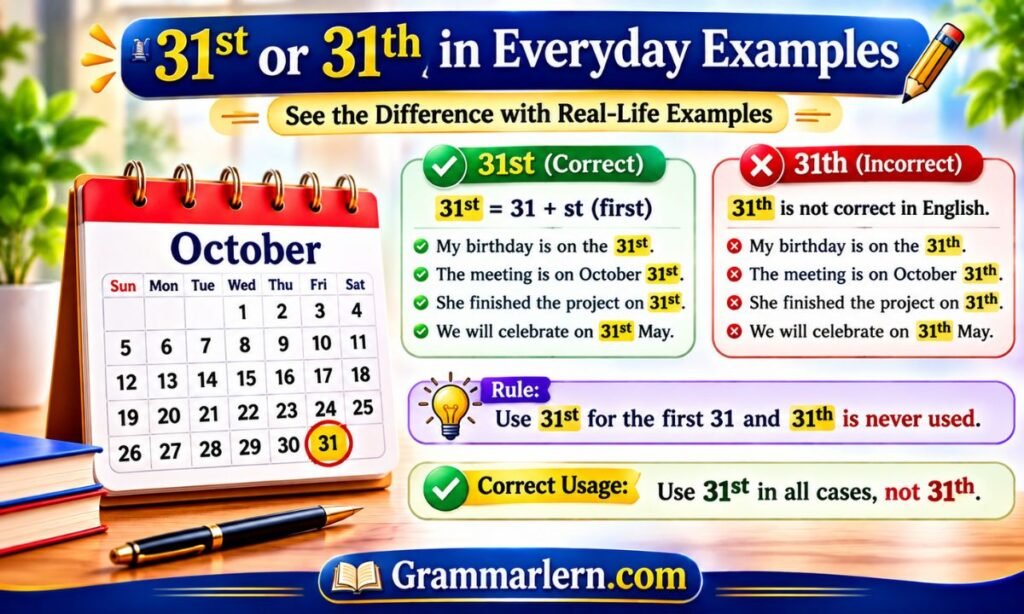
31st or 31th in Everyday Examples
Emails
“Please confirm your attendance by the 31st.”
News Writing
“The policy officially ends on December 31st.”
Social Media
“Only 3 days left until the 31st don’t miss out!”
Formal Writing
“All applications must be submitted no later than the 31st of May.”
Across every format casual or formal the spelling never changes. Only the tone around it does.
Common Mistakes with 31st or 31th
Mistake 1: Adding “th” to every number
Many learners assume every ordinal ends in “th.” That works for 4th, 5th, and 6th but not for numbers ending in 1, 2, or 3.
❌ 21th, 31th, 41th → ✅ 21st, 31st, 41st
Mistake 2: Forgetting the 11–13 exception
Numbers ending in 1 usually take “st” except 11, 12, and 13, which always take “th.”
✅ 11th, 12th, 13th (no exceptions here)
Mistake 3: Using 31nd or 31rd
These aren’t real forms at all. “nd” belongs to 2, “rd” belongs to 3 neither applies to 31.
❌ 31nd, 31rd → ✅ 31st
Mistake 4: Adding a space “31 st”
The suffix attaches directly to the number with no space.
❌ 31 st → ✅ 31st
Memory trick: Match the last digit 1→st, 2→nd, 3→rd, everything else→th then remember that 11, 12, and 13 always break the pattern with “th.”
31st or 31th: Google Trends & Usage Data
Search data shows a clear pattern: “31th” is searched often, but almost always by people looking for confirmation, not because it’s an accepted spelling. Non-native speakers and casual writers are the most common source of the mix-up, usually because they’ve over-applied the “th” ending from more common ordinals like 4th, 5th, and 10th.
In actual published writing books, news outlets, and professional documents 31st appears almost exclusively. “31th” shows up almost only in search queries and rough drafts, never in edited, final text.
Frequently Asked Questions
Is 31th ever correct?
No. In standard English, 31th is always incorrect there’s no context where it’s accepted.
What does 31st mean?
31st is the ordinal form of 31, used to describe position, rank, or date as in “the 31st of the month” or “31st place.”
How do you write 31 in English as an ordinal?
Write it as 31st, and in full words, as “thirty-first.”
Is it correct to say “31st years old”?
Not quite for age, you’d say “31st birthday” or simply “31 years old.” “31st” describes order (like a birthday number), while “31” alone describes quantity (age itself).
Why is it “31st” and not “31th”?
Because the spoken form, “thirty-first,” ends in “first” the written ending simply follows the pronunciation.
Does the rule change between British and American English?
No. Only the date order changes (day-first vs. month-first) the spelling “31st” stays the same everywhere.
Final Thoughts
The answer is simple: 31st is correct, 31th is not. English ordinal numbers follow the last digit of the number 1 takes “st,” and since 31 ends in 1, it becomes 31st, just like “thirty-first” sounds.
Keep the 11, 12, 13 exception in mind, stay consistent whether you’re writing dates, rankings, or birthdays, and you’ll never second-guess “31st or 31th” again.