

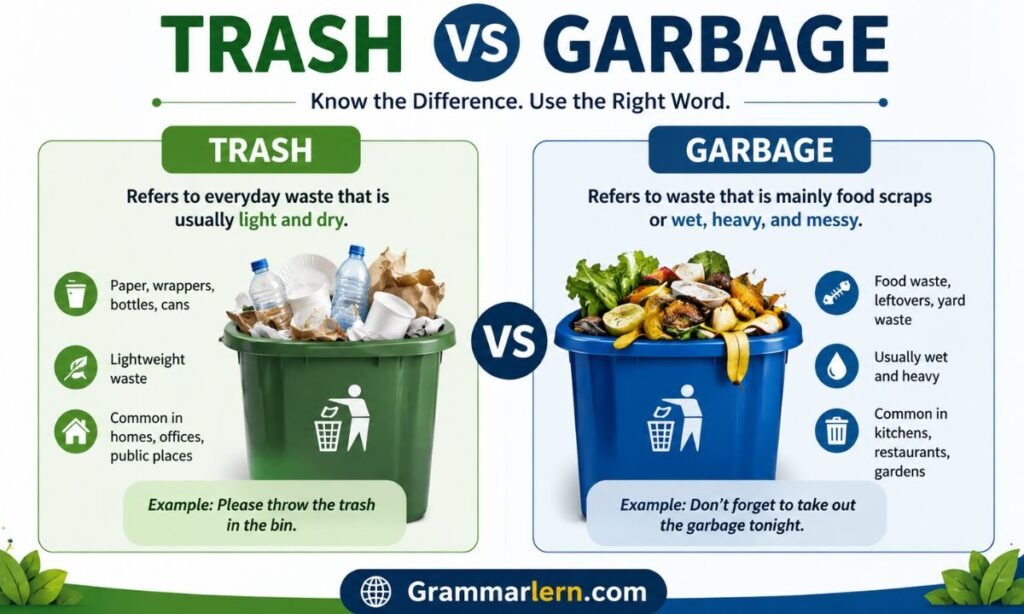
Trash and garbage — do they really mean the same thing? Most people use them interchangeably, but English hides a small, traditional difference between the two.
In short, trash means dry waste like paper and plastic, while garbage means food-related, wet waste from the kitchen.
This guide covers the meaning, key differences, and real-life usage of trash vs garbage — including how American and British English use these words differently.
Quick Answer
Trash refers to dry, non-food waste such as paper, plastic, and packaging. Garbage refers to wet or organic waste, mostly food scraps and kitchen leftovers. In everyday American English, both words are often used interchangeably, but this traditional distinction still shows up in waste-management contexts and formal writing.
What Does “Trash” Mean?
Trash Definition
Trash describes discarded materials that are typically dry and not related to food. It covers everyday household and office waste that doesn’t spoil or produce odor the way food waste does.
Common Examples of Trash
- Cardboard boxes and packaging
- Old newspapers and magazines
- Plastic wrappers and bottles
- Broken household items
- Used paper towels
- Torn clothing
Because trash is mostly dry, it tends to attract fewer pests and produce less odor than garbage, which is one reason many recycling programs sort it separately.
What Does “Garbage” Mean?
Garbage Definition
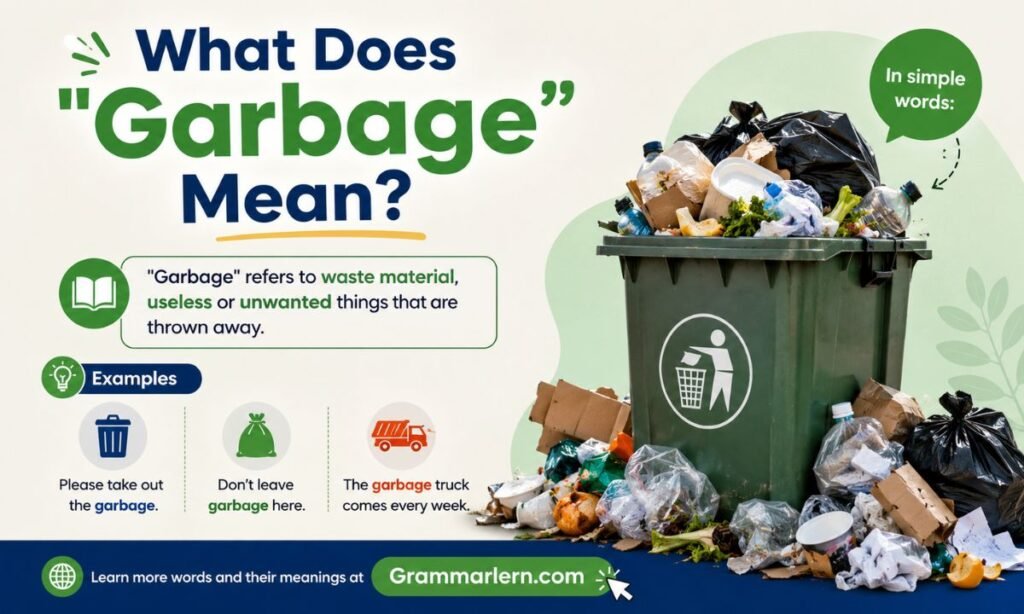
Garbage traditionally refers to organic, food-related waste — the kind of material that comes from cooking, eating, or food storage. It’s usually wet and biodegradable.
Common Examples of Garbage
- Vegetable peels and fruit scraps
- Leftover meals
- Spoiled or expired food
- Coffee grounds
- Meat and bones
Because garbage decomposes quickly, it produces odor faster and often needs more frequent disposal than trash.
Trash vs Garbage – Key Differences (Comparison Table Explanation)
| Category | Trash | Garbage |
| Type of waste | Dry, non-food materials | Wet, food-related waste |
| Common source | Packaging, offices, general household use | Kitchens, food preparation |
| Odor | Low | High |
| Decomposition | Slow | Fast |
| Recyclable | Often | Rarely |
| Compostable | Rarely | Often |
The core difference comes down to source and moisture: trash comes from everyday non-food items, while garbage comes almost entirely from food.
Are Trash and Garbage the Same?
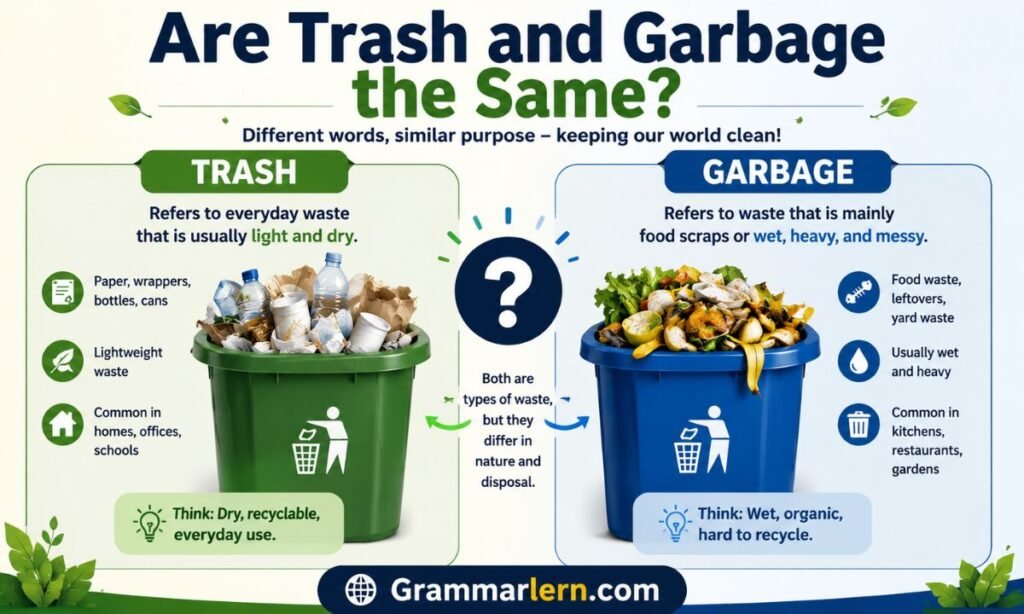
Not exactly — but in casual American English, they’re close enough that most people treat them as synonyms. You’ll hear “take out the trash” even when the bag contains food waste, and “garbage truck” even when it’s collecting mixed household waste.
The traditional distinction still matters in specific situations: environmental studies, municipal waste policy, recycling programs, and academic or professional writing. In daily conversation, though, context — not strict definitions — decides which word sounds natural.
Trash vs Garbage in American English vs British English
American English Usage
In the U.S., both trash and garbage are widely used, sometimes interchangeably and sometimes with the traditional split (trash = dry waste, garbage = food waste). Municipal services in different cities may officially use either term — “garbage collection” or “trash pickup” — without one being more correct than the other.
British English Usage (Rubbish)
British English rarely uses “trash” or “garbage” in daily speech. Instead, rubbish covers all types of household waste, regardless of whether it’s dry or organic. “Put it in the rubbish bin” is the standard phrasing across the UK.
Related Waste Terms: Rubbish, Litter, Refuse & Junk Explained
Beyond trash and garbage, several related words describe waste — each with a slightly different meaning:
- Rubbish – the British equivalent of trash, covering all household waste
- Litter – waste discarded improperly in public spaces, like streets or parks
- Refuse – a formal term used in government and waste-management documents
- Junk – unwanted items that are usually larger or reusable, like old furniture or electronics
- Waste – the broadest term, covering trash, garbage, recyclables, and more
Knowing these related terms helps you choose the most accurate word depending on context — casual conversation, professional writing, or environmental discussions.
Real-Life Examples of Trash and Garbage in Sentences
Using trash correctly:
- Please put the empty boxes in the trash.
- The office trash bin is full of old paper.
- We filled two bags with trash after the move.
Using garbage correctly:
- The garbage smells because of last night’s leftovers.
- Throw the vegetable peels in the garbage.
- The garbage disposal stopped working again.
Where either word works:
- Take out the trash. / Take out the garbage.
- The trash truck comes Monday. / The garbage truck comes Monday.
Trash Can vs Garbage Bin – Are They Different?
Technically, a trash can traditionally holds dry waste, while a garbage bin traditionally holds food waste. In real life, though, most households and businesses use both terms — and both containers — for mixed waste without any strict rule. Regional habits, not grammar, usually decide which term people prefer.
Types of Household Waste
Understanding household waste is easier when you break it into categories.
Dry Waste
Includes paper, cardboard, plastic packaging, and other non-food items — commonly labeled as trash.
Wet/Organic Waste
Includes food scraps, spoiled food, and kitchen leftovers — commonly labeled as garbage. This waste often qualifies for composting.
Recyclable Waste
Includes glass, metal, certain plastics, and paper products that can be processed and reused, reducing landfill volume.
What Happens After You Throw Trash or Garbage?
Once waste leaves your home, it typically goes through a few stages:
- Collection – trucks pick up waste from homes, businesses, and public bins
- Sorting – waste is separated into recyclables, organic material, and general waste
- Processing – recyclables go to recycling facilities, organic waste may be composted, and the rest goes to landfills
This system is part of broader municipal solid waste management, which aims to reduce landfill dependency and support recycling and composting programs.
Common Mistakes People Make When Using Trash and Garbage
- Assuming the two words always mean exactly the same thing in every context
- Using “garbage” for all waste, including clearly dry materials, in formal or academic writing
- Overthinking casual conversations, where either word is almost always acceptable
- Ignoring regional preferences, which can make one term sound more natural than the other depending on where you live
Quick Summary Table
| Term | Traditional Meaning | Common Examples |
| Trash | Dry, non-food waste | Paper, plastic, cardboard |
| Garbage | Food-related, organic waste | Fruit peels, leftovers |
| Rubbish | British term for all household waste | General waste |
| Litter | Waste discarded improperly in public | Bottles, wrappers |
| Refuse | Formal term for discarded materials | Used in official documents |
Frequently Asked Questions
Are trash and garbage the same thing?
Not traditionally. Trash refers to dry waste, while garbage refers to food-related waste. In casual American English, though, they’re often used interchangeably.
What is the main difference between trash and garbage?
Trash is dry, non-food waste like paper and plastic. Garbage is wet, organic waste that mostly comes from food.
Is garbage only food waste?
Traditionally, yes — garbage usually refers to food scraps and other organic kitchen waste.
What do British people call trash?
British English typically uses “rubbish” instead of trash or garbage.
Can trash and garbage be used interchangeably?
Yes, in everyday conversation both words are commonly interchangeable, especially in American English.
Is “trash vs treasure” related to trash vs garbage?
Not directly — “trash vs treasure” is a separate expression meaning something one person discards, another person may find valuable. It isn’t part of the trash-vs-garbage distinction.
What’s the difference between trash, garbage, and litter?
Trash and garbage describe waste by type (dry vs food-related), while litter describes waste based on location — specifically, waste discarded improperly in public spaces.
Final Thoughts
The difference between trash and garbage comes down to one simple idea: trash is dry, non-food waste, while garbage is food-related and organic. Most Americans use both words casually, and that’s perfectly fine.
The distinction matters more in professional, academic, or environmental writing, where precise terminology counts.
Whether you say “take out the trash” or “take out the garbage,” your meaning will always come through clearly — and now you know exactly why both are correct.