


Confused between “people do” and “people does”? You’re not alone. This is one of the most common subject-verb agreement mistakes in English, and it trips up even confident speakers. The good news is that the rule is simple once you understand it.
The correct phrase is “people do,” because “people” is a plural noun and always pairs with a plural verb. In this guide, you’ll learn the exact grammar rule, see real examples, and understand why “people does” never fits standard English.
Quick Answer: People Do or People Does?
The correct form is always “people do.” The word “people” functions as a plural noun, and plural subjects require the verb “do,” never “does.” “People does” is grammatically incorrect in every standard context, whether you’re speaking casually, writing an email, or drafting a formal report.
A simple test works every time: replace “people” with “they.” If “they do” sounds natural, “people do” is correct too.
People Do or People Does? Understanding the Grammar Behind the Confusion
Many learners assume “people” is singular because it doesn’t end in an obvious plural marker like “-s.” Words such as apple, table, and simple all sound similar, which tricks the brain into treating “people” the same way.
English doesn’t follow that pattern here, though. “People” is already plural in both meaning and grammar, so it needs a plural verb. Understanding this one exception clears up most of the confusion around do versus does.
Understanding What “People” Really Means
People as a Plural Noun
In almost every case, “people” is the plural form of “person.” One individual is a person; two or more are people.
- People do amazing things every day.
- People are waiting outside.
Since “people” refers to more than one person, it behaves exactly like “they,” not like “he,” “she,” or “it.”
Rare Case: “People” as a Singular Collective
Occasionally, “people” refers to a nation or ethnic group as a single unit, for example, “A people is defined by its shared history.” This usage is rare and mostly limited to academic, historical, or political writing. In everyday spoken and written English, treat “people” as plural.
Subject–Verb Agreement: Why It Matters
Subject-verb agreement keeps sentences grammatically correct by matching the verb form to the subject’s number. This linguistic rule applies across formal and informal writing alike.
Singular Subject → Singular Verb
- She does
- He does
- It does
Plural Subject → Plural Verb
- They do
- We do
- People do
Why “People Does” Is Incorrect
“Does” only pairs with singular third-person subjects: he, she, or it. Since “people” is plural, pairing it with “does” creates a grammatical mismatch. “People do understand this” is correct; “people does understand this” is not.
Understanding Verb Conjugation: Do vs Does
Conjugation Table (Simple Present)
| Subject | Correct Verb |
| I | do |
| You | do |
| We | do |
| They | do |
| People | do |
| He | does |
| She | does |
| It | does |
Why “People” Pairs with “Do”
Because “people” behaves grammatically like “they.” Try the replacement test: “They do work hard” sounds natural, so “People do work hard” is correct too.
Irregular Verb Note
“Do” is an irregular verb and doesn’t follow the standard -s or -es pattern used by regular verbs. This irregularity is part of why the do/does distinction feels tricky for many native English speakers and learners alike. Once you accept that “do” simply doesn’t change form for plural subjects, the rule becomes second nature.
Practical Examples Using “People Do”
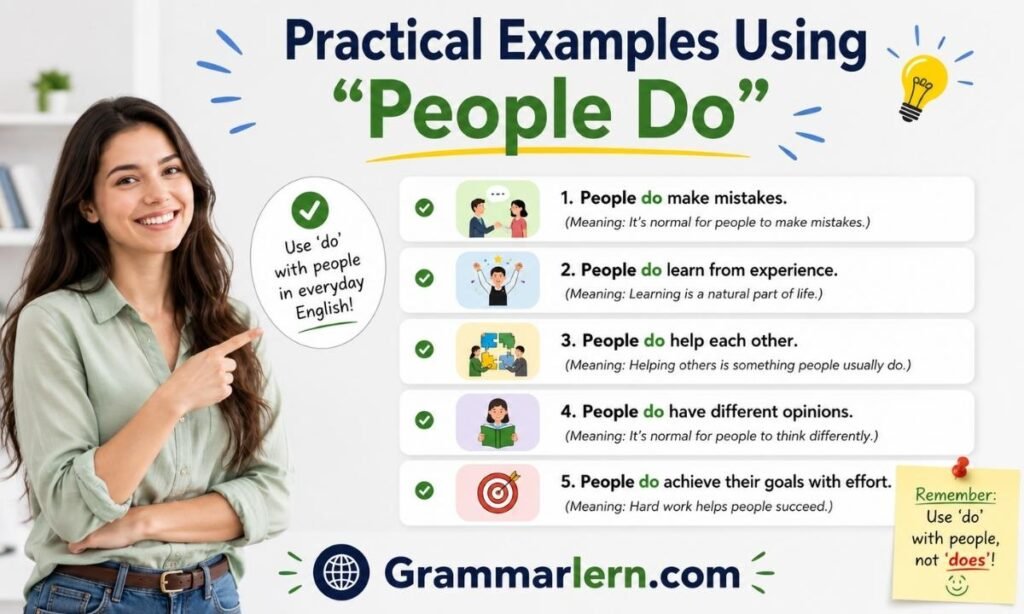
Everyday English Examples
- People do complain about traffic.
- People do love good food.
- People do make mistakes.
Formal Writing Examples
- People do contribute positively to society through volunteer work.
- People do respond differently to stress.
Conversational Examples
- “People do that sometimes.”
- “People do say weird things online.”
Incorrect Examples and How to Fix Them
Incorrect vs Correct — Common Sentence Pairs
- Incorrect: People does want change. Correct: People do want change.
- Incorrect: People does come here often. Correct: People do come here often.
- Incorrect: People does what’s necessary. Correct: People do what’s necessary.
Common Grammar Mistakes With “People”
Mistake 1: Thinking “People” Sounds Singular
It sounds singular but functions grammatically as plural.
Mistake 2: Matching Verbs Based on Meaning, Not Grammar
Even when a group acts as one unit, the grammar still stays plural.
Mistake 3: Overgeneralizing “Does”
Learners sometimes assume anything that sounds collective should take “does.” It shouldn’t, unless the subject is truly singular.
Mistake 4: Forgetting That “People” Equals “They”
This one trick resolves most confusion instantly. If “they” fits, use “do.”
People Do vs Everyone Does: Why They’re Different
“People” and “everyone” both refer to groups, but grammatically they work differently. “People” is plural and takes “do.” “Everyone” is treated as singular in grammar and takes “does.”
- People do what they believe is right.
- Everyone does what they believe is right.
This distinction matters because “everyone” focuses on each person individually, while “people” refers to the group as a whole.
Tips to Avoid Subject–Verb Agreement Errors
Useful Memory Tricks
Remember: people equals plural equals they equals do.
Saying Sentences Out Loud Helps
“People does” sounds awkward when spoken aloud. “People do” flows naturally.
Spot the Subject First
Identify who performs the action before choosing the verb. A plural subject always needs a plural verb.
Pay Attention to Helping Verbs
“Do” frequently pairs with other verbs, as in “People do eat early here” or “People do enjoy festivals.”
Mini Case Study: Real Learners Fixing the Mistake
Background
A group of ESL learners consistently wrote “people does” in their essays.
Before Correction
- People does think social media is important.
- People does work overtime here.
Teacher’s Strategy
The instructor asked learners to replace “people” with “they,” read the sentence aloud, and rewrite it using “do.”
After Correction
- People do think social media is important.
- People do work overtime here.
How Verb Choice Changes Meaning
Correct Meaning with “Do”
“People do learn from failure” sounds clear, confident, and grammatically correct.
Wrong Meaning with “Does”
“People does learn from failure” feels awkward and reduces credibility, especially in professional writing or emails.
What Grammar Experts and Dictionaries Say
Standard grammar authorities, including Merriam-Webster and Cambridge Dictionary, confirm that “people” functions as a plural noun requiring plural verb forms in nearly all everyday usage. This aligns with the core subject-verb agreement rule taught in standard American English grammar: plural subjects require plural verbs, without exception, unless “people” is used in its rare collective sense referring to a nation or ethnic group.
More Practical Sentence Patterns
Affirmative Sentences
People do appreciate honesty.
Negative Sentences
People do not like being ignored. People don’t wait long here.
Question Forms
Do people understand this rule? Why do people act this way?
Emphasis Sentences
People do care about their reputation. People do make time when it’s important.
Grammar Table for Quick Reference
| Type of Subject | Verb to Use | Example |
| Singular | does | He does the work. |
| Plural | do | They do the work. |
| People | do | People do the work. |
| Collective “a people” | does | A people does survive hardship. |
Strategies for Remembering Grammar Structures
- Read English daily to absorb natural sentence structure.
- Practice writing short sentences using “people do.”
- Compare your sentences with native English speaker examples.
- Check the subject before choosing the verb, every time.
Frequently Asked Questions
Which is correct, “people do” or “people does”?
“People do” is correct. Since “people” is plural, it always takes the plural verb “do,” never “does,” in standard English.
Is “people” singular or plural?
“People” is generally plural, functioning as the plural form of “person.” It only acts as singular in rare contexts referring to a nation or ethnic group.
Which is correct: “some people do” or “some people does”?
“Some people do” is correct. Adding “some” doesn’t change the plural nature of “people,” so the plural verb “do” still applies.
Which is correct, “do people” or “does people”?
“Do people” is correct in question form. For example, “Do people really believe that?” follows the same plural agreement rule as statements.
Why is “people does” grammatically incorrect?
“Does” is reserved for singular third-person subjects like he, she, or it. Because “people” is plural, pairing it with “does” breaks subject-verb agreement.
Can “people” ever take a singular verb like “does”?
Only in the rare case where “people” means a single nation or cultural group, as in “A people does have its own traditions.” In everyday English, this usage is uncommon.
Final Thoughts
Getting “people do” versus “people does” right comes down to one simple fact: “people” is a plural noun, so it always needs a plural verb. Once that idea clicks, the rest of the rule falls into place naturally, whether you’re writing a formal report or a casual message.
Keep the “they” test in mind whenever you’re unsure, and correct usage will start to feel automatic. Mastering small grammar rules like this one goes a long way toward making your English sound clear, confident, and professional in every situation.