

Ever paused mid-text, unsure whether to type “fav” or “fave”? You’re not alone this tiny two-letter debate confuses even confident writers every single day. Both words come from the same source, yet they show up differently across texts, social media, and casual writing.
The truth is simple: “fav” and “fave” are both correct informal abbreviations of “favorite.” The real difference isn’t grammar it’s context, tone, and platform. This guide breaks down exactly when to use each one, so you never second-guess your spelling again.
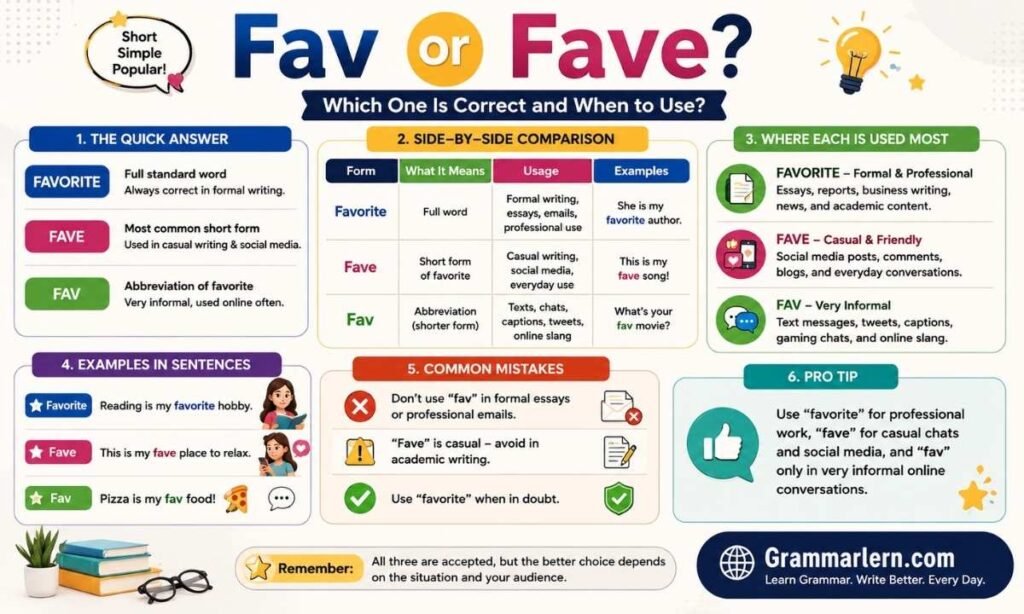
Favorite Short Form: Quick Answer ✅
The short answer: both “fav” and “fave” are correct short forms of “favorite.” Neither one is wrong they’re just used in slightly different situations.
“Fav” is shorter and shows up most often in app buttons, menus, and quick texts. “Fave” is closer to how the word actually sounds, so it feels more natural in sentences, captions, and everyday conversation.
Examples
- “That’s my fav app icon.” (label/UI style)
- “This is my fave coffee shop.” (natural sentence)
- “Drop your fav below.” (social media, quick)
- “She’s become my new fave.” (conversational)
Fav vs Fave: What’s the Difference?
There’s no rule that makes one version “more correct” than the other. The real difference lies in how each word is typically used one leans toward brevity, the other toward natural speech.
When to Use “Fav”
Use “fav” when space is limited or when you’re writing something label-like rather than conversational.
- App buttons (“Add to Fav”)
- Website menus and tags
- Text messages where brevity matters
- Hashtags (#favsong, #favmovie)
When to Use “Fave”
Use “fave” when you want your writing to sound like natural speech.
- Social media captions
- Blog posts and lifestyle content
- Everyday conversation (“You’re my fave”)
- Reviews and recommendations
Where Did “Fav” and “Fave” Come From?
Both words trace back to “favorite,” but they didn’t appear at the same time or in the same context. Knowing their origin makes it easier to understand why each one feels slightly different today.
Origin of “Fav”
“Fav” is the older of the two forms. It first showed up in the 1930s, originally used in horse racing to describe the projected winner of a race a usage still reflected in the phrase “the fav to win.” Over time, it spread beyond racing into everyday clipped speech, especially in notes and labels where shorter was better.
Origin of “Fave”
“Fave” emerged shortly after, appearing in entertainment writing in the late 1930s. Unlike “fav,” it was mostly associated with show business describing a favorite performer or act. The extra “e” made the word look and sound closer to how it’s actually pronounced, which is likely why it became the more natural-feeling option in casual writing.
Also Read This Interested In or On? Grammar Rule & Examples
How to Pronounce “Fav” and “Fave”
These two words don’t just look different they sound different too, even though they mean the same thing.
“Fav” uses a short “a” sound, rhyming with “have.” It’s quick and clipped, matching its role as a compact abbreviation.
“Fave” uses a long “ay” sound, rhyming with “save.” The added “e” signals that longer vowel sound, making it read more like natural spoken English.
British English vs American English Spelling 🇬🇧🇺🇸
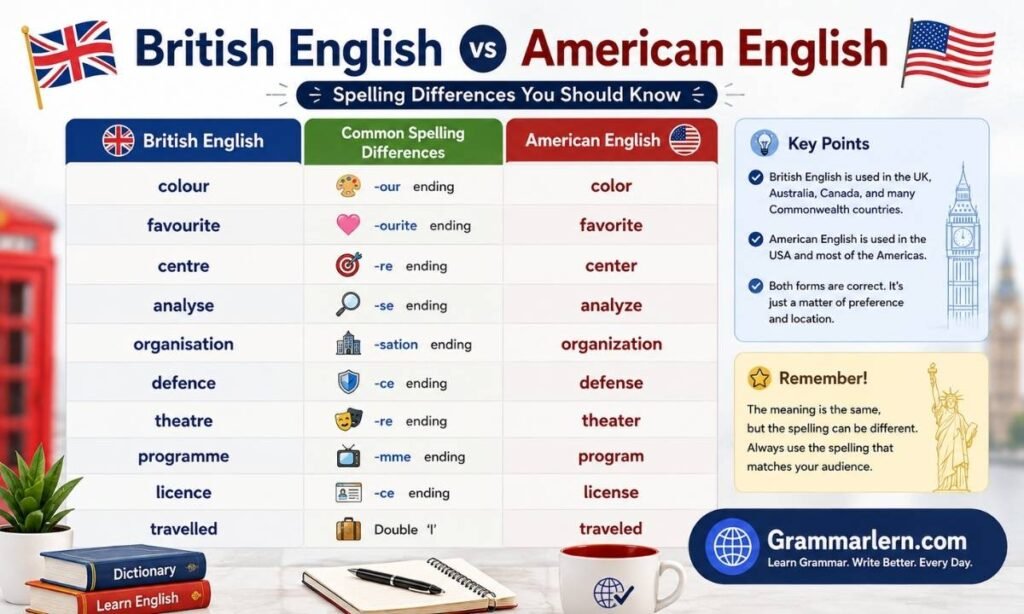
The word “favorite” itself changes spelling depending on where you are in the world and that difference carries over into how people think about its short forms.
Key Difference
American English drops the “u,” giving you favorite. British English (along with Canada, Australia, and most Commonwealth countries) keeps it, giving you favourite.
Examples
| Region | Full Word | Short Form |
| United States | favorite | fav / fave |
| United Kingdom | favourite | fav / fave |
| Canada & Australia | favourite | fav / fave |
Even though the full word changes spelling, the short forms stay the same everywhere. No one writes “favu” or adjusts the abbreviation for British English “fav” and “fave” remain universal.
Which Spelling Should You Use? 🌍
Your choice really comes down to your audience and the tone you’re going for.
Use “favorite” if:
- You’re writing for an American audience
- You’re creating content for US-based schools or businesses
- Your platform or brand uses American English
Use “favourite” if:
- You’re writing for a British or Commonwealth audience
- You’re targeting UK, Canadian, or Australian readers
- Your brand follows British English conventions
“fav” or “fave” if:
- You’re writing casually
- You’re posting on social media
- You’re texting or chatting informally
- You want a friendly, relaxed tone
Best Global Choice
If you’re writing for an international audience, use the full word (“favorite” or “favourite”) in formal contexts, and lean on “fav” or “fave” for casual, informal content. This keeps your writing clear no matter where your reader is from.
Also Read This Also Read This Interested In or On? Grammar Rule & Examples
Favs vs Faves: The Plural Forms
Once you’re comfortable with “fav” and “fave,” the plural versions follow the exact same logic they just refer to more than one favorite thing.
“Favs” is the plural of “fav,” and “faves” is the plural of “fave.” Both mean the same thing: a group of favorite items, people, or choices.
When to Use “Favs”
“Favs” works best in the same short, label-style spaces as its singular form think saved lists, app menus, and quick captions.
- “Check out my music favs.”
- “Save this to your favs list.”
- “Customer favs this month.”
When to Use “Faves”
“Faves” fits naturally into conversational writing, especially blogs, reviews, and social captions.
- “These are my travel faves.”
- “Sharing my skincare faves this week.”
- “My all-time reading faves.”
Common Mistakes with Favorite Short Form ❌⚠️
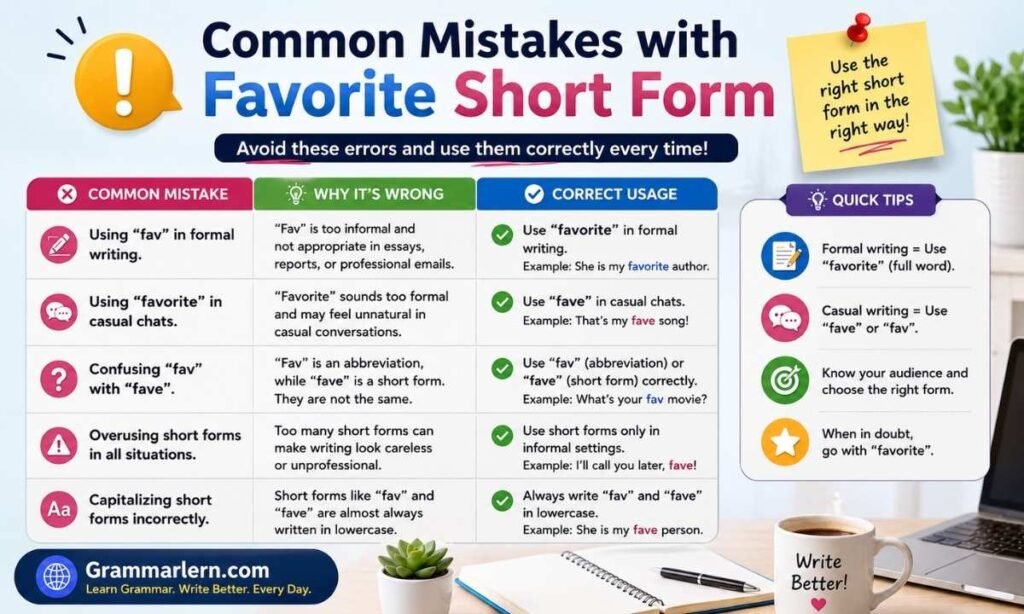
1. Using Short Forms in Formal Writing
❌ “Please send your fav document.”
✔ “Please send your favorite document.”
Why?
Formal emails and business writing should avoid slang abbreviations, as they can come across as unprofessional.
2. Mixing British and American Spellings
❌ “My favourite color is blue.”
✔ British: “My favourite colour is blue.”
✔ American: “My favorite color is blue.”
3. Writing “Fave” in Academic Writing
❌ “This is my fave author.”
✔ “This is my favorite author.”
Why?
“Fave” reads as casual and conversational, which doesn’t fit the formal tone academic writing requires.
4. Adding Unnecessary Periods
❌ “fav..”
✔ “fav” or “fav.” (a single period is acceptable in notes, but never double)
5. Using Capital Letters Randomly
❌ “My FAV Movie”
✔ “My fav movie”
Favorite Short Form in Everyday Examples 📱
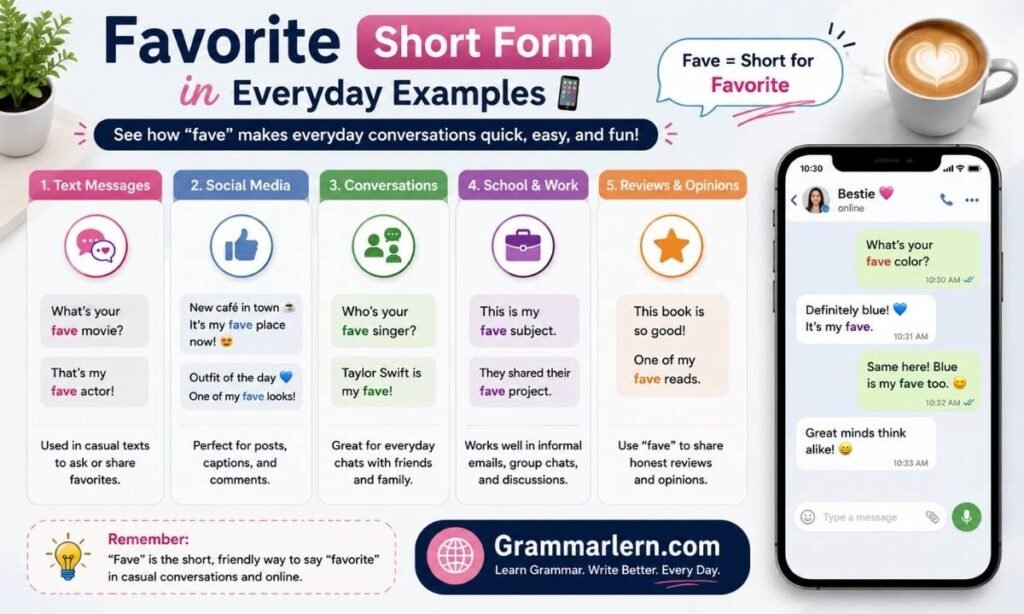
In Text Messages
- “That song is my fav!”
- “What’s your fave place to eat?”
In Chats & WhatsApp
- “Send me your favs when you get a chance.”
- “This is my fave sticker pack 😄”
In Social Media
- “My fave travel spot 🌍”
- “Drop your fav movie below!”
Casual Email
- “Here are my fav designs let me know your thoughts.”
Professional Email
- “Here are my favorite designs for your review.”
In School Notes
- “Fav subject: Science”
Favorite Short Form: Google Trends & Usage Data 📊
Most Common Regions
| Country | Popular Form |
| United States | fav |
| United Kingdom | fav |
| Canada | fav |
| Australia | fave / fav |
Online Usage Trends
| Platform | Common Form |
| TikTok | fav |
| fav | |
| X / Twitter | fav |
| Blogs | fave |
| Formal websites | favorite |
Why “Fav” Is Popular
“Fav” tends to edge out “fave” in fast-paced digital spaces simply because it’s shorter and quicker to type a small advantage that adds up across millions of posts, captions, and hashtags every day.
Comparison Table: Favorite Short Form Variations 📋
| Form | Type | Formal or Informal | Common Usage |
| favorite | Full American spelling | Formal | US writing |
| favourite | Full British spelling | Formal | UK writing |
| fav | Short form | Informal | Social media, texting, apps |
| fave | Natural short form | Informal | Blogs, conversation, captions |
| favs | Plural short form | Informal | Saved lists, menus |
| faves | Plural natural form | Informal | Social captions, reviews |
Frequently Asked Questions
What is correct, fav or fave?
Both are correct. “Fav” and “fave” are both accepted informal short forms of “favorite” neither is grammatically wrong. The choice comes down to context: “fav” fits labels, buttons, and quick texts, while “fave” sounds more natural in everyday sentences.
What is the short form of favorite?
The two most common short forms are “fav” and “fave.” Their plural versions “favs” and “faves” are used the same way when referring to more than one favorite thing.
Is it my fave or my fav?
Both work. “My fave” tends to sound more conversational and is common in social captions and casual chats, while “my fav” is shorter and often used in app labels or quick texts. Neither is incorrect.
How do you say “fav”?
“Fav” is pronounced with a short “a” sound, rhyming with “have.” This is different from “fave,” which rhymes with “save” and uses a long “ay” sound the extra “e” signals that longer vowel.
What does FAV mean in medical terms?
In a medical context, FAV is an unrelated abbreviation it typically stands for fetal-abdominal volume or is used in other clinical shorthand, depending on the field. It has no connection to “favorite” and should not be confused with the informal short form discussed in this guide.
Can you use “fav” or “fave” in formal writing?
No. Both are informal abbreviations and should be avoided in emails, academic papers, or professional documents. In formal writing, always use the complete word “favorite” (American English) or “favourite” (British English).
Final Thoughts
At the end of the day, the fav or fave debate isn’t about right versus wrong it’s about tone and setting. Both words come from “favorite,” carry the exact same meaning, and are equally accepted in everyday, informal English.
Use “fav” when space is tight, like app labels or quick texts, and reach for “fave” when you want your writing to sound natural and conversational. Save the full word, favorite or favourite, for anything formal emails, reports, or academic work.
Once you know this simple rule, you’ll never second-guess your spelling again. Pick the version that fits your audience, stay consistent, and let your writing do the talking.