

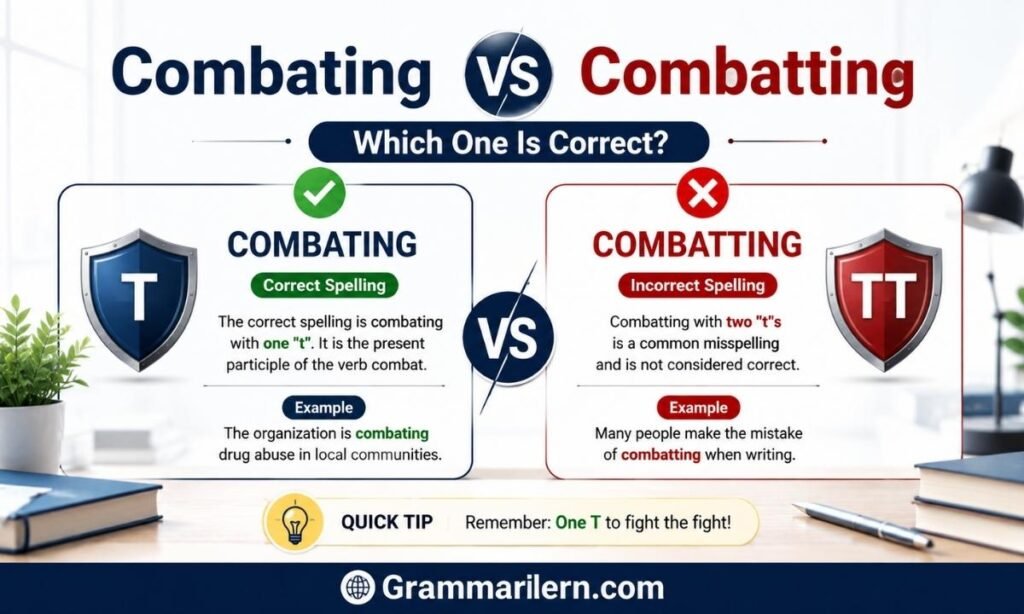
“Combating” or “combatting” — which one is correct? Both spellings look almost identical, yet only one fits your writing style. This guide gives you a quick, clear answer, backed by dictionary sources and style-guide rules.
The truth is simple: it’s not about right or wrong. It’s about American English vs British English, two regional spelling conventions. Once you understand this one rule, you’ll never second-guess it again.
Combating or Combatting: Understanding the Root Word “Combat”
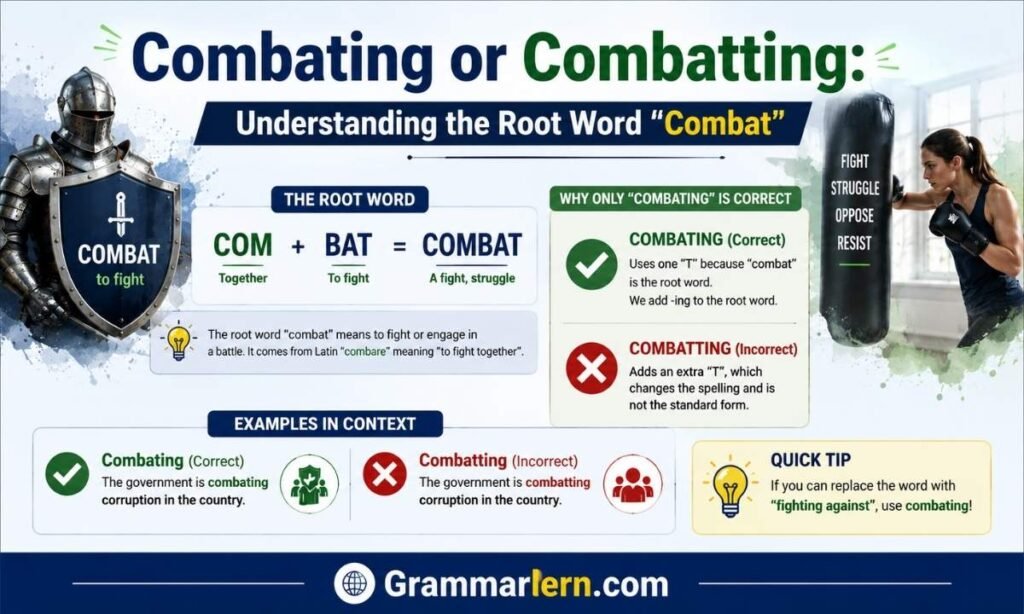
Before choosing a spelling, it helps to understand the word both forms come from. Combat works as both a noun and a verb, and that dual role shapes how it behaves when you add an ending.
As a noun, combat means fighting or conflict, as in “Soldiers entered combat at dawn.” As a verb, it means to fight against or stop something, as in “We combat misinformation daily.” Adding “-ing” to the verb creates the present participle that becomes either combating or combatting, depending on regional convention.
Why Both Spellings Exist
English spelling isn’t always consistent across regions, and that’s exactly what happens here. The core rule for adding “-ing” is simple: English doubles the final consonant when stress falls on the last syllable.
Since combat is stressed on its first syllable, COM-bat rather than com-BAT, no doubling is needed. That’s why American English settled on “combating.” British English doesn’t always follow stress-based rules strictly, which is why “combatting” survived as an accepted variant.
Combating in American English
American English favors simpler, streamlined spelling, and “combating” fits that pattern perfectly.
✔️ Correct in American English: combating
Because the stress falls on the first syllable, American spelling conventions don’t double the final “t.” This makes “combating” the standard choice across US newspapers, academic papers, and business writing. Examples: “The team is combating fraud with new technology” and “Scientists are combating climate change through renewable energy.”
❌ Usually incorrect: combatting
Within American English specifically, “combatting” is non-standard, not wrong globally. US style guides and dictionaries list “combating” as preferred, so the double-t version can look like a typo to most American readers.
Combatting in British English
British English places more weight on traditional spelling patterns, and this is where the second “t” earns its place.
Acceptable in British English: combatting
UK publications, government documents, and some Commonwealth outlets use “combatting” regularly. It reflects older spelling conventions that don’t rely solely on stress patterns for doubling.
Also acceptable: combating (used but less common)
British English hasn’t fully abandoned the single-t form. “Combating” still appears in UK writing, especially in international or digital content, though “combatting” remains the more traditional choice.
Also Read this Past Tense of Swing: Swung, Not Swang (Full Grammar Guide)
Combating Meaning & Dictionary Recognition (Oxford, Merriam-Webster & More)
Both spellings carry the exact same meaning: to fight against, oppose, reduce, or prevent something harmful. Major dictionaries recognize this shared definition, even if the preferred spelling differs by region.
Merriam-Webster, the leading American dictionary, lists “combating” as the primary entry. The Oxford English Dictionary and Cambridge Dictionary, both British references, acknowledge “combatting” as a valid variant alongside “combating.” Is “combating” a word? Yes, and so is “combatting.” Neither is a misspelling; they are regional variants of the same verb, both listed in reputable dictionaries.
How Pronunciation Affects Spelling
English spelling sometimes follows pronunciation, but not always, and “combat” proves that.
Stress pattern:
Words like begin → beginning and forget → forgetting double their final consonant because stress lands on the last syllable. Combat doesn’t follow that pattern. Its stress sits on the first syllable, so doubling the “t” isn’t required. This is why American English treats “combating” as default, while British English sometimes doubles the consonant anyway, based on historical habit rather than pronunciation logic.
Understanding “Combating” and “Combatting” as Verb Forms
Regardless of spelling, both words serve identical grammatical functions.
Present participles
Both forms work in continuous tenses to describe an ongoing action: “We are combating misinformation” or “We are combatting misinformation.” Either spelling is valid here; only the regional preference changes.
Gerunds
Both spellings can also function as gerunds, acting like a noun: “Combating pollution requires global cooperation.” The spelling doesn’t change the grammar; it only reflects regional convention.
Combated vs Combatted: Past Tense Forms
The spelling choice carries into the simple past tense too. American English pairs “combating” with combated, as in “Officials combated the outbreak through vaccination.” British English pairs “combatting” with combatted, as in “The council combatted rising crime through local programs.”
Stay consistent: if you use “combating,” pair it with “combated,” and vice versa. Mixing forms in one piece looks unpolished.
Synonyms for Combating
If you want variety in your writing, several words can stand in for “combating.” Common alternatives include fighting, opposing, countering, resisting, tackling, and preventing. “Combating pollution” could become “fighting pollution” or “tackling pollution,” depending on tone.
Real-World Usage Examples
Seeing both spellings in context makes the regional pattern easier to remember.
American Context
- Combating inflation
- Combating misinformation
- Combating climate change
British Context
- Combatting corruption
- Combatting knife crime
- Combatting public health crises
Notice how the spelling choice tends to follow the publication’s audience and regional style rather than any strict grammar rule.
Case Study: Combating Climate Change vs Combatting Climate Change
A side-by-side comparison shows how professional writing reflects regional style guides.
US Environmental Research Paper
“Scientists are combating climate change by developing next-generation carbon capture systems.” This matches US style guides like APA, MLA, and AP.
UK Government Report
“The committee is committed to combatting climate change through sustainable transport reforms.” UK institutions often follow Oxford or Cambridge guidance, which permits the double-t form. Your spelling should reflect your audience and platform, not just personal preference.
Also Read this Past Tense of Swing: Swung, Not Swang (Full Grammar Guide)
Historical Development of Both Spellings
English spelling wasn’t always standardized, and this split has roots going back over a century.
Key historical influences:
Before the 20th century, spelling was far less consistent across English-speaking regions. British English preserved older habits favoring doubled consonants, while American English pursued simplification, largely driven by lexicographers like Noah Webster. The same pattern shows up in travelling/traveling, cancelling/canceling, and modelling/modeling. Once dictionaries and schools standardized spelling, the current divide between “combating” and “combatting” became fixed.
How to Choose the Correct Spelling
Choosing the right spelling comes down to your audience and style guide.
✔️ Choose combating if:
Your audience is primarily American, you write for global digital platforms, or you follow AP, APA, MLA, or Chicago style.
✔️ Choose combatting if:
Your audience is British or Commonwealth-based, or you’re writing for UK government, academic, or journalistic outlets that prefer the double-t spelling.
Bonus Tip
If unsure, default to “combating.” It’s more widely recognized internationally and works safely across American and global audiences.
Common Consonant Doubling Rules
Understanding this rule helps you apply the same logic to similar consonant-doubling questions.
Double the final consonant when:
The verb ends in consonant-vowel-consonant and the final syllable carries the stress. Examples: admit → admitting, begin → beginning.
Do NOT double when:
The stress falls on the first syllable, or the final consonant isn’t part of a stressed CVC pattern. Examples: open → opening, combat → combating.
Table: Comparison of Consonant Doubling
| Word | Stress Pattern | US Spelling | UK Spelling |
| combat | COM-bat | combating | combatting / combating |
| travel | TRA-vel | traveling | travelling |
| cancel | CAN-cel | canceling | cancelling |
| benefit | BEN-e-fit | benefiting | benefitting (rare) |
Frequently Asked Questions
Which is correct, combatting or combating?
Both are correct. “Combating” is standard in American English, while “combatting” is an accepted variant found more in British and Commonwealth writing. Neither spelling changes the word’s meaning.
What does combatting mean?
Combatting means fighting against, opposing, or taking action to reduce something harmful, the same meaning as combating. It’s simply the British-preferred spelling of the same verb.
Is “combating” or “combatting” correct in AP style?
AP style recommends “combating” with a single “t,” matching standard American English used across US journalism and professional writing.
Is combatting correct in British English?
Yes. “Combatting” is widely accepted in British English, though “combating” also appears frequently in UK publications. Both are recognized as correct there.
What is the past tense: combated or combatted?
“Combated” is the American past tense, paired with “combating.” “Combatted” is the British variant, paired with “combatting.” Choose one pattern and stay consistent.
What is a synonym for combating?
Common synonyms include fighting, opposing, countering, resisting, tackling, and preventing, depending on tone and context.
Final Thoughts
The difference between combating and combatting isn’t about right or wrong; it’s about regional spelling preference. American English favors the single-t form, while British and Commonwealth English often accept the doubled-t version. Both describe the exact same action: fighting against something harmful.
When you’re unsure which spelling fits your audience, combating remains the safer, more globally recognized choice. Stick to one spelling consistently throughout your writing, match it with the correct past-tense form, and you’ll never trip over this word again.