

If you’ve ever typed “to early” and paused, wondering if it looked wrong, you’re not alone. This tiny spelling mix-up shows up in texts, emails, and even professional writing every single day. The good news? The rule is simple once you know it.
“Too early” is always correct, and “to early” is a common but incorrect spelling. In this guide, you’ll learn exactly why “too” wins here, see real examples in action, and pick up a quick trick that makes this mistake disappear from your writing for good.
Quick Answer: Is It “Too Early” or “To Early”?
Too early is the correct phrase. To early doesn’t exist in standard English, because early is an adjective or adverb, and to simply can’t attach to it the way too does.
Whenever you mean “earlier than expected” or “earlier than it should be,” reach for too early. You’ll never have a legitimate reason to write to early — that combination doesn’t hold up grammatically no matter how the sentence is built.
Golden rule: if the meaning is excessively early, use too, not to.
Why “To” vs “Too” Causes So Much Confusion
The confusion starts with sound, not meaning. To and too are homophones — they sound completely identical out loud, so your ear gives you zero clues about which one belongs on the page.
Add fast typing, autocorrect that doesn’t always catch the error, and years of casual texting into the mix, and the mistake turns into a habit. Once that habit forms, it slips into emails, school assignments, and even resumes without the writer noticing.
What “To” Really Means in English Grammar
“To” mainly does two jobs in English: it shows direction or relationship, and it introduces the base form of a verb.
“To” as a Preposition
As a preposition, to points to a destination, a recipient, or a connection between two things.
- She drove to the airport.
- Send the invoice to your client.
- This gift belongs to you.
In each case, to links one thing to another. It never expresses excess or intensity — that job belongs to a different word entirely.
“To” as Part of an Infinitive Verb
To also sits in front of a base verb to form an infinitive — think “to run,” “to write,” “to decide.”
Examples:
- to arrive
- to explain
- to celebrate
Here’s the rule that matters most for our topic: to needs a verb right after it. Early is not a verb; it’s an adjective or adverb. So pairing to directly with early breaks this pattern completely.
What “Too” Really Means (And Why It Changes Everything)
Too is the word you actually want when you’re describing something happening earlier than it should.
“Too” as an Adverb of Degree
As an adverb of degree, too signals excess — more than necessary, more than expected, more than comfortable.
- The soup is too spicy.
- This jacket is too tight.
- He drives too fast.
Swap “early” in for any of those adjectives and you land exactly on the phrase we’re breaking down: too early.
“Too” to Show Agreement
Too has a second job that has nothing to do with excess: it can also mean “also” or “as well.”
- I’m coming too.
- She likes it too.
Same spelling, same sound, completely different function. Context always tells you which meaning applies.
The Core Idea
Here’s the one-line rule that solves almost every case: if you’re describing something happening before it should, or more than what’s ideal, you need too, not to.
Hold onto that single idea, and the too early vs to early mix-up mostly disappears on its own.
Breaking Down the Phrase “Too Early”
Literal Meaning of “Too Early”
Literally, too early means earlier than necessary, expected, or appropriate.
- We got to the venue too early.
- The alarm went off too early this morning.
- He submitted the form too early, before the office even opened.
Every example here describes a clock-based timing problem — something happened ahead of when it should have.
Figurative Meaning of “Too Early”
Too early doesn’t always refer to the clock. Sometimes it describes readiness rather than actual time.
- It’s too early to celebrate the win.
- She felt it was too early to trust him completely.
- It’s too early in the process to draw conclusions.
Here, “early” points to a lack of information or maturity in a situation, not a literal hour. The grammar rule stays exactly the same either way.
Why “To Early” Is Incorrect in Standard Grammar
Why “To Early” Fails Grammatically
To early fails because to demands a verb right behind it, and early simply isn’t one.
Early functions as an adjective (“an early flight”) or an adverb (“she arrived early”). It never acts as a verb, so it can’t complete the to + verb pattern that makes an infinitive work. Without that verb, the phrase collapses.
Sentence Breakdown Example
Take the sentence: “It’s to early to decide.”
Break it apart, and the problem shows up immediately:
- “to” expects a verb next
- “early” isn’t a verb
The sentence has no legal way to function as written.
Correct version: “It’s too early to decide.” Now too modifies early, and the sentence works exactly as it should.
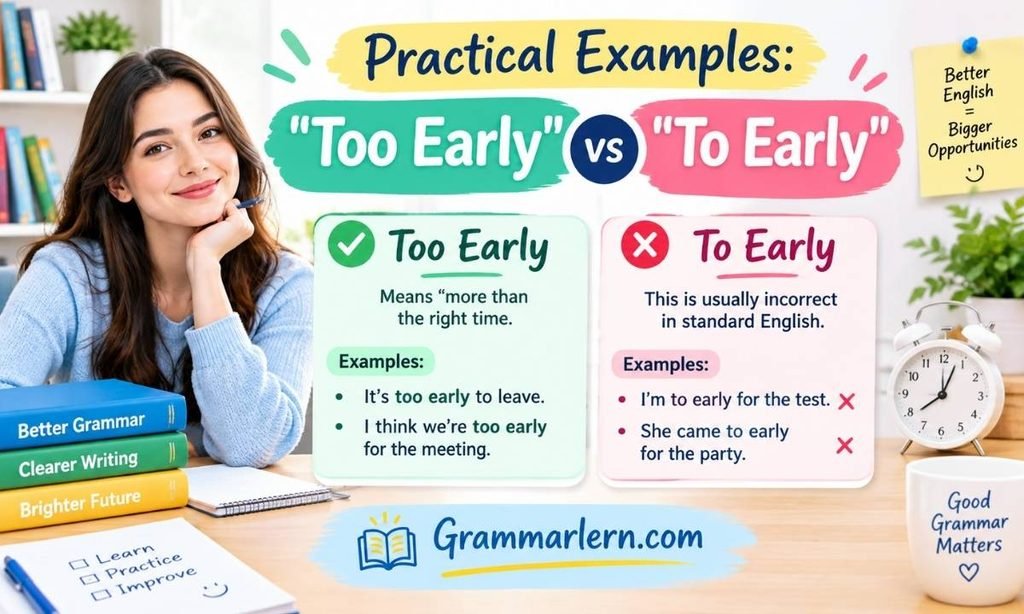
Practical Examples: “Too Early” vs “To Early”
Correct Uses of “Too Early”
- It’s too early to know the results.
- We left too early and had to wait outside.
- Calling her now would be too early.
- The bakery opens too early for most commuters.
Every example points to timing that’s ahead of what’s ideal. That’s the signature of too early.
Advanced Cases: When “Too” and “To” Appear Together
“Too Early to + Verb” Explained
This pattern shows up constantly in everyday English: too + adjective + to + verb.
- too early to tell
- too tired to continue
- too late to apologize
Each word plays its own role. Too signals excess, early describes timing, and to + verb names the action that’s premature. Nothing overlaps, and nothing breaks.
You’ll also see to appear near early without modifying it directly:
- It’s too early to decide. (to introduces “decide,” not “early”)
- She woke up early to study. (to introduces “study”)
- He left early to avoid traffic. (to introduces “avoid”)
In all three, too either isn’t there or it modifies early separately from whatever to is doing. Once you spot that pattern, this “advanced” case stops feeling advanced at all.
Too Early vs Too Soon vs Very Early: What’s the Real Difference?
These three phrases feel interchangeable, but each carries its own shade of meaning.
Too early usually points to a specific time that’s ahead of schedule, like arriving too early for an appointment. Too soon leans toward something happening prematurely relative to an event or expectation, such as joking too soon after bad news. Very early simply means earlier than usual, with no negative judgment attached — waking up very early to catch a sunrise is neutral, even admirable.
The key difference: too early and too soon both carry a sense that the timing was a problem. Very early doesn’t.
Is “Too Early” the Same in British and American English?
Yes. Too early works identically in both British and American English, with no spelling or usage differences at all.
Unlike words such as “colour/color” or “realise/realize,” the to/too distinction isn’t a regional variation. It’s a universal grammar rule, and to early is incorrect everywhere English is written, whether you’re following British, American, Australian, or any other standard.
Related Word Confusions: To vs Too vs Two
To and too aren’t the only members of this confusing trio. Two joins the group as a third homophone with yet another job entirely.
| Word | Function | Example |
| To | Preposition / infinitive marker | Walk to school; want to leave |
| Too | Excess or “also” | Too loud; me too |
| Two | The number 2 | Two apples |
All three sound identical, which is exactly why writers mix them up. If you already double-check to vs too, it’s worth extending that same habit to two whenever numbers show up in your sentence.
Insights from Grammar Experts and Style Guides
Dictionaries and style guides agree without exception: too functions as an adverb meaning “excessively” or “more than enough,” and that’s precisely its role in too early. Standard references like Merriam-Webster define “too” this way, and no major style guide — academic, journalistic, or business — lists “to early” as an accepted alternative.
If you ever spot “to early” in a published piece, it’s an editing slip, not a legitimate variation.
Quick Reference Table: “To” vs “Too” with “Early”
| Phrase | Correct? | Why |
| too early | Yes | Shows excess timing |
| to early | No | “Early” isn’t a verb |
| too early to decide | Yes | Correct too + adjective + to + verb structure |
| early to rise | Yes (on its own) | “To” introduces the infinitive “to rise” correctly |
| way too early | Yes | Intensifier + too + early, still correct |
Keep this table bookmarked. It settles almost every version of this question in one glance.
Synonyms and Opposite of “Too Early”
Need a different way to say too early? Try one of these:
- prematurely
- ahead of schedule
- before time
- excessively early
Example: The announcement came prematurely, before the results were finalized.
The direct opposite of too early is too late.
Example: We arrived too late to catch the opening act.
Common Errors and How to Avoid Them
Most too early / to early mistakes come from habit, not ignorance. Here’s what typically goes wrong, and how to fix it:
- Writing by sound instead of checking sentence structure
- Typing fast and trusting autocorrect to catch every error
- Copying casual texting habits into formal writing
- Skipping a second read-through before hitting send
The fix is simple. Pause on any to/too, ask whether a verb follows it, and read the sentence aloud once before you send it. That one habit catches almost every version of this mistake.
Memory Tricks That Actually Work
The “Extra O” Rule
Too has one extra “o” compared to to, and that extra letter is your memory cue. Extra letter, extra meaning. When something is excessively early, reach for the word with the extra “o.”
The Verb Test
Ask yourself one question: can a verb follow “to” here? If the answer is no, “to” doesn’t belong in that spot.
Replace Test
Try swapping too for “excessively.” If the sentence still makes sense, as in “it’s excessively early,” you’ve picked the right word.
Frequently Asked Questions
Is it “too early” or “to early”?
“Too early” is correct. “To early” isn’t a valid phrase in standard English, since “to” needs a verb right after it, and “early” isn’t one.
What does “too early” mean?
It means earlier than expected, necessary, or appropriate, describing timing that happens before the ideal moment.
Why is “too early” correct in English grammar?
Because “too” functions as an adverb of degree, showing excess. It modifies “early” the same way it modifies “hot,” “fast,” or “loud” in other sentences.
Can “to” ever be used before “early”?
Only when “to” is introducing a separate verb nearby, like “early to bed” or “she left early to catch the train.” In those cases, “to” isn’t modifying “early” directly; it’s doing its own job elsewhere in the sentence.
Is it “too early to tell” or “to early to tell”?
“Too early to tell” is correct. This follows the exact too + adjective + to + verb pattern, and swapping in “to” instead of “too” breaks the structure.
What’s the difference between “to” and “too”?
“To” is a preposition or infinitive marker showing direction or connecting to a verb. “Too” is an adverb meaning “excessively” or “also.” They sound identical, but they serve completely different roles in a sentence.
Conclusion
Once you understand what too and to actually do in a sentence, this mistake stops being confusing. Too early is the only correct option whenever you’re describing something happening ahead of schedule, and to early simply has no legitimate place in standard English.
Keep the extra-o trick in your back pocket, run the verb test when you’re unsure, and you’ll never second-guess this pair again. Small grammar fixes like this one make your writing look sharper, and too early is one of the easiest to lock in for good.