

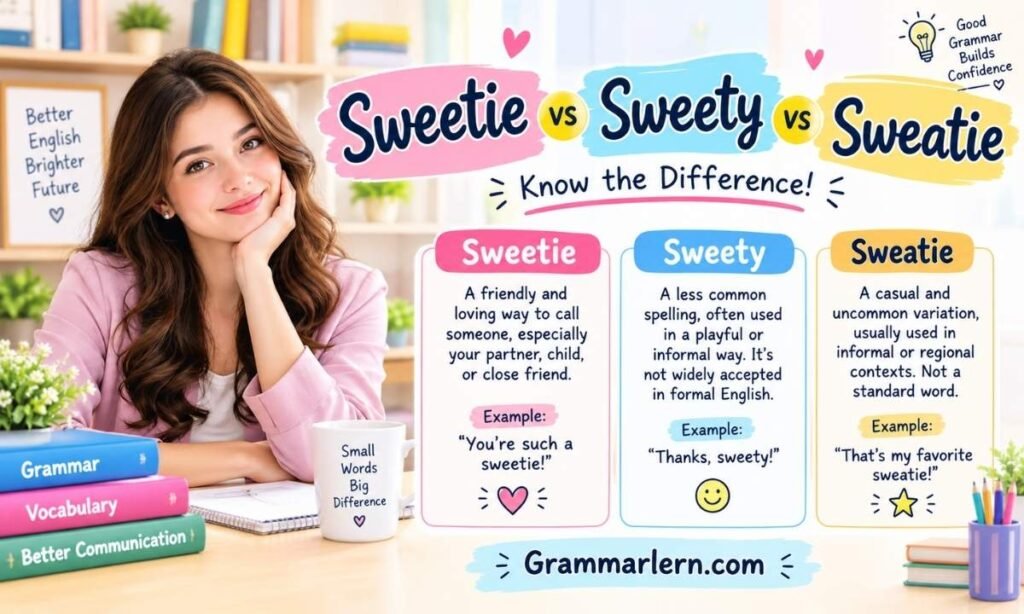
You typed “sweetie.” Then doubt hit was it “sweety”? Or “sweatie”? Only one spelling is actually correct, and the other two don’t mean what you think.
Here’s the quick answer: “sweetie” is the standard, dictionary-correct spelling of this term of endearment. “Sweety” is a common informal misspelling, and “sweatie” often means something completely different sometimes literally sweaty. Get this wrong, and your affectionate nickname can land the wrong way.
Quick Answer: Which Spelling Is Correct?
“Sweetie” is the only correct spelling. It’s the version you’ll find in every major dictionary, and it’s the safe, grammatically correct choice for texts, emails, and everyday speech.
“Sweety” isn’t wrong because it sounds different it’s wrong because English never standardized that ending for this affectionate nickname. And “sweatie” isn’t really a recognized word at all. Most of the time it’s either a typo for “sweetie” or a nod to “sweaty.”
| Word | Status | Meaning | Best Use |
| Sweetie | Correct spelling | Term of affection | Everyday speech, texts, casual writing |
| Sweety | Informal misspelling | Same meaning, nonstandard spelling | Avoid in anything you want to look polished |
| Sweatie | Incorrect usage | Rarely means “little sweaty one”; usually a typo | Avoid entirely |
Sweetie vs Sweety vs Sweatie: Why These Spellings Confuse People
English didn’t hand down one tidy rule for words like this, so people end up guessing. All three spelling variations sound nearly identical when spoken, which is exactly where the confusion starts.
A few things push writers toward the wrong spelling without them even noticing:
- Autocorrect isn’t always right. It sometimes lets “sweaty” slip through where “sweetie” was meant.
- Fast typing on a phone invites errors. One extra or missing letter and you’ve landed on a different word entirely.
- Similar words create bad habits. “Beauty,” “pretty,” and “cutie” all end differently than you’d expect, and that inconsistency rubs off on related terms.
- Non-native speakers often default to phonetic spelling. If it sounds like “sweet-ee,” writing it as “sweety” feels logical, even though it isn’t the standard spelling.
None of this makes the mistake embarrassing. It just means the correct usage is worth learning once and remembering for good.
Sweetie vs Sweety: The Real Difference

Sweetie The Correct, Standard, Universally Accepted Spelling
Every dictionary agrees on this one: sweetie is the correct spelling, full stop. It comes from “sweet,” and it functions as an affectionate nickname for someone you care about a classic term of endearment in everyday English.
You’ll hear it constantly in ordinary conversation:
- “Thanks for grabbing that, sweetie.”
- “How was school today, sweetie?”
- “You did great, sweetie.”
It works for partners, kids, close friends, and family. The tone stays warm without sounding overdone.
Also Read This Any Problem or Any Problems? The Correct Usage Explained
Sweety The Common Misspelling That Appears Everywhere
“Sweety” shows up constantly online, but that popularity doesn’t make it correct. It’s a spelling variation that happens to look plausible, mostly because so many affectionate words end in a “y” sound.
Here’s the honest take: using “sweety” once in a casual text won’t confuse anyone. But it’s not a spelling you want in an email, a caption for a business page, or anything you’re putting your name on professionally. Save “sweetie” for that.
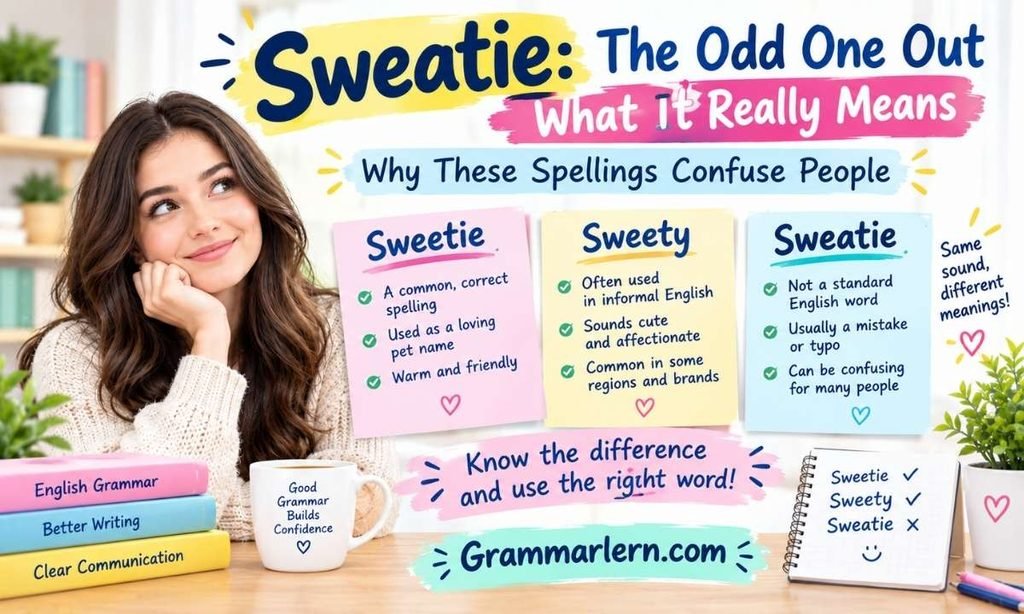
Sweatie: The Odd One Out What It Really Means
What Sweatie Actually Means
Taken literally, “sweatie” would describe someone who sweats a rough diminutive of “sweaty.” It’s not a word you’ll find used seriously in standard English, and it’s certainly not a recognized term of endearment.
Most people who type it didn’t mean to. It usually shows up in one of two ways: a typing slip aimed at “sweetie,” or an autocorrect swap nobody caught before hitting send.
Sweatie vs Sweaty A Common Typing Mishap
“Sweaty” describes someone covered in sweat after a workout, on a hot day, during a nervous moment. “Sweatie” tries to turn that into a cute nickname, and it just doesn’t work that way in proper English.
The mix-up usually plays out like this: you meant to write “you’re such a sweetie,” and what landed on the screen was “you’re such a sweatie.” The message goes from affectionate to accidentally funny in one letter.
Is Sweatie Ever Used as a Pet Name?
Rarely, and almost never on purpose. A handful of people use it as a joke between close friends, but it’s not something you’ll find recommended anywhere as a genuine pet name. If your goal is to sound sweet, this isn’t the word for it.
Other Common “Sweetie” Terms You’ll See
Sweetie Pie Meaning
“Sweetie pie” is an extra-affectionate variation of “sweetie,” often used for children or a partner in a playful, old-fashioned way. It carries the same warmth as the original word but with a softer, more nostalgic feel think of how a grandparent might address a grandchild.
Sweetie Girl What It Implies
“Sweetie girl” usually shows up as a nickname for a daughter, a young child, or sometimes a pet. It leans affectionate and gentle rather than romantic, and it’s common in family conversations rather than formal writing.
Sweetie Fruit A Different Word Entirely
Here’s a genuinely different meaning worth knowing: “Sweetie” is also the name of a real citrus fruit, a cross between a grapefruit and a pomelo, known for being less bitter than a standard grapefruit. If you’ve spotted “sweetie fruit” in a grocery store or recipe, that’s what it’s referring to nothing to do with pet names at all.
“Sweetie” as British English for Candy
In British English, “sweetie” (often “sweeties” in the plural) also means candy the kind you’d buy at a corner shop. A parent in the UK telling a child “no more sweeties before dinner” isn’t talking about affection at all. This regional meaning runs alongside the pet-name sense without ever overlapping with it.
Pet Names in American English and Where “Sweetie” Fits

Why People Use Pet Names
Pet names exist to soften language and build closeness. A quick “sweetie” or “honey” tells someone you’re comfortable with them without needing extra words. They show up most in relationships where warmth already exists you wouldn’t reach for one with someone you just met.
Common Pet Names in American English
| Casual | Romantic | Family |
| Sweetie | Babe | Honey |
| Cutie | Darling | Sweetheart |
| Pal | Love | Kiddo |
Why “Sweety” and “Sweatie” Don’t Fit the Pattern
Every legitimate pet name on that list has a settled, dictionary-backed spelling. “Sweety” and “sweatie” break that pattern they look like typos next to correctly spelled words, which can make a message feel careless even when the sentiment behind it is genuine.
Where These Words Come From: The History Behind Sweet, Sweetie & Sweety
The Origin of “Sweet”
“Sweet” traces back to the Old English word swēte, which originally described taste before it grew to describe personality. By the 1300s, English speakers were already using it to talk about people they found pleasant or lovable, not just food.
How “Sweetie” Developed
English has a long-standing habit of adding “-ie” to make a word feel smaller or more affectionate “dog” becomes “doggie,” “mom” becomes “mommy.” “Sweet” followed the same pattern, turning into “sweetie” as a natural, tender form of the word.
How “Sweety” Emerged
“Sweety” doesn’t have that kind of etymology behind it. It’s a product of modern habits quick typing, casual online writing, and the influence of words like “beauty” and “pretty” that end similarly. It didn’t evolve through dictionaries; it just became common through repetition and informal usage.
Also Read This Any Problem or Any Problems? The Correct Usage Explained
Context Matters: When to Use These Terms (and When to Avoid Them)
When to Use “Sweetie”
“Sweetie” fits naturally with people you’re genuinely close to: a partner, a child, a close friend, or a family member. It works well when you’re comforting someone or offering quick encouragement, like “You’ve got this, sweetie.”
When You Shouldn’t Use Pet Names
Skip pet names with coworkers, clients, strangers, or anyone in a first conversation. In those settings, “sweetie” can come across as overly familiar or even condescending, no matter how well you meant it.
Recognizing the Fine Line
The right call depends on the relationship, not the word itself. What feels warm to one person can feel intrusive to another, so read the room before you use it especially with someone you don’t know well.
Choosing the Right Word: Practical Tips You Can Use Today
Spell It Correctly Every Time
When in doubt, write “sweetie.” It’s the version every dictionary recognizes, and it never looks like a spelling mistake.
Avoid “Sweety” Unless It’s Playful
Save “sweety” for casual texts where the tone is already relaxed and the relationship is close. Keep it out of anything you’d want to look polished or professional.
Treat “Sweatie” as a Mistake to Avoid
Unless you’re specifically talking about sweat, there’s no real reason to use “sweatie.” Treat it as a typo to catch before you hit send.
Etiquette Tips for Using Pet Names
- Watch how the other person reacts if they seem uncomfortable, stop.
- Match the pet name to how close you actually are.
- Never use one with someone who has authority over you, or vice versa.
Personal vs Professional Examples
| Situation | Appropriate? | Example |
| Texting a partner | Yes | “Good morning, sweetie!” |
| Emailing a coworker | No | “Hi sweetie, can you send that file?” |
| Talking to your child | Yes | “It’s okay, sweetie, we’ll fix it.” |
| Customer service chat | No | “Thanks sweetie, have a great day!” |
Frequently Asked Questions
Is “sweety” ever correct?
No. “Sweety” is a common misspelling of “sweetie.” It’s understood in casual writing, but it’s not the standard spelling.
What does “sweatie” mean?
Taken literally, it would mean someone who sweats. In practice, it’s almost always a typo for “sweetie” or an autocorrect mistake.
Can I call a coworker “sweetie”?
It’s best avoided. Pet names like this can come across as too familiar or unprofessional in a workplace setting, even with good intentions.
What does “sweetie pie” mean?
It’s an affectionate variation of “sweetie,” often used for children or a partner, with a slightly old-fashioned, gentle tone.
Is “sweetie” the same as candy in British English?
Not quite the same usage. In British English, “sweetie” can also mean a piece of candy, separate from its use as a term of affection.
Is there a fruit called “sweetie”?
Yes. “Sweetie” is the name of a citrus fruit, a cross between grapefruit and pomelo, known for a milder, less bitter taste.
Final Thoughts
The rule here is simpler than it feels in the moment: “sweetie” is the correct spelling, and it’s the one worth defaulting to whether you’re texting a partner or writing something more polished. “Sweety” is a misspelling that slides by in casual conversation, and “sweatie” is best left out entirely unless you’re actually talking about sweat.
Once you know the correct usage, the choice becomes automatic. Stick with “sweetie” for anything affectionate, save the variants for context where they genuinely fit, and your writing will read exactly the way you meant it to.
1 thought on “Sweetie vs Sweety vs Sweatie: Which Is Correct?”