

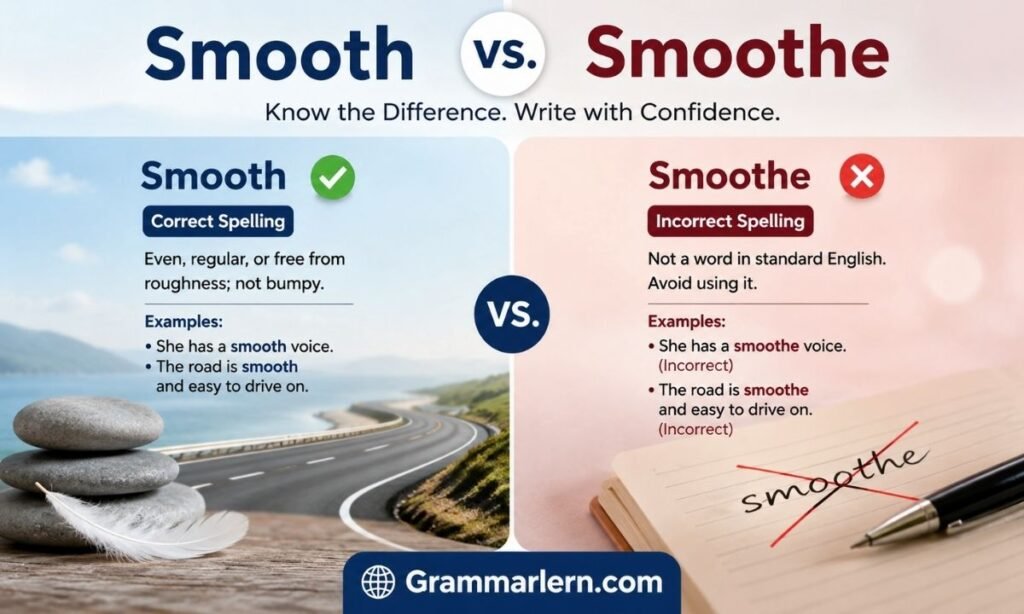
Ever paused mid-sentence, unsure whether to write “smooth” or “smoothe”? You’re not alone — this tiny extra letter confuses even experienced writers. The good news is that the answer is simple, and you’re about to learn it in seconds.
“Smooth” is the correct spelling in modern English, used as both an adjective and a verb. “Smoothe” is a common misspelling, and understanding why will help you write with confidence every single time.
Smooth vs. Smoothe — What’s the Difference?
The short answer is straightforward: “smooth” is the only standard, dictionary-recognized spelling, while “smoothe” is a nonstandard variant that most style guides and editors treat as an error.
Both words are meant to describe the same idea — something even, flat, polished, or free of rough edges. The difference isn’t in meaning; it’s purely in spelling. “Smooth” works as an adjective, a verb, and even informally as an adverb in casual speech (“drive smooth”), while “smoothe” carries no separate function of its own. It simply mimics the sound of “smooth” with an extra letter tacked on.
Once you understand why English never needed that extra “e,” the confusion disappears for good.
The Correct Spelling: Why “Smooth” Is the Only Standard Form
Every major dictionary — from Merriam-Webster to Oxford — lists “smooth” as the sole correct spelling for this word’s adjective and verb forms. There is no regional variant, no historical form, and no accepted alternate spelling that includes a silent “e.”
Writers sometimes borrow patterns from similar-sounding word pairs, assuming English spelling should behave consistently everywhere. But spelling in English isn’t built on universal rules — it’s built on the individual history of each word, and “smooth” simply never developed a silent “e” form.
Why English Doesn’t Add a Silent E Here
A silent “e” at the end of an English word usually does one of three jobs:
- It lengthens the vowel sound before it (as in “rid” becoming “ride”).
- It softens a preceding consonant (as in “race” or “dance”).
- It follows specific consonant clusters that require it for pronunciation.
“Smooth” already has a long vowel sound, a double “o,” and a soft “th” ending. Adding a silent “e” would change nothing about how the word is pronounced or read — which is exactly why English never adopted it. The spelling stayed simple because there was no functional reason to complicate it.
Where the Confusion Comes From
If “smooth” is so clearly correct, why does “smoothe” keep appearing online, in emails, and even in some published writing? A few patterns explain it:
- Mishearing the “th” sound, which can make the word feel like it needs an extra letter to “complete” it visually.
- Overcorrecting based on similar word pairs like breathe, clothe, and bathe (more on this below).
- Stylized branding, where companies intentionally misspell words to stand out.
- Assuming formality, since longer spellings sometimes feel more “official” to inexperienced writers.
None of these reasons make “smoothe” correct — they simply explain why the mistake spreads so easily.
Word Origin: Where Does “Smooth” Come From?
The word “smooth” traces back to Old English “smōð,” meaning free from roughness or irregularity. Over centuries of language evolution, the spelling simplified into the modern “smooth” we use today, while the meaning stayed remarkably consistent — describing surfaces, actions, and even personalities that are even, easy, or free from friction.
Because the word’s spelling was already settled long before modern English standardized its dictionaries, “smoothe” never had a historical foothold to begin with. It’s a modern-day error, not an old form resurfacing.
Smooth as an Adjective
As an adjective, “smooth” describes something with an even, consistent, or uninterrupted surface, feeling, flow, or manner. It’s one of the most versatile descriptive words in English, covering everything from physical texture to personal charm.
1. Physical Texture
This is the most literal use of the word — describing surfaces that are free of bumps, grooves, or roughness.
- A smooth table
- Smooth skin
- Smooth stones
2. Effortless or Flowing Motion
“Smooth” also describes movement or processes that happen without interruption or difficulty.
- A smooth transition
- A smooth flight
- Smooth dancing
3. Polished, Refined, or Impressive
In professional or performance contexts, “smooth” signals confidence and skill.
- A smooth performance
- He gave a smooth presentation
4. Social Charm
Informally, “smooth” describes someone persuasive, confident, or charismatic — sometimes with a hint of slyness.
- “He’s a smooth talker.”
In short:
As an adjective, “smooth” means even, easy, polished, or pleasant — and the exact meaning shifts naturally depending on context, whether you’re talking about a surface, a process, or a personality.
Smooth as a Verb
As a verb, “smooth” means to make something even, flat, polished, or free from bumps or irregularities — whether that “something” is physical or situational.
Common uses:
- Smooth the fabric
- Smooth your hair
- Smooth the icing on a cake
- Smooth out a misunderstanding
Writers frequently pair “smooth” with a preposition to add nuance as a phrasal verb:
| Verb Form | Meaning |
| Smooth out | Remove bumps or wrinkles |
| Smooth over | Reduce conflict or tension |
| Smooth away | Remove obstacles |
Conjugation of “Smooth” (Verb)
Here is the complete, correct conjugation table for “smooth” as a verb:
| Tense | Form | Example |
| Present | smooth / smooths | She smooths the fabric. |
| Past | smoothed | We smoothed the edges. |
| Future | will smooth | They will smooth the path. |
| Present Participle | smoothing | He is smoothing the dough. |
| Past Participle | smoothed | The icing was smoothed perfectly. |
Notice that no form of the verb ever adds a silent “e.” The only letter change happens naturally with the regular past-tense “-ed” ending.
Is “Smoothe” a Word?
Put simply: “smoothe” is a misspelling, not a recognized alternate form. It doesn’t appear in standard dictionaries, and style guides consistently flag it as an error. Still, it’s worth understanding exactly why it keeps showing up.
1. People assume it follows “breathe” and “clothe.”
These word pairs shift from a voiceless “th” sound in the noun form (breath, cloth) to a voiced “th” sound in the verb form (breathe, clothe) — and that shift is marked with a silent “e.” “Smooth” doesn’t have a matching noun-verb pair that requires this change, so the pattern simply doesn’t apply.
2. Misleading marketing or branding.
Some brands use stylized spellings for aesthetic appeal — a hypothetical product called “SmootheSkin,” for example. Creative branding doesn’t change standard English spelling rules.
3. Users think adding an “e” makes it more “verb-like.”
There’s a common (but incorrect) instinct that longer spellings look more grammatically “active.” In reality, “smooth” already functions perfectly as a verb without any added letters.
Smooth vs. Smoothen vs. Smoothe
English has three related forms floating around, but only two of them have any real standing.
“Smoothe” → Incorrect
Not found in standard dictionaries. Should be avoided in all writing, formal or casual.
“Smoothen” → Rare but Real
“Smoothen” does technically exist and means “to make something smooth.” However, since “smooth” already works perfectly as a verb, “smoothen” is largely redundant and rarely used in modern writing. Most editors recommend sticking with “smooth” instead.
When Writers Invent Words Like “Smoothe”
Spelling mistakes like “smoothe” usually spread through a mix of misunderstood pronunciation rules, pattern-matching with unrelated word pairs, and simply copying what’s already circulating online. Once enough people repeat an error, it can start to look legitimate — even though frequency online has nothing to do with dictionary accuracy.
In language, correctness comes from established usage and historical development, not from how often a mistake appears in a comment section or social post.
Smooth vs. Sleek
These two words often get used interchangeably, but they emphasize different qualities.
Smooth
Describes texture, flow, or ease.
- Smooth skin
- Smooth jazz
- Smooth ride
Sleek
Focuses on appearance — glossy, stylish, and streamlined.
- Sleek design
- Sleek hairstyle
- Sleek vehicle
Quick Comparison Table
| Word | Focus | Example |
| Smooth | Texture, ease, evenness | Smooth wooden table |
| Sleek | Appearance, shine, design | Sleek smartphone |
Smooth vs. Polished
“Smooth” and “polished” overlap in meaning but aren’t identical.
Smooth
Means even, bump-free, and consistent — often achieved naturally or with minimal effort.
Polished
Means refined or perfected, usually through deliberate effort — whether that’s literal shining or figurative preparation.
- Smooth stone vs. polished stone
- Smooth speech vs. polished speech
- Smooth surface vs. polished surface
“Polished” generally implies a higher, more intentional level of refinement than simply being smooth.
Examples of Correct Usage
Smooth as an Adjective
- The table felt smooth under my hand.
- Her speech was smooth and confident.
- The software provides a smooth user experience.
Smooth as a Verb
- He smoothed the icing with a spatula.
- They smoothed out the wrinkles in the plan.
- She smoothed her hair before the meeting.
Smooth in Idioms
- Smooth sailing — easy progress
- Smooth move (sarcastic) — a bad decision
- Smooth operator — a charming, clever person
Incorrect Examples
- Smoothe the surface
- The road is smoothe
- She smootheed her dress
Corrected
- Smooth the surface
- The road is smooth
- She smoothed her dress
Why Correct Spelling Matters
Getting this one letter right isn’t just about following a rule — it affects how your writing is perceived.
1. Clarity
Readers shouldn’t have to pause and wonder whether a word is real. Correct spelling keeps your message instantly understandable.
2. Credibility
A misspelled word — even a small one like “smoothe” — can quietly signal carelessness to your reader, regardless of how strong your ideas are.
3. Professionalism
In resumes, emails, academic writing, and published content, small spelling errors can undercut an otherwise polished piece of writing.
4. Reader Trust
When your writing is accurate, readers stay confident in your message and are more likely to trust the information you’re presenting.
Frequently Asked Questions
What does “smoothe” mean?
“Smoothe” is not a standard word in modern English. It is a common misspelling of “smooth,” which means even, polished, or free from bumps.
Does “smooth” have an e at the end?
No. “Smooth” never takes an extra “e,” even in its verb form. The only accepted spelling change happens in the past tense, “smoothed.”
Is it “smooth out” or “smoothen out”?
“Smooth out” is the correct and widely used phrase. “Smoothen out” is technically possible but sounds redundant, since “smooth” already works as a verb.
Is “smooth” or “smoothly” correct?
Both are correct, but they serve different roles. “Smooth” is an adjective or verb, while “smoothly” is an adverb used to describe how an action happens, as in “the meeting went smoothly.”
Is “smooth” a verb?
Yes. As a verb, “smooth” means to make something even, flat, or free of wrinkles, such as smoothing fabric or smoothing over a disagreement.
Is “smoothe” used in British English?
No. British English follows the same rule as American English — “smooth” is the only accepted spelling, with no regional exception for “smoothe.”
Final Thoughts
At the end of the day, the rule is simple: “smooth” is always correct, and “smoothe” is a misspelling with no place in standard English writing. Whether you’re describing a texture, a process, or a personality trait, “smooth” covers every use case without needing an extra letter.
Next time you pause mid-sentence wondering which spelling to use, remember this guide. Choosing “smooth” every time keeps your writing clear, credible, and easy for readers to trust.
1 thought on “Smooth vs. Smoothe: Which Spelling Is Correct?”