

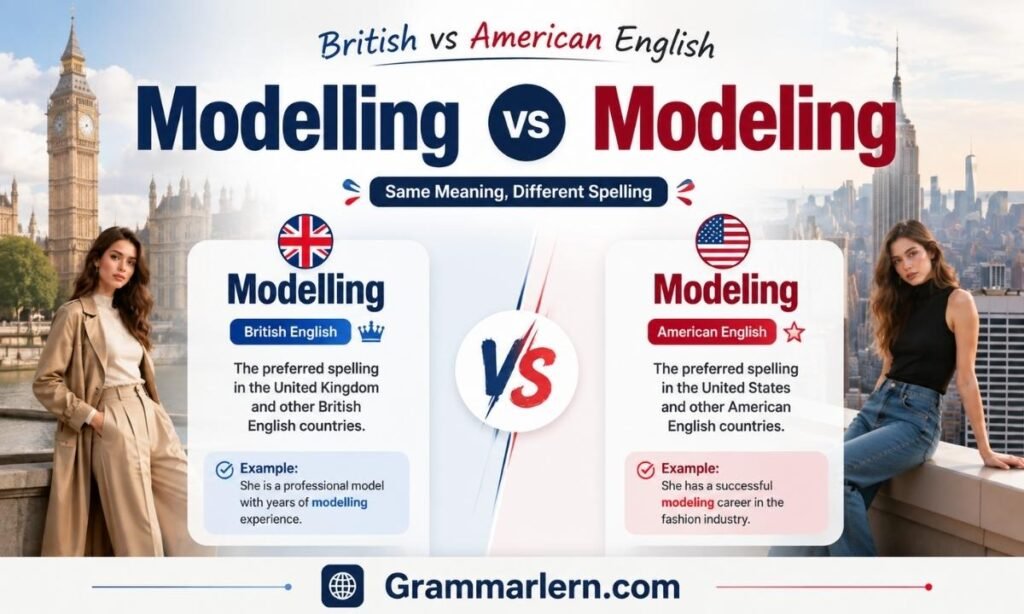
Confused whether to write modelling or modeling? You’re not the only one — this is one of the most searched spelling debates in English today. The truth is simple: both spellings are 100% correct, and the difference comes down to just one thing — which English you’re writing.
American English always uses modeling (one L), while British, Australian, and Canadian English prefer modelling (two Ls). The meaning never changes — only the spelling does. In this guide, you’ll learn the exact rule, see real examples, and finally pick the right spelling for your audience.
Quick Answer
Modeling and modelling mean exactly same thing. Modeling is the standard spelling in American English, while modelling is standard in British, Australian, and Canadian English. Neither one is wrong — the choice simply depends on your audience. This spelling convention has remained stable for decades and still holds true in 2026, across both print and digital writing.
What Does Modeling or Modelling Mean?
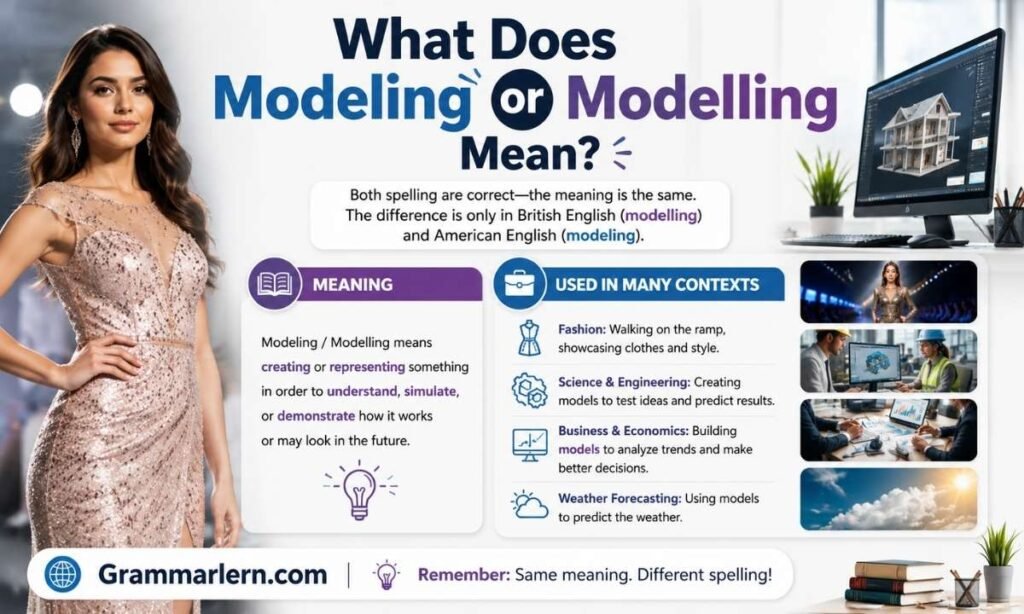
Both words describe the act of creating, representing, demonstrating, or serving as an example of something. The meaning shifts slightly depending on the field it’s used in:
- Fashion modeling
- Data modeling
- 3D modeling
- Business modeling
- Role modeling
- Scientific modeling
No matter the spelling you choose, the underlying activity stays the same.
Grammar Function (Verb, Gerund & Present Participle)
Both spellings come from the base verb model. When used as a gerund, the word acts as a noun (“Modeling is her career”). When used as a present participle, it describes an ongoing action (“She is modeling the new collection”). This grammar structure — covering verb forms, gerunds, and participles — applies identically whether you follow American spelling rules or British spelling conventions.
How Do You Pronounce Modeling or Modelling?
Pronunciation does not change between the two spellings. Both are pronounced the same way — MOD-uh-ling — regardless of the region or spelling style you follow.
Why Are There Two Different Spellings?
The difference comes from a basic consonant doubling rule that splits American English spelling and British English spelling. In American English orthography, words ending in a vowel plus a consonant usually don’t double that consonant before adding “-ing.” In British English, this same final consonant is doubled instead — a spelling convention rooted in traditional English grammar.
This is why we get:
- Traveling → Travelling
- Counseling → Counselling
- Modeling → Modelling
This single rule explains why both spellings exist across books, websites, and professional writing worldwide.
Also Read This Respond vs. Response: The Simple Rule to Get It Right
Modelling vs Modeling Comparison Table
| Feature | Modeling | Modelling |
| English Style | American English | British English |
| Meaning | Same | Same |
| Pronunciation | Same | Same |
| Standard Region | USA | UK, Australia, Canada |
| Accepted in Formal Writing | Yes | Yes |
| Accepted in Academic Writing | Yes | Yes |
Modeling and Modelling Around the World (Regional Usage)
Spelling preference depends heavily on geography. Here’s how different regions handle it:
| Region | Preferred Spelling |
| United States | Modeling |
| United Kingdom | Modelling |
| Australia | Modelling |
| Canada | Modelling |
| New Zealand | Modelling |
| Ireland | Modelling |
Canada is worth noting separately — while it often leans toward American spelling in other words, it follows British convention here, making modelling the standard choice in Canadian writing.
When to Use “Modeling”
Use modeling when writing for an American audience or following U.S. style guides. Common examples include:
- Data modeling improves database design.
- She is modeling the latest fashion trends.
- Financial modeling helps predict business performance.
- 3D modeling is essential in game development.
Most U.S. publications, universities, and businesses use this spelling by default.
When to Use “Modelling”
Use modelling when writing for readers in the UK, Australia, Canada, or other Commonwealth regions. Examples include:
- The firm specialises in financial modelling.
- She is modelling for a luxury brand.
- Computer modelling helps engineers test new designs.
- Climate modelling supports environmental research.
British and Commonwealth publications treat this spelling as the standard.
Examples of Modelling vs Modeling in Different Contexts
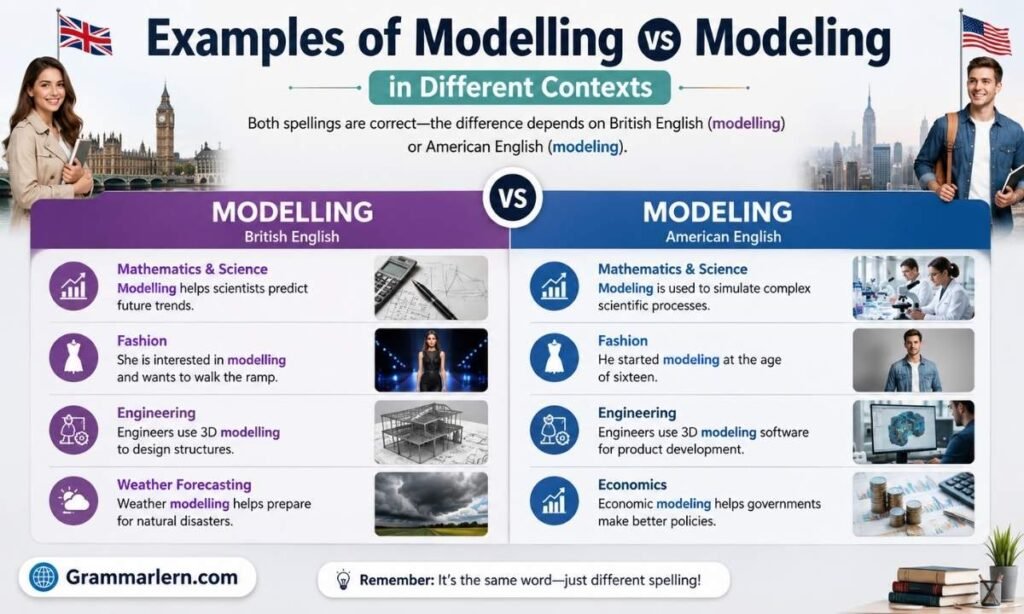
Fashion
American: She is modeling for a leading clothing brand. British: She is modelling for a leading clothing brand.
Business
American: Financial modeling helps investors make smarter decisions. British: Financial modelling helps investors make smarter decisions.
Technology
American: The team focuses on 3D modeling software. British: The team focuses on 3D modelling software.
Science
American: Researchers are modeling disease transmission patterns. British: Researchers are modelling disease transmission patterns.
Mathematics
American: Mathematical modeling helps predict complex system behavior. British: Mathematical modelling helps predict complex system behaviour.
Engineering & 3D Modeling
American: Engineers rely on 3D modeling to test structural designs before construction. British: Engineers rely on 3D modelling to test structural designs before construction.
In every context above, only the spelling changes — the meaning stays identical.
Modelled/Modeled and Modeler/Modeller — Other Related Word Forms
The same spelling rule extends to every inflected form of the word, not just the gerund.
| Word Form | American English | British English |
| Present Participle | Modeling | Modelling |
| Past Tense | Modeled | Modelled |
| Person (Agent Noun) | Modeler | Modeller |
For example, an American writer would say “He modeled his business plan on a successful startup,” while a British writer would say “He modelled his business plan on a successful startup.” Staying consistent with one form throughout your writing avoids mixed signals.
Common Mistakes People Make
Mistake #1: Mixing Styles
Many writers accidentally combine both spellings in the same document, which weakens the consistency of their writing style.
Incorrect: The company specializes in financial modelling and data modeling. Correct (American English): The company specializes in financial modeling and data modeling. Correct (British English): The company specialises in financial modelling and data modelling.
Mistake #2: Assuming One Is Wrong
Some people believe one spelling is incorrect. In reality, both are grammatically valid — the only difference is regional preference, not correctness.
Mistake #3: Ignoring Audience Location
Using British spelling for an American audience — or vice versa — can make writing feel inconsistent. Always match your spelling to where your readers are based.
Also Read This Also Read This Respond vs. Response: The Simple Rule to Get It Right
How to Choose the Right Spelling
Who Is Your Audience?
If your readers are mostly American, use modeling. If they’re British, Australian, or Canadian, use modelling.
What Style Guide Are You Following?
Many style guides — like AP Style or the Chicago Manual of Style for American English, or the Oxford English Dictionary and Cambridge Dictionary for British English — specify a preferred spelling. Always check your required style guide before publishing to maintain consistent language usage.
Are You Writing for SEO?
If your target keyword includes both spellings, it’s fine to mention them together once. But for the rest of your content, stick to a single spelling style for consistency.
Related Words and Spelling Differences
The modeling vs modelling pattern isn’t unique — it applies to several other American and British word pairs:
| American English | British English |
| Traveling | Travelling |
| Counseling | Counselling |
| Labeled | Labelled |
| Fueled | Fuelled |
| Modeling | Modelling |
Recognizing this pattern makes it much easier to switch between American and British writing styles confidently.
Is Modeling More Common Online?
Generally, modeling appears more often across the internet since American English dominates much of the global digital content landscape. That said, modelling remains firmly standard in UK websites, Australian publications, academic journals, and international organizations that follow British English. Search engines recognize both as valid spelling variations of the same word.
Frequently Asked Questions
What Does Modelling Mean?
Modelling means the act of creating, representing, or demonstrating something — whether that’s fashion modelling, data modelling, or scientific modelling. It’s the British spelling of the same word used as “modeling” in American English.
Does Modelling Have One L or Two?
Modelling has two Ls in British, Australian, and Canadian English. In American English, the same word is spelled with one L as “modeling.”
Is It Financial Modelling or Modeling?
Both are correct. Use financial modeling for American audiences and financial modelling for British, Australian, or Canadian audiences — the concept and process remain exactly the same.
Which Spelling Is More Common Online?
Modeling tends to appear more frequently online overall due to the global reach of American English, though modelling remains the standard across UK, Australian, and Canadian content.
What Is the Past Tense of Model — Modeled or Modelled?
In American English, the past tense is modeled (one L). In British English, it’s modelled (two Ls) — following the same regional spelling rule.
Do Modeling and Modelling Mean the Same Thing?
Yes, completely. There is zero difference in meaning, pronunciation, or grammar between the two — only the spelling changes based on region.
Final Thoughts
At the end of the day, choosing between modeling and modelling isn’t about right versus wrong — it’s about knowing your audience and following the correct regional spelling convention. American English keeps it simple with one L, while British, Australian, and Canadian English prefer the doubled L. Once you identify your readers, the correct spelling becomes an easy, automatic choice.
Whichever version you choose, the key is consistency — stick to one style throughout your writing, whether it’s an email, an article, or a business report. Get that right, and your writing will always look polished, professional, and easy to trust, no matter which side of the spelling divide your readers stand on.