


Yes, “looking forward to seeing you” is grammatically correct — and it’s one of the most common phrases in English emails today. The confusion usually comes from one small word: why “seeing” and not “see.”
The answer lies in a simple grammar rule most people never learned. Once you understand it, you’ll never doubt this phrase again — and you’ll also discover 50+ natural alternatives to keep your writing fresh.
Quick Answer
“Looking forward to seeing you” is 100% correct English. In this phrase, “to” works as a preposition rather than part of an infinitive verb, and prepositions are always followed by a gerund (the “-ing” form). That’s why “seeing” is right and “see” is wrong. The phrase works equally well in emails, texts, and everyday conversation, in both formal and casual settings.
What Does “Looking Forward To Seeing You” Mean?

“Looking forward to seeing you” simply means you feel happy or excited about meeting someone in the near future. It’s a warm, polite way to close an email, end a phone call, or wrap up a conversation before a planned meeting.
People use this phrase across almost every context — a business email to a client, a text to a friend, or a closing line in a job interview follow-up. It signals genuine anticipation without sounding overly emotional, which is exactly why it has stayed so popular in modern English.
For example: “I’m looking forward to seeing you at the meeting on Friday” tells the other person you’re glad the meeting is happening, not just that it’s scheduled.
Is “Looking Forward To Seeing You” Grammatically Correct?
Yes — this phrase follows standard English grammar rules perfectly. The confusion usually comes from one specific question: should it be “to see you” or “to seeing you”?
The rule is simple. In “look forward to,” the word “to” is a preposition, not part of an infinitive. Prepositions are always followed by a noun or a gerund, never a base verb. That’s why “seeing” is correct and “see” is not.
Correct:
- Looking forward to seeing you.
- Looking forward to meeting you next week.
Incorrect:
- Looking forward to see you.
- Looking forward to meet you next week.
This single rule explains nearly every mistake learners make with this phrase, so once it clicks, the confusion disappears for good.
Also Read this Reel vs Real: Meaning, Difference & Correct Usage
Understanding the Grammar of “Look Forward To”
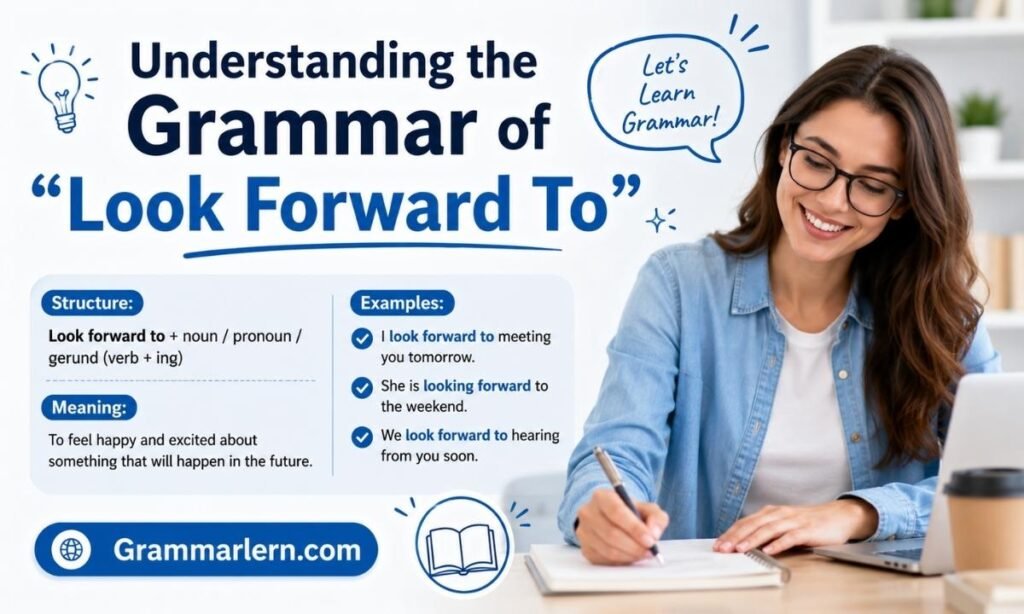
The phrase “look forward to” is a phrasal verb, and its structure trips people up because “to” looks like it belongs to an infinitive (“to see,” “to meet,” “to hear”). It doesn’t. Here, “to” behaves exactly like “at,” “on,” or “in” — a preposition that needs a noun-type word after it.
Since verbs can’t directly follow prepositions, English uses the gerund (verb + “-ing”) to turn the action into a noun-like form. That’s why you’ll see this same pattern repeat itself:
- Look forward to + seeing
- Look forward to + meeting
- Look forward to + hearing
- Look forward to + working
You can also drop the verb entirely and use a plain noun instead, since “to” is a preposition: “I’m looking forward to the weekend,” “I’m looking forward to summer,” “I’m looking forward to it.” Just remember — never leave “to” off completely. Saying only “I’m looking forward” without an object sounds incomplete to a native speaker.
One subtle detail worth knowing: the gerund also carries a slight sense of duration or process, unlike a quick, instant “see.” That’s part of why “seeing” fits the phrase’s tone of anticipation better than a bare infinitive ever could.
When Should You Use “Looking Forward To Seeing You”?
Use this phrase whenever you want to express genuine anticipation about a future meeting with someone you already know. It fits naturally at the end of business emails, before client meetings, after job interviews, and in casual messages to friends or family before a visit.
It works especially well when a meeting is already planned — a call, an event, a scheduled catch-up — because it reflects real, expected anticipation rather than a vague hope.
Examples:
- “Looking forward to seeing you at the conference next month.”
- “Looking forward to seeing you this weekend.”
- “Looking forward to seeing you soon.”
“Looking Forward To Seeing You” vs “Looking Forward To Seeing You Later”
Both phrases are correct, but they carry a slightly different feel. “Looking forward to seeing you” is neutral and works for any upcoming timeframe — tomorrow, next week, or next month. Adding “later” narrows the timing and often implies the same day or a very near, specific moment, such as texting a friend before meeting them that evening.
If no time is mentioned, “seeing you soon” is the safer, more universally understood choice for professional writing.
Is “Looking Forward To Seeing You” Formal or Informal?
This phrase sits comfortably in the middle — it’s neither strictly formal nor purely casual, which is exactly why it’s used so widely. In professional emails to clients, recruiters, or coworkers, it sounds polished and courteous without feeling stiff. In personal messages to friends and family, it feels warm and sincere rather than distant.
Compared to something more casual like “can’t wait to see you,” this phrase reads as more composed. Compared to a stiffer line like “I anticipate our meeting,” it feels more natural and approachable. That flexibility is what makes it one of the safest closing lines in both business and personal writing.
Looking Forward To Seeing You vs Looking Forward To Meeting You
These two phrases are often confused, but the difference comes down to one thing: whether you already know the person.
“Looking forward to seeing you” implies you’ve met before and expect to see them again — a returning client, a colleague, a friend. “Looking forward to meeting you” is reserved for someone you haven’t met in person yet, like a new business contact or a job interviewer.
- “I’m looking forward to seeing you at the reunion.” (you already know them)
- “I’m looking forward to meeting you at the interview.” (first time meeting)
Using the wrong one isn’t a grammar mistake, but it can send a slightly confusing signal about your relationship with the person — so it’s worth getting right.
Looking Forward To Seeing You vs Can’t Wait To See You
Both phrases express excitement about an upcoming meeting, but their tone sits at different points on the formality scale.
“Looking forward to seeing you” is composed and professional, making it appropriate for clients, managers, recruiters, and general workplace communication. “Can’t wait to see you” is more emotional and enthusiastic, which fits close friends, family, or romantic partners far better than a business setting.
If you’re unsure which one to use, default to “looking forward to seeing you” — it’s rarely, if ever, the wrong choice, while “can’t wait” can feel too casual in professional contexts.
Professional Alternatives to “Looking Forward To Seeing You”
Repeating the same closing line in every email gets stale fast. Here are professional alternatives that keep the same meaning while adding variety:
- I look forward to our meeting.
- I look forward to connecting with you.
- I look forward to speaking with you soon.
- I appreciate the opportunity to meet.
- I’m eager to discuss this further with you.
- It will be a pleasure to see you.
- I anticipate our upcoming conversation.
- I look forward to hearing your thoughts.
- I look forward to working together.
- I’m keen to catch up soon.
These work particularly well in client emails, networking messages, and interview follow-ups where you want a professional but not robotic tone.
Casual & Everyday Alternatives
For texts, social messages, or conversations with friends and family, a more relaxed tone usually fits better:
- Can’t wait to see you!
- Counting down the days until we meet.
- So excited you’re coming!
- Can’t wait for our catch-up.
- Really looking forward to it.
- It’ll be so nice to see you again.
- Missing you already — see you soon!
- This is going to be great, see you then.
Save the professional phrases for work-related writing, and keep these casual options for friends, family, or informal chats.
“Looking Forward To Seeing You” In French (and Other Languages)
If you need to translate this phrase, the closest natural French equivalents are:
- “J’ai hâte de te voir” — casual, used with friends or family.
- “Dans l’attente de vous voir” — formal, used in business letters or official emails.
- “Au plaisir de vous voir” — a polite, semi-formal option common in professional correspondence.
Note that a direct word-for-word translation doesn’t always sound natural in other languages — French, Spanish, and most other languages have their own set expressions for anticipation, so it’s better to use the equivalent phrase rather than translating literally.
Examples of “Looking Forward To Seeing You” in Sentences
Seeing the phrase in real context makes it easier to use naturally in your own writing.
Email Examples
- “Thank you for confirming the appointment. I’m looking forward to seeing you on Tuesday.”
- “We appreciate your continued partnership and look forward to seeing you at the annual conference.”
- “I’m looking forward to seeing you at next week’s team meeting to go over the project details.”
Romantic & Personal Examples (Quotes)
- “I’ve been counting down the days — I’m looking forward to seeing you this weekend.”
- “Every day feels a little longer knowing I’ll be looking forward to seeing you soon.”
- “I’m looking forward to seeing you more than words can say.”
These personal examples show how the same core phrase can carry real warmth, not just professional politeness.
Also Read This Also Read this Reel vs Real: Meaning, Difference & Correct Usage
How to Reply to “Looking Forward To Seeing You”
When someone sends this phrase to you, a short, natural reply keeps the conversation warm without overthinking it. Common, native-sounding replies include:
- “Likewise!”
- “Same here — see you soon!”
- “Looking forward to it too!”
- “Me too, can’t wait!”
- “Looking forward to seeing you as well.”
For professional emails, “Likewise, looking forward to our meeting” or “I look forward to it as well” keeps the same polished tone as the original message.
Common Mistakes to Avoid
Even confident English speakers slip up with this phrase from time to time.
Mistake 1 — Using the infinitive instead of the gerund ✘ Looking forward to see you. ✔ Looking forward to seeing you.
Mistake 2 — Dropping “to” entirely ✘ Looking forward seeing you. ✔ Looking forward to seeing you.
Mistake 3 — Missing “am” or “I’m” before “looking” ✘ I look forward to seeing you (used incorrectly as a fragment in casual speech). ✔ I am looking forward to seeing you. / I look forward to seeing you.
Mistake 4 — Using “meeting you” for someone you already know Since “meeting” implies a first encounter, using it for someone you’ve already met can sound slightly off. Stick with “seeing you” once you’ve met before.
Each of these mistakes comes back to the same root cause: forgetting that “to” here is a preposition, not part of an infinitive.
How Native English Speakers Use This Phrase Today
Native speakers use “looking forward to seeing you” constantly, in both speech and writing, because it strikes the right balance — sincere, polite, and easy to understand without sounding forced.
In professional settings, it’s most common as a closing line in emails, right before the sign-off. In personal conversations, it shows up in texts and calls before family visits, holidays, and social plans. Despite newer slang and casual alternatives becoming popular, this phrase hasn’t gone out of style — it remains a dependable, versatile choice for almost any audience.
Whether you’re writing to a manager, a new client, or an old friend, this expression continues to communicate genuine anticipation without any risk of sounding wrong.
Frequently Asked Questions
Is it correct to say “looking forward to seeing you”?
Yes. It’s grammatically correct because “to” functions as a preposition here, which is why “seeing” (a gerund) is used instead of “see.”
What can I say instead of “looking forward to seeing you”?
You can use alternatives like “I look forward to our meeting,” “can’t wait to see you,” or “I’m eager to catch up,” depending on how formal or casual the situation is.
How do you say you are looking forward to seeing someone?
You can say “I’m looking forward to seeing you,” “I look forward to seeing you,” or “I can’t wait to see you,” depending on the tone — the first two work well formally, while the last one is more casual.
How do you reply to “looking forward to seeing you”?
A simple “Likewise!” or “Same here, looking forward to it too!” works well. In formal emails, “I look forward to it as well” keeps the same professional tone.
Is “looking forward to seeing you” formal or informal?
It works for both. It sounds polished enough for professional emails and warm enough for personal messages, which is why it’s used so widely in both contexts.
Is “looking forward to seeing you” the same as “looking forward to meeting you”?
No. “Seeing you” is used when you already know the person, while “meeting you” is reserved for someone you’re about to meet for the first time.
How do you say “looking forward to seeing you” in French?
Common equivalents include “J’ai hâte de te voir” (casual) or “Dans l’attente de vous voir” (formal), though the exact phrase depends on context and tone.
Final Thoughts
“Looking forward to seeing you” is a grammatically correct, versatile phrase that fits naturally into both professional and personal communication. The key grammar rule is simple: since “to” acts as a preposition, it’s always followed by a gerund — “seeing,” not “see.”
Once you understand this rule, you can use the phrase with full confidence in emails, texts, and everyday conversation. And with dozens of professional and casual alternatives available, you’ll never have to repeat yourself or worry about sounding stiff.
Whether you’re closing a business email or texting a friend before a visit, “looking forward to seeing you” remains one of the most reliable, natural ways to express genuine anticipation in English.