

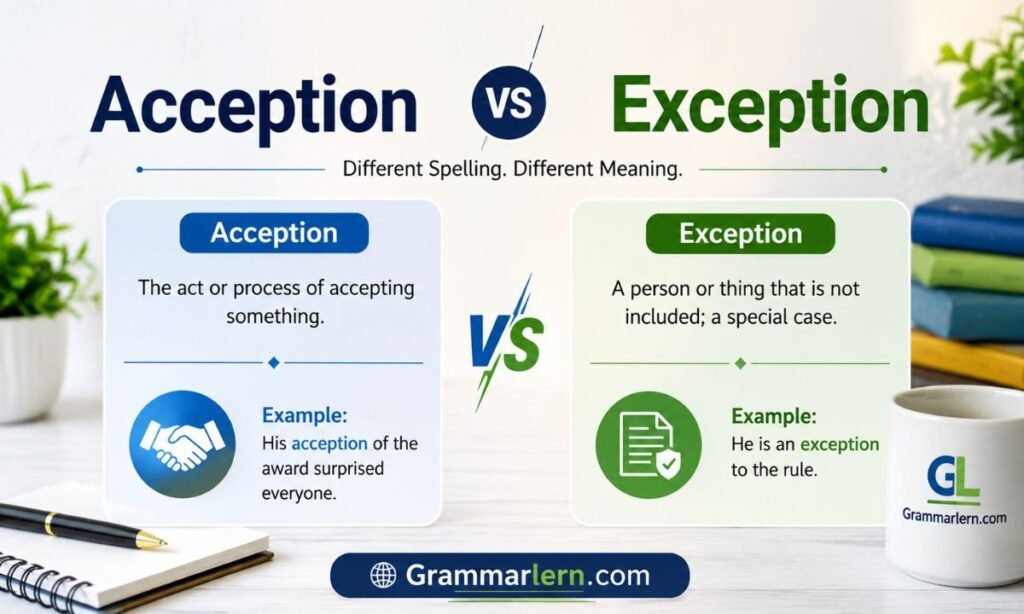
Confused between acception and exception? You’re not alone — this is one of the most common English word mix-ups today. Here’s the fast, clear answer you’re looking for.
Exception is the word you’ll need almost every time you write. Acception, on the other hand, is a rare term mostly limited to dictionaries and linguistics. By the end of this guide, you’ll know exactly which word fits your sentence — and never second-guess yourself again.
Quick Answer
In almost every situation, the correct word is exception, not acception. Exception means something that does not follow a general rule. Acception is a real word, but it is rare and mostly limited to discussions about the meaning of a word in dictionaries or linguistics.
If you are unsure which one to use, exception is almost always the safer choice.
What Does “Exception” Mean?
Exception is a common English noun. It describes someone or something that does not follow the usual rule or pattern.
Simple Definition
An exception is something left out of a general rule.
Examples of “Exception”
- Everyone passed the test, with one exception.
- There are no exceptions to this policy.
- She made an exception for her closest friend.
Common Phrases With “Exception”
- Make an exception
- With the exception of
- No exceptions
- An exception to the rule
These phrases appear often in both American and British English, and they are worth learning if you want your writing to sound natural.
Also Read This Skillset vs Skill Set: Which One Is Actually Correct?
What Does “Acception” Mean?

Acception is a real word, but it belongs to a small, specialized corner of English.
Definition of “Acception”
Acception refers to the accepted meaning or sense of a word, often discussed in dictionaries, theology, or linguistic studies.
Example of “Acception” (Linguistic Use)
- In one acception of the word “light,” it means illumination rather than weight.
Important Note
Many writers assume acception is just another way to spell acceptance. It is not.
- Acceptance means agreeing to or receiving something.
- Acception refers to a specific sense or meaning of a word.
If you mean agreeing to something, always write acceptance, not acception.
Is “Acception” a Word?
Yes, acception is a real English word. It appears in some larger dictionaries, but it is extremely rare in everyday writing. Most native speakers never use it, and it is generally reserved for academic or historical discussions about language.
Acception vs Exception: Side-by-Side Comparison
| Feature | Acception | Exception |
| Meaning | The accepted sense of a word | Something excluded from a rule |
| Commonly Used? | Very rare | Very common |
| Everyday Writing | Almost never used | Frequently used |
| Best Context | Academic, linguistic | Legal, business, casual |
| Example | A rare acception of the term | An exception to the rule |
Why People Confuse Acception and Exception
1. Similar Spelling
Both words end in “-ception,” which makes them look closely related at first glance.
2. Sound Similarity
When spoken quickly, the two words can sound almost the same, especially in casual conversation.
3. Confusion With “Acceptance”
Many people mean to write acceptance or exception, but accidentally type acception instead. This is one of the most common spelling slips in English.
Can Acception and Exception Be Used Interchangeably?
No, they cannot. Although the spelling looks similar, the meanings are completely different.
- Incorrect: There was one acception to the policy.
- Correct: There was one exception to the policy.
If you are writing about a rule, use exception. Acception only fits when you are discussing the meaning of a word itself.
Common Mistakes (And How to Fix Them)
Incorrect:
Everyone was invited with no acception.
Correct:
Everyone was invited with no exception.
Incorrect:
There was one acception to the rule.
Correct:
There was one exception to the rule.
Incorrect:
The teacher made an acception for latecomers.
Correct:
The teacher made an exception for latecomers.
American vs British English Differences
There is no spelling difference between American and British English for these two words.
- Exception is used the same way in both varieties.
- Acception remains rare and specialized in both American and British English.
So if you are unsure, the confusion has nothing to do with regional spelling; it comes down to word choice.
When Should You Actually Use “Acception”?
Acception is appropriate only in a few narrow situations, such as:
- Academic linguistics papers
- Theological or historical texts
- Dictionary definitions discussing word senses
If you’re writing blog posts, emails, essays, or everyday content, avoid acception and use exception or meaning instead.
Also Read This Skillset vs Skill Set: Which One Is Actually Correct?
Real-World Usage Scenarios

In Business Writing
- Correct: This discount applies to all items without exception.
- Wrong: We do not make acception to this policy.
Using the wrong word here can make professional writing look careless.
In Academic Writing
- Correct: There are few exceptions to this theory.
- Correct (rare, linguistic use): In one acception of the term, it implies authority.
Notice that acception only fits when the topic is specifically about a word’s meaning.
Synonyms and Related Words
Synonyms for Exception
- Exclusion
- Anomaly
- Irregularity
- Special case
Related Words
- Except
- Exceptional
- Acceptance
- Accept
Using these related words correctly can also strengthen your overall writing clarity.
Quick Memory Trick
Exception equals exit from the rule. Both words start with “ex,” so if something exits the normal pattern, it’s an exception. Simple and easy to recall.
Frequently Asked Questions
What is the meaning of acception?
Acception refers to the accepted meaning or sense of a word, mostly used in dictionaries and linguistic discussions.
Is it “no acception” or “no exception”?
It is always “no exception.” Acception is not used in this phrase in modern English.
Can you make an acception or exception?
You make an exception, not an acception. Exception is the correct word when talking about rules or exclusions.
Can you use the word “acception” in a sentence?
Yes, but only when discussing a word’s meaning, such as: “This acception of the term appears mainly in older texts.”
Is acception a real word?
Yes, it is a real English word, though it is extremely rare in modern, everyday usage.
What’s the difference between acception and acceptance?
Acceptance means agreeing to or receiving something. Acception refers to a specific sense or meaning of a word. They are not interchangeable.
Final Thoughts
Exception is the word you will need in almost every situation, whether you are writing an email, a report, or a casual message. It clearly signals something that breaks from the usual rule, and it works the same way in both American and British English.
Acception, on the other hand, stays reserved for rare linguistic and academic contexts. Once you remember this simple split, acception vs exception stops being confusing, and your writing gains the clarity it deserves.