


English plurals are often confusing, and roof is a perfect example of that. Do you find yourself wondering whether the correct plural is roofs or rooves? You are not alone. This is one of the most common grammar mix-ups in English.
The good news is that the answer is simple. “Roofs” is the standard and correct plural form in modern English, while “rooves” is a rare and outdated version that survives mostly in old or dialectal writing. This guide breaks down the reason behind the confusion, the grammar rule, and real examples so you can use the right word with confidence.
Quick Answer
Roofs is the correct plural of roof in modern English. Rooves is an old, non-standard variant that dictionaries treat as rare or archaic. If you are writing for school, work, or everyday communication, always choose roofs.
What Does “Roof” Mean?
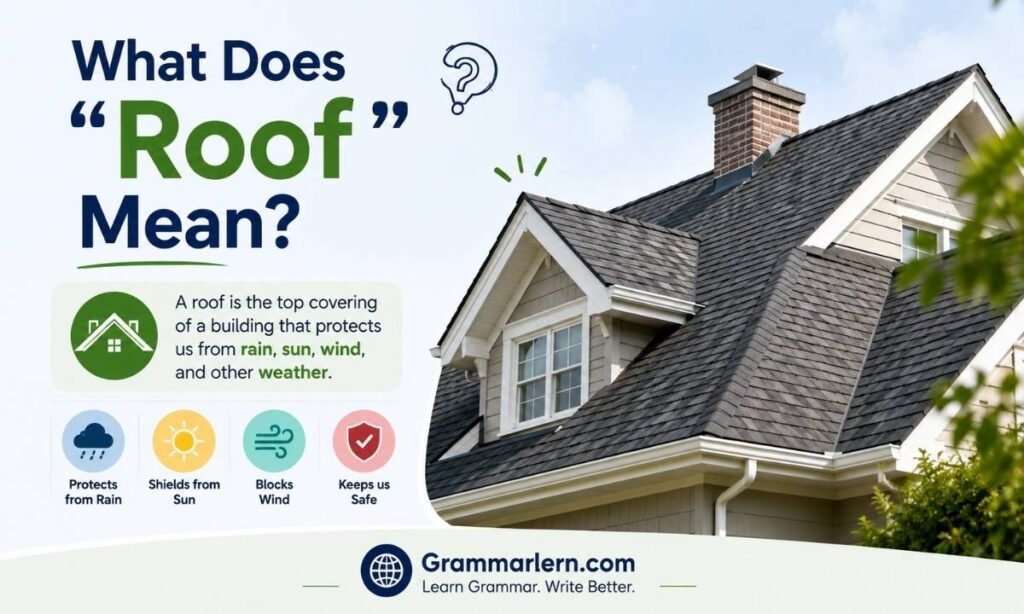
A roof is the top covering of a building, vehicle, or structure. It protects whatever is underneath from rain, snow, sun, and wind. The word is a common noun, and like most English nouns, it needs a plural form when referring to more than one.
Examples of “Roof” in Sentences
- The storm damaged the roof of our house.
- A bird landed on the roof of the shed.
- They replaced the roof after the leak got worse.
Roofs vs Rooves: The Main Difference
The core difference between these two words comes down to modern usage versus historical spelling.
| Word | Meaning | Status Today |
| Roofs | Plural of roof | Standard and correct |
| Rooves | Old plural of roof | Rare, mostly historical |
Dictionaries, editors, and style guides overwhelmingly recommend roofs for any modern writing, whether it is academic, professional, or casual.
Why Do People Think “Rooves” Is Correct?
The confusion exists because several English words ending in -f shift to -ves in their plural form. Familiar examples include leaf becoming leaves, wolf becoming wolves, and knife becoming knives. Since this pattern feels so common, many writers assume roof should follow the same rule and become rooves.
However, English pluralization is not fully consistent. Words like belief, chief, and cliff simply add an -s, and roof follows this same simpler pattern. That is why roofs, not rooves, is the accepted modern form.
Is “Rooves” Ever Correct?
Rooves is not entirely wrong, but its use is limited. You may still come across it in older poetry, classical literature, or regional dialects. In everyday or professional writing, though, it tends to look outdated rather than sophisticated.
Example from Older-Style Writing
- Smoke rose above the village rooves.
This kind of sentence carries a literary, old-fashioned tone that does not fit modern content.
What Do Dictionaries Say? (Oxford, Merriam-Webster & More)
Major dictionaries agree that roofs is the standard plural.
- The Oxford English Dictionary lists rooves as a dialectal variant, not the primary form.
- Merriam-Webster marks rooves as archaic.
- Chambers Dictionary notes that rooves is non-standard in writing, even though it appears occasionally in speech.
- Garner’s Modern English Usage estimates that roofs is used over 500 times more often than rooves in real writing.
Across every major English dictionary, roofs remains the recommended and most widely accepted spelling.
American vs British English: Roofs or Rooves?
Unlike many words that differ between American and British spelling, this one does not split along those lines.
American English
American English strongly prefers roofs in every context, from casual writing to formal documents.
British English
British English also favors roofs. While rooves appears in a few regional dialects, it is not considered standard even in the UK.
Pronunciation Difference
Pronunciation adds another layer of confusion for many speakers.
Also Read This Reinforce or Reenforce: Which Spelling Is Correct?
“Roof” Pronunciation
Some speakers say it as /ruːf/, rhyming with “proof.” Others pronounce it as /rʊf/, closer to “book.” Interestingly, some regional accents pronounce the plural with a “v” sound even though it is spelled roofs. Pronunciation, however, does not change the correct spelling, which remains roofs.
Examples of Correct Usage
Everyday Sentences
- Snow covered the roofs of the cabins.
- The workers repaired several roofs after the storm.
- Solar panels were installed on the apartment roofs.
Professional and Construction-Related Examples
- Metal roofs are increasingly popular in modern architecture.
- Flat roofs require more frequent maintenance.
- The inspector checked all the damaged roofs before filing the report.
Common Mistakes People Make
Mistake #1: Writing “Rooves” Automatically
Many writers default to rooves simply because it feels grammatically “expected.” This is incorrect in modern usage.
- Incorrect: The houses had damaged rooves.
- Correct: The houses had damaged roofs.
Mistake #2: Assuming All -f Words Become -ves
Not every noun ending in -f follows the leaf-to-leaves pattern. Words like beliefs, chiefs, and cliffs prove otherwise, and roof belongs in this same group.
Mistake #3: Mixing Formal and Archaic Styles
Using rooves in a business email, academic paper, or news article can make the writing look inconsistent or outdated rather than intentional.
Grammar Rule Behind Roofs
There is no single universal rule for English nouns ending in -f. Some change to -ves, such as knife to knives and calf to calves. Others simply add -s, such as roof to roofs, safe to safes, and proof to proofs. Since there is no perfect formula, the safest approach is learning these exceptions individually rather than applying one blanket rule.
Related Words and LSI Keywords
Understanding roofs vs rooves becomes easier when you see it alongside related grammar concepts:
- irregular plural nouns
- English pluralization rules
- archaic English spellings
- noun pluralization exceptions
- modern English usage
- correct plural of roof
Roofs in Real-Life Contexts
The word roofs appears constantly across practical, everyday industries where precision matters.
Examples
- Green roofs are becoming popular for urban sustainability projects.
- Tile roofs are common across Mediterranean-style homes.
- Strong winds tore the roofs off several buildings during the storm.
Because roofs is used so frequently in construction, real estate, and insurance documentation, using the correct spelling directly affects how professional your writing appears.
Historical Background of “Rooves”
English spelling was far less standardized centuries ago. During the Middle English and Early Modern English periods, writers often used multiple plural forms for the same word without a fixed rule. Rooves, hoofs, and wharfs all existed as competing spellings during this time.
As dictionaries and publishers began standardizing English in later centuries, roofs became the accepted modern form, while rooves gradually faded into rare, mostly literary use.
Which Form Should You Use Today?
Roofs
For nearly every modern context, roofs is the correct choice. This includes:
- academic writing
- business communication
- journalism and blogging
- everyday conversation
- social media content
Rooves should only appear when you are deliberately aiming for an old-fashioned or poetic tone.
Easy Memory Trick
A simple way to remember the correct form: think of similar words like proofs, chiefs, and beliefs. All of these take a plain -s, not -ves. Since roof follows this same family, roofs is the natural and correct choice.
Frequently Asked Questions
Is it correct to say roofs or rooves?
Roofs is the correct and standard plural form of roof in modern English. Rooves is considered rare and outdated.
When did rooves change to roofs?
Roofs became the standardized plural as English spelling was formalized between the 18th and 19th centuries. Rooves was more common before standardization took hold.
Is it roofs or rooves in Canada?
Canadian English follows the same pattern as American and British English. Roofs is the standard and expected plural form.
Is “roofs” singular or plural?
Roofs is the plural form. The singular form is roof.
Does the Oxford Dictionary accept “rooves”?
The Oxford English Dictionary lists rooves as a dialectal variant, not as the primary or recommended plural. Roofs remains the standard entry.
Is “rooves” a real word?
Yes, rooves is a real word, but it is considered archaic and non-standard in modern writing. It still appears occasionally in older literature and regional speech.
Final Thoughts
The confusion around roofs vs rooves comes from the uneven nature of English plural rules. While some -f words shift to -ves, roof follows the simpler and far more common pattern of adding -s, making roofs the correct and modern plural form. Rooves still lingers in older literature and a few regional dialects, but it has no real place in everyday or professional writing.
Whenever you need the plural of roof, roofs is the safe, accurate, and widely accepted choice for any American, British, or Canadian audience. Keeping this one distinction in mind will make your writing sound clearer, more polished, and more confident every time you use it.