

Confused about born in or born on? You’re not alone — even confident English speakers pause before writing a birth date. The right choice depends on one simple factor: how specific the time or place is.
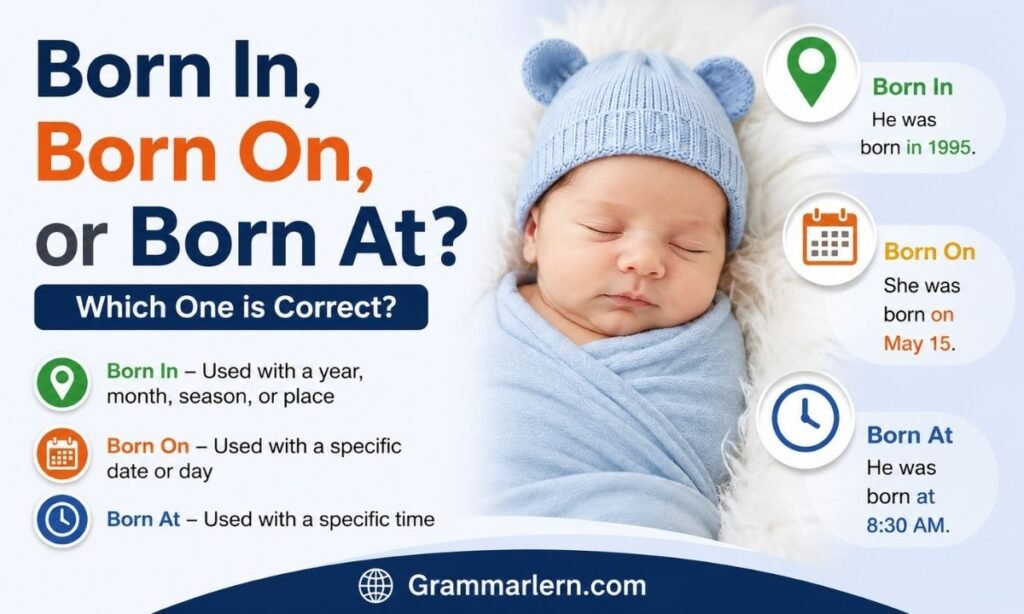
Use born in for years, months, and places like cities or countries. Use born on for exact dates and days, and born at for precise times or addresses. This guide breaks down each rule with clear, real-life examples so you never have to guess again.
Quick Answer
- Born in — years, months, seasons, decades, centuries, cities, and countries.
- Born on — specific dates, days of the week, and holidays.
- Born at — exact times, addresses, or named places like hospitals.
If you can point to it on a calendar square, use “on.” If it’s a larger period of time or a place, use “in.” If it’s an exact moment or precise spot, use “at.”
What Does “Born In” Mean?
“Born in” refers to a broader time period or a physical location. English treats years, months, and places as containers, so anything with duration or size takes “in.”
Use born in for:
- Years: born in 2001
- Months: born in July
- Seasons: born in winter
- Decades and centuries: born in the 1990s
- Countries and cities: born in Pakistan, born in Lahore
What Does “Born On” Mean?
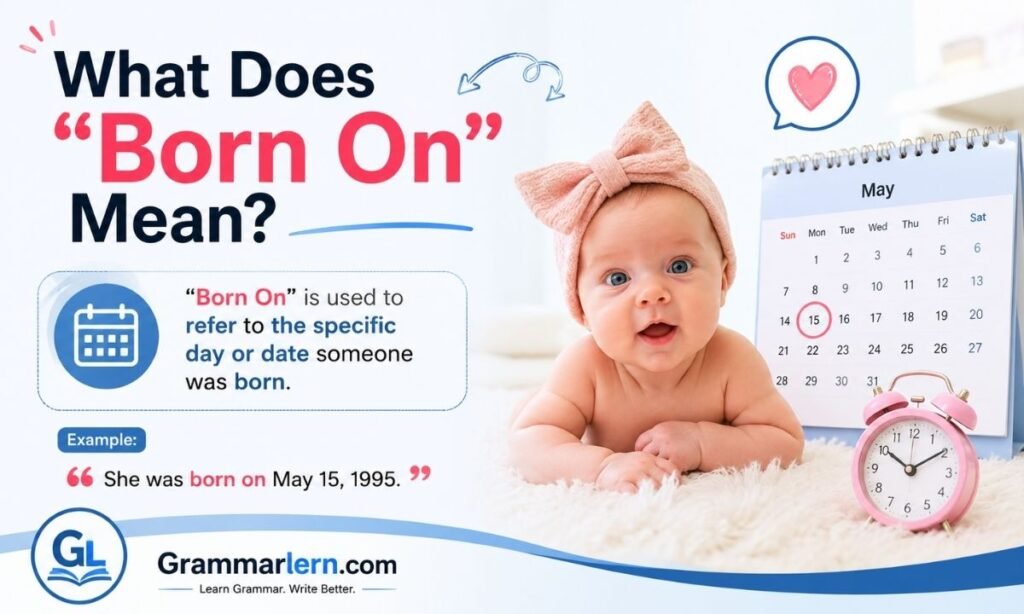
“Born on” ties birth to one exact point in time. It answers a single, specific question: which day?
Use born on for:
- Specific dates: born on July 4
- Days of the week: born on Monday
- Named holidays tied to a specific day: born on Christmas Day
What Does “Born At” Mean?
“Born at” is the most precise of the three. It marks an exact clock time or a specific address, not a broad period.
Use born at for:
- Exact times: born at 6:45 a.m.
- Specific addresses: born at 22 Oak Street
- Named institutions: born at City Hospital
Born In vs Born On vs Born At: The Main Difference
| Preposition | Used For | Example |
| Born in | Years, months, seasons, cities, countries | She was born in 1998. |
| Born on | Specific dates, days, holidays | He was born on May 10. |
| Born at | Exact times, addresses, institutions | The baby was born at 3:20 a.m. |
Simple rule: broad periods take “in,” exact days take “on,” precise points take “at.”
Examples of Born In
- My father was born in 1975.
- She was born in December.
- The author was born in England.
- He was born in the twentieth century.
- They were born in New York.
Examples of Born On
- She was born on Sunday.
- I was born on October 12.
- He was born on June 15, 1999.
- The twins were born on Christmas Day.
Examples of Born At
- She was born at 4:15 p.m.
- He was born at St. Mary’s Hospital.
- The baby was born at their family home.
Combining Time and Place in One Sentence
Full sentences often need more than one preposition at once, and each part still follows its own rule.
- She was born in Lahore on March 3, 1995.
- He was born at City Hospital in Chicago in 1988.
- They were born on a Tuesday in the middle of winter.
Each piece keeps its own logic: place and broad time take “in,” the exact day takes “on,” and a precise location or time takes “at.”
Common Mistakes People Make
- Incorrect: I was born on 1998. Correct: I was born in 1998.
- Incorrect: She was born in July 15. Correct: She was born on July 15.
- Incorrect: He was born on London. Correct: He was born in London.
- Incorrect: I was born in on May. Correct: I was born on May 10, or I was born in May.
- Incorrect: The baby was born in 6 a.m. Correct: The baby was born at 6 a.m.
Do You Always Need a Preposition? (CVs, Forms & Formal Writing)
Not always. In formal documents such as CVs, résumés, and official records, many writers drop the preposition entirely and let the date stand on its own.
- Born 12 June 1985
- Born June 12, 1985
This shortened style is common in biographies, legal papers, and application forms, but it rarely appears in speech. In conversation and narrative writing, “on” is still expected: “I was born on June 12, 1985.”
Why This Grammar Rule Matters
Prepositions are small, but getting them wrong stands out. In interviews, academic writing, and professional documents, a misplaced “on” or “in” briefly pulls the reader’s attention away from your actual message.
Getting this right also signals fluency. It shows natural command of English rather than a direct translation from another language.
Time Prepositions Related to Birth
English uses the same three prepositions across most time expressions, and birth follows the same pattern:
- In for months, years, seasons, and places
- On for days and dates
- At for exact times
Example set: born in 1990, born on March 15, born at 7:30 a.m. The same logic carries over to other events, such as graduated in 2015 but graduated on May 15.
American vs British English
The rule itself doesn’t change between American and British English. Only the date format shifts.
- American English: born on April 3, 2000
- British English: born on 3 April 2000
Both varieties still use “in” for years and places the same way: born in 2000, born in England.
Figurative & Idiomatic Uses of “Born”
“Born” also appears in expressions that describe circumstances rather than literal birth, and these follow fixed patterns instead of the in/on/at rule:
- Born into wealth
- Born with a silver spoon
- Born under a lucky star
These phrases are idiomatic, so their prepositions stay fixed regardless of context.
Tips to Remember the Difference
- If you can point to one square on a calendar, use “on.”
- If the period covers more than a single day, use “in.”
- If you need an exact time or address, use “at.”
Quick mental test: are you naming a container of time (in), a specific point on a calendar (on), or a precise spot (at)?
Quick Practice: Test Your Understanding
Correct these sentences before checking the answers below.
- She was born on 2005.
- He was born in Monday.
- I was born in March 12.
- The baby was born in 6 a.m.
- They were born on New York.
Answers: 1. born in 2005, 2. born on Monday, 3. born on March 12, 4. born at 6 a.m., 5. born in New York.
Frequently Asked Questions
Is it born in or born on a date?
Use born on with a specific date. Example: She was born on August 14.
Which is correct: “I was born in 1971” or “I was born on 1971”?
“I was born in 1971” is correct. Years are treated as broad periods, so they always take “in,” never “on.”
Is it born in May or born on May?
Born in May is correct because May, by itself, refers to a whole month rather than a single day.
Is it born on Monday correct?
Yes. Days of the week are specific points in time, so they always take “on.”
Is there a difference between British and American English?
No. Both use born in and born on the same way. Only the date format changes, not the preposition.
Is it “I was born” or “I am born”?
“I was born” is correct in almost every case, since birth is a completed past action. “I am born” only appears in rare literary or figurative contexts.
Can I use “in” and “on” together in one sentence?
Yes. Each part follows its own rule, as in “She was born in Lahore on March 3, 1995,” where the place takes “in” and the exact date takes “on.”
Final Thoughts
Getting born in or born on right comes down to one question: are you naming a broad period or an exact point in time? Once that distinction feels natural, choosing between in, on, and at stops being a guessing game.
Practice these patterns in your own sentences, and they’ll soon feel automatic rather than memorized. Small details like this are exactly what make your English sound clear, natural, and confident.