

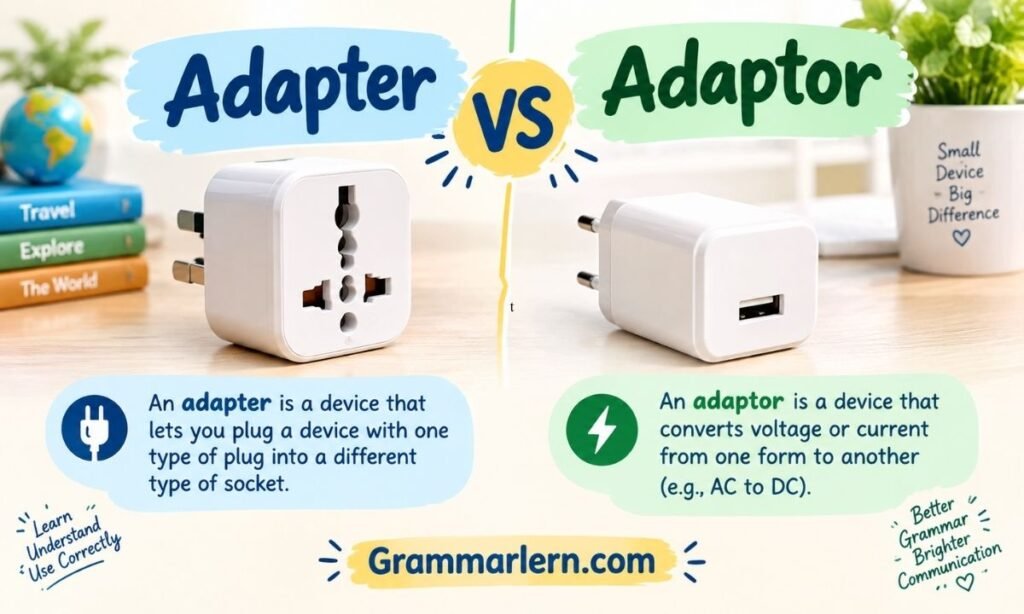
Adapter and adaptor look almost identical, sound the same, and cause constant second-guessing the moment you sit down to write. You’ve probably typed one, paused, and wondered if you just made a mistake.
Here’s the short answer: both spellings are correct, and neither one is grammatically wrong. The real difference comes down to region, context, and consistency, not right versus wrong.
In this guide, you’ll learn exactly when to use each spelling, where the American-versus-British split actually holds up (and where it doesn’t), and which version to pick for clear, professional writing every time.
Quick Answer: Adapter vs Adaptor — Which Is Correct?
Both adapter and adaptor are correct spellings of the same word. Adapter is the more widely used and recommended spelling today, especially in American English and global technology writing. Adaptor remains an accepted variant, mainly in British English. If you’re unsure, use adapter and stay consistent.
Understanding “Adapter” vs “Adaptor”
Both words describe the same thing: a device, tool, or person that makes two incompatible things work together. The spelling doesn’t change the meaning, pronunciation, or function, only how often each version appears depending on style guide, region, and industry.
What Does Adapter Mean?
An adapter is a device that lets two otherwise incompatible systems or devices connect and work together. It can also mean a person who adapts something, such as a screenwriter adapting a novel for film.
What Does Adaptor Mean?
An adaptor carries the exact same meaning as adapter. It’s a spelling variant more common in British English and older technical texts, though modern British publishing increasingly favors adapter too.
Etymology and History of Adapter and Adaptor
Both words trace back to the Latin verb adaptare, meaning “to fit” or “to adjust.” English absorbed the term during the industrial and scientific growth of the 18th and 19th centuries. Historical records show both spellings existing side by side from early on, contrary to the common claim that adaptor came first and adapter is a modern shortcut.
Adapter vs Adaptor Usage in Modern English
Adapter dominates modern usage across nearly every English-speaking region and industry. Product packaging, tech documentation, and online marketplaces overwhelmingly favor adapter, making it the safer default for most writing today.
American English vs British English Usage
A common claim is that adapter is strictly American and adaptor strictly British. That’s an oversimplification. Long-term usage data shows adapter is actually the more frequent spelling in both American and British English books, though adaptor appears somewhat more often in British writing. The regional split is real, but it’s a matter of degree, not a hard rule.
What Do Dictionaries and Style Guides Say About Adapter vs Adaptor? (Oxford, AP, Chicago)
| Source | Preferred Spelling |
| Merriam-Webster | Adapter (adaptor as variant) |
| Oxford Dictionary | Both; adapter more common |
| AP / Chicago Style | Adapter |
If you’re writing US content or following AP or Chicago style, adapter is the standard choice. For traditional British English content, adaptor is still acceptable.
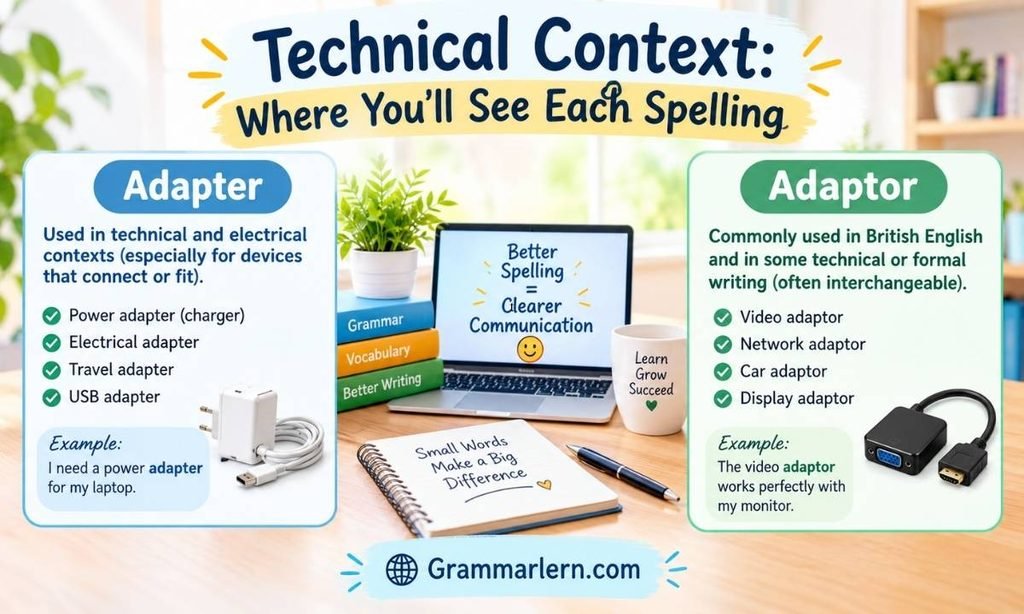
Technical Context: Where You’ll See Each Spelling
Electronics and Hardware
Chargers, power bricks, and USB adapters almost always use “adapter” on packaging and manuals, regardless of the manufacturer’s home country.
Engineering and Mechanical Design
Older mechanical and industrial documentation, especially legacy British texts, sometimes uses adaptor, though newer engineering standards favor adapter.
Software and Network Architecture
In software design, the “Adapter Pattern” describes making incompatible interfaces work together. Developers consistently spell it adapter, never adaptor.
Different Types of Adapters (With Real Examples)
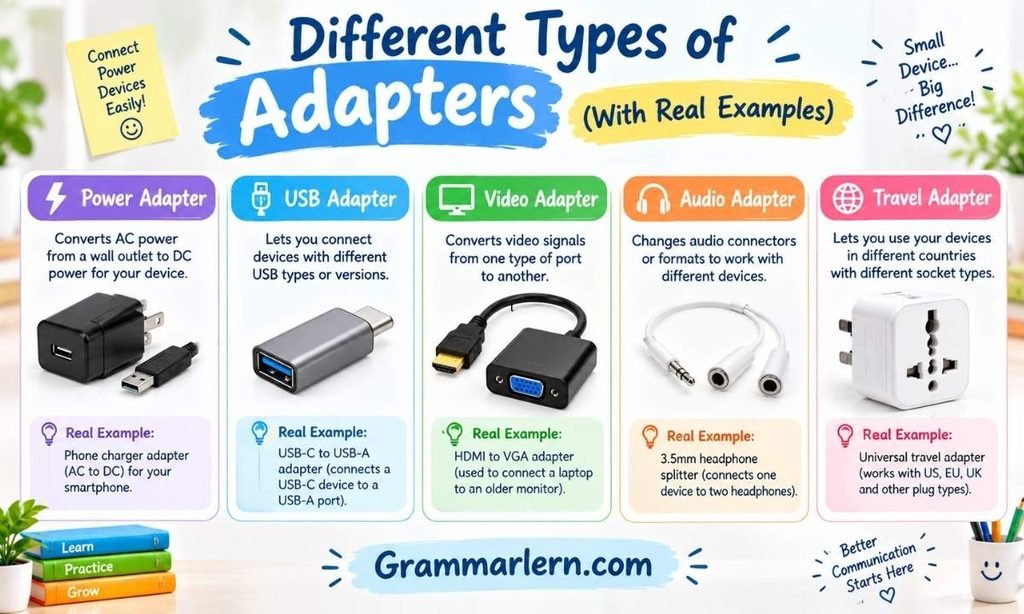
Power Adapters
Convert electrical current so a device can safely charge or run, such as a laptop charger.
Travel Adapters
Change the plug shape to fit foreign sockets. Note: a travel adapter usually does not convert voltage, so a separate converter may still be needed.
Computer and Electronic Adapters
HDMI-to-VGA adapters, USB-C hubs, and Ethernet adapters let devices with mismatched ports communicate.
Mechanical Adapters
Used in manufacturing and plumbing to connect parts of different sizes or thread types.
Adapter vs Adaptor in a Sentence: Real Examples
- I forgot to pack a travel adapter, so my charger didn’t fit the socket.
- The engineer replaced the old adaptor with a newer, standardized part.
- You’ll need a USB-C adapter to connect that cable to your laptop.
Both spellings work correctly in nearly identical sentences. The choice comes down to style, not grammar.
Common Mistakes and Misconceptions
“Adaptor Is Wrong.”
False. Adaptor is a fully valid, dictionary-recognized spelling, simply less common in modern, especially American, writing.
Adapter vs Converter vs Connector: What’s the Difference?
| Term | Function |
| Adapter | Makes systems compatible without changing power |
| Converter | Changes voltage or energy format |
| Connector | A fixed part of a device or cable |
A plug shape mismatch calls for an adapter. A voltage mismatch calls for a converter.
Pronunciation: Does the Spelling Change the Sound?
No. Adapter and adaptor are pronounced identically: uh-DAP-ter. The spelling difference is purely visual.
Which One Should You Use: Adapter or Adaptor?
Use adapter for US or global audiences, AP/Chicago style, and technical or SEO content. Use adaptor only for strictly British English content or when matching an older British document’s style. When in doubt, choose adapter and stay consistent.
Historical Trend in Usage: Adapter vs Adaptor Over Time
| Period | Trend |
| Before 1950 | Both common |
| 1950–2000 | Adapter rising, adaptor declining |
| 2000–Present | Adapter dominant globally |
SEO and Writing Strategy for Adapter vs Adaptor
Use adapter as your primary keyword since it carries higher search volume and broader reach. Mention adaptor once or twice for British English searches, but avoid switching spellings randomly within the same piece.
Cultural and Language Evolution Insight
English has long favored shorter, simpler spellings over time, similar to colour becoming color in American English. Adapter’s dominance fits this broader pattern, reinforced by global digital communication.
Real Case Study: How Brands Use Adapter vs Adaptor
Tech Company Product Naming
Major global electronics brands, regardless of headquarters location, consistently label products “adapter” for worldwide consistency, rather than adjusting spelling by country.
Frequently Asked Questions
Which is correct, “adapter” or “adaptor”?
Both are correct. Adapter is the more common, recommended spelling; adaptor remains an accepted British English variant.
Is it “a” or “an” before adapter or adaptor?
Use “an” before both, since they start with a vowel sound: “an adapter,” never “a adapter.”
What is the difference between “adapter” and “adopter”?
Different words entirely. An adapter connects devices; an adopter is someone who adopts something, like a pet or new technology.
Do Americans use “adapter” or “adaptor”?
Americans almost exclusively use adapter, the standard in US style guides and packaging.
Are “adapter” and “converter” the same thing?
No. An adapter changes physical connection type; a converter changes voltage or energy format.
Can I use both spellings in the same document?
Not recommended. Mixing them looks inconsistent. Pick one spelling and use it throughout.
Final Thoughts
The debate between adapter and adaptor ultimately comes down to consistency, not correctness. Both spellings work in any sentence, and neither is a grammar mistake, only a matter of regional style and preference.
If you want the safest, most widely understood choice for modern writing, go with adapter. It fits American English, most style guides, and today’s global, tech-driven audience, giving your writing a clean, professional, and consistent feel every time.