

Typing fast and suddenly unsure if it’s amount or ammount? You’re not alone this is one of the most common spelling mistakes in English. The confusion usually happens because of how the word sounds when spoken.
The correct spelling is amount, with just one “m.” Ammount is always incorrect and has no place in proper English writing. This guide breaks down the spelling, meaning, and simple tricks to remember it for good.
Amount or Ammount – Quick Answer
The correct spelling is amount. Ammount is a misspelling and is not recognized in any English dictionary, formal writing, or academic context.
- Correct: The total amount due is $250.
- Incorrect: The total ammount due is $250.
There is only one “m” in amount, and this rule never changes, regardless of tense, region, or writing style.
Ammount or Amount Meaning
As a noun, amount refers to a quantity, sum, or total of something money, time, effort, or any measurable quantity. As a verb, amount means to add up to a total or to be equivalent to something in effect. Ammount carries no meaning at all; it is simply a spelling error that occurs when writers mistakenly double the “m.”
The Origin of Amount or Ammount
The word amount comes from the Old French amonter, meaning “to go up” or “to ascend,” which itself traces back to a mont literally “to the mountain.” When the word entered Middle English as amounten, it kept its single “m” and gradually developed its modern meaning of “total” or “sum.”
At no stage in this history did the word ever contain a double “m.” The spelling ammount is a modern typing error, not a historical variant or regional form.
How to Remember the Correct Spelling (Memory Trick)
A simple way to lock in the correct spelling is to break the word into its two natural parts: a + mount = amount. Since mount as in a mountain already has one “m,” you only need to add “a” in front of it, giving you the correct spelling every time.
Another quick reminder: one amount, one m. Practicing this phrase a few times helps the correct spelling become automatic, even under pressure while typing quickly.
British English vs American English Spelling
Unlike words such as colour/color or organise/organize, amount does not change between British and American English. Both spelling systems use the exact same word.
Comparison Table
| Variant | British English | American English |
| Correct spelling | Amount | Amount |
| Incorrect spelling | Ammount | Ammount |
Which Spelling Should You Use?
The answer is the same no matter where you are writing from:
- US audience: Use amount
- UK audience: Use amount
- Commonwealth countries: Use amount
- Academic and business writing worldwide: Use amount
There is no context, region, or style guide in which ammount is acceptable.
Amount – Grammar: Noun and Verb Uses
Amount functions as both a noun and a verb, and understanding both uses helps you apply it correctly in different sentences.
As a noun, it refers to a quantity or total:
- A large amount of rain fell overnight.
- The total amount was higher than expected.
As a verb, it is usually followed by “to” and means either “to add up to” or “to be equivalent to”:
- The repairs amounted to more than the car’s value.
- Ignoring the warning would amount to negligence.
Forms of Amount (Amount, Amounts, Amounted, Amounting)
| Form | Function | Example |
| amount | Singular noun / base verb | The amount is correct. |
| amounts | Plural noun / third-person verb | Small amounts can add up. |
| amounted | Past-tense verb | The bill amounted to $80. |
| amounting | Present participle | Fees amounting to $80 were charged. |
Note that invented forms like ammounting and ammounted are never correct the extra “m” carries through incorrectly into every tense.
Amount vs Number: What’s the Difference?
This is one of the most useful distinctions to learn alongside correct spelling. Traditional English uses amount with mass or uncountable nouns, and number with countable, individual items.
| Use case | Preferred word | Example |
| Uncountable quantity (time, money, water) | amount | a small amount of time |
| Countable, individual items | number | a large number of students |
- ✅ A large amount of homework was assigned.
- ✅ A large number of students attended.
- ❌ A large amount of students attended.
Common Mistakes with Amount or Ammount
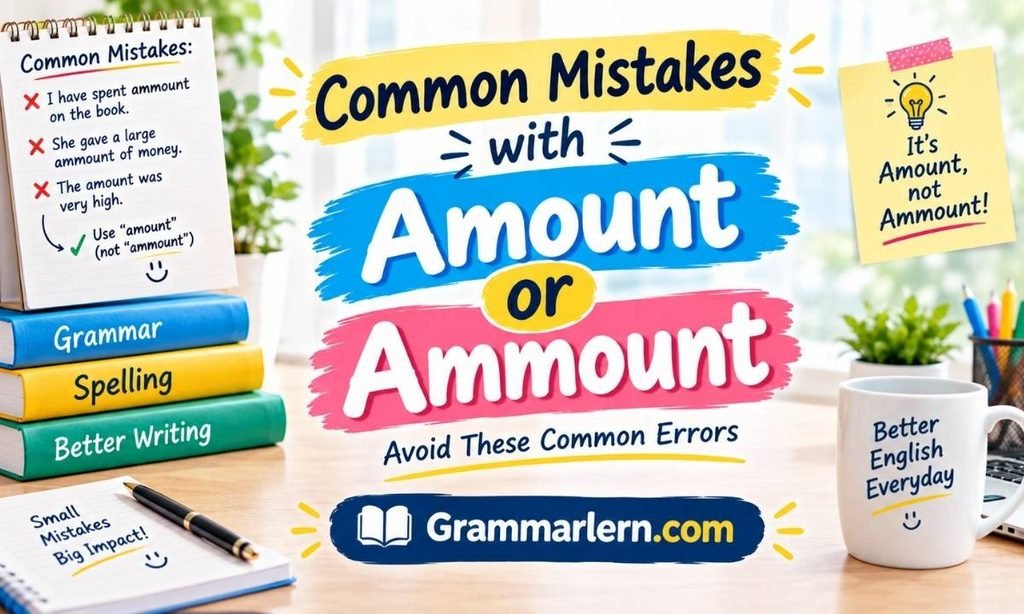
- Writing ammount with a double “m” instead of amount
- Assuming the spelling changes between British and American English it does not
- Ignoring spellcheck warnings when typing quickly
- Using “amount” with countable nouns instead of “number”
- Writing invented forms like ammounting or ammounted
Amount or Ammount in Everyday Examples
- Emails: Please confirm the total amount due by Friday.
- News: A record amount of rainfall caused flooding this week.
- Social media: That show had a huge amount of hype online.
- Academic writing: The grant amount was approved by the committee.
Amount of Money in Business & Finance
Correct spelling matters most when money or legal terms are involved, since a spelling slip next to a figure can look unprofessional.
| Phrase | Meaning |
| invoice amount | The total sum charged on an invoice |
| amount due | The money currently owed |
| outstanding amount | The unpaid balance |
| refund amount | The sum returned to a customer |
Example: Please confirm that the amount due is $750 and that payment is expected by October 15.
Amount – Oxford Dictionary Definition
According to standard English dictionaries, including Oxford, amount is defined as “a quantity of something, especially the total of a thing or things in number, size, or value.” This confirms that amount is the only recognized dictionary spelling ammount does not appear as a valid entry in any major dictionary.
Amount Meaning in Hindi
In Hindi, amount translates to मात्रा (matra) when referring to quantity, or राशि (raashi) when referring to a sum of money. For example, “the total amount” would be translated as “कुल राशि” in a financial context. The English spelling itself does not change only the meaning is translated.
Amount or Ammount – Google Trends & Usage Data

Search data shows that people frequently look up “ammount” mainly to confirm whether it is a spelling mistake, not because it is an accepted alternative. The correct form, amount, appears far more often in books, official documents, and professional writing. Most searchers are students, professionals, and non-native English speakers trying to avoid this common error.
Amount or Ammount Comparison Table
| Feature | Amount | Ammount |
| Correct spelling | ✅ Yes | ❌ No |
| Recognized dictionary word | Yes | No |
| Used in exams and academic writing | Yes | No |
| Accepted in business documents | Yes | Never |
| Regional variation (UK/US) | None | Not applicable |
Frequently Asked Questions
What is the correct spelling of amount?
The correct spelling is amount, spelled A-M-O-U-N-T, with only one “m.”
What does “amount” mean?
Amount refers to a quantity, sum, or total of something. It can also function as a verb meaning “to add up to.”
Is “amount” a noun or a verb?
It can be both. As a noun: “The amount is correct.” As a verb: “The fees amount to $50.”
What is the difference between amount and number?
Use amount with uncountable quantities like time or money, and number with countable items like people or files.
Can “amount” be plural?
Yes. Use “amounts” when referring to multiple quantities, as in “small amounts of sugar.”
Is “ammount” ever a correct spelling?
No. Ammount is not recognized in any dictionary, dialect, or writing style. It is always a misspelling of amount.
Final Thoughts
The confusion between amount and ammount comes down to one simple rule: amount has only one “m,” and ammount is never correct in any form of English. Whether you are writing an email, an invoice, or an academic paper, remembering the “a + mount” trick will help you get it right every time.
Getting this small detail correct makes your writing look more polished and professional. Once the rule sticks, you will never second-guess the spelling of amount again.