

Address is the correct spelling “adress” is not. This tiny mix-up shows up constantly in emails, forms, and job applications, and one missing letter can make even strong writing look careless.
The word always keeps a double “d” and double “s,” whether you’re writing in British or American English. Below, you’ll find the correct spelling, real examples, and simple tips to remember it for good.
Key Takeaways
- The correct spelling is address, with two “d’s” and two “s’s.”
- Adress is always a misspelling it has no meaning in standard English.
- The spelling never changes between British and American English.
- Address works as both a noun (a location) and a verb (to speak to someone or deal with a matter).
- A simple memory trick: ad + dress = address.
Address or Adress – Quick Answer
The correct spelling is address. “Adress” is a common typing mistake that drops the second “d.”
Examples
- ✅ Please confirm your home address.
- ❌ Please confirm your home adress.
- ✅ She emailed me her new address.
- ❌ She emailed me her new adress.
What Does Address Mean?
Address carries a few related meanings, depending on how it’s used in a sentence.
Address as a Noun
As a noun, address refers to the specific location of a person, business, or organization your street name, house number, and postal code. It can also refer to a web address (URL), an IP address on a network, or a formal speech, such as a graduation address or a president’s address to the nation.
Address as a Verb
As a verb, address means to speak directly to someone, or to deal with a problem. You might address a crowd, address a complaint, or address an envelope before mailing it.
How to Pronounce Address
Pronunciation shifts slightly with meaning. As a noun, the stress usually falls on the first syllable: AD-dress. As a verb, the stress moves to the second syllable: ad-DRESS. Either way, the spelling stays the same.
The Origin of Address or Adress
Address comes from the Old French word adresser, meaning “to direct” or “to straighten.” It entered Middle English and gradually settled into its modern form, keeping both double letters from its French roots. “Adress” never became an accepted spelling it’s simply a shortened, incorrect version that appears when people type quickly or forget the second “d.”
British English vs American English Spelling
Unlike words such as colour/color or organise/organize, address does not change between British and American English. Both varieties use the same double-d, double-s spelling.
Comparison Table
| Region | Correct Spelling | Incorrect Spelling |
| American English | address | adress |
| British English | address | adress |
| Australian English | address | adress |
| Canadian English | address | adress |
Which Spelling Should You Use?
Always use address, regardless of your audience or region. There’s no version of English formal or informal, American or British where “adress” is correct. Using the wrong form in a resume, business email, or academic paper can quietly undercut how professional your writing looks.
Address – Grammar Rules
Plural of Address
The plural form is addresses. Example: Please double-check that all the shipping addresses are correct.
Past Tense of Address
The past tense is addressed. Example: The manager addressed the team’s concerns during Monday’s meeting.
Common Mistakes with Address or Adress
Missing a Letter
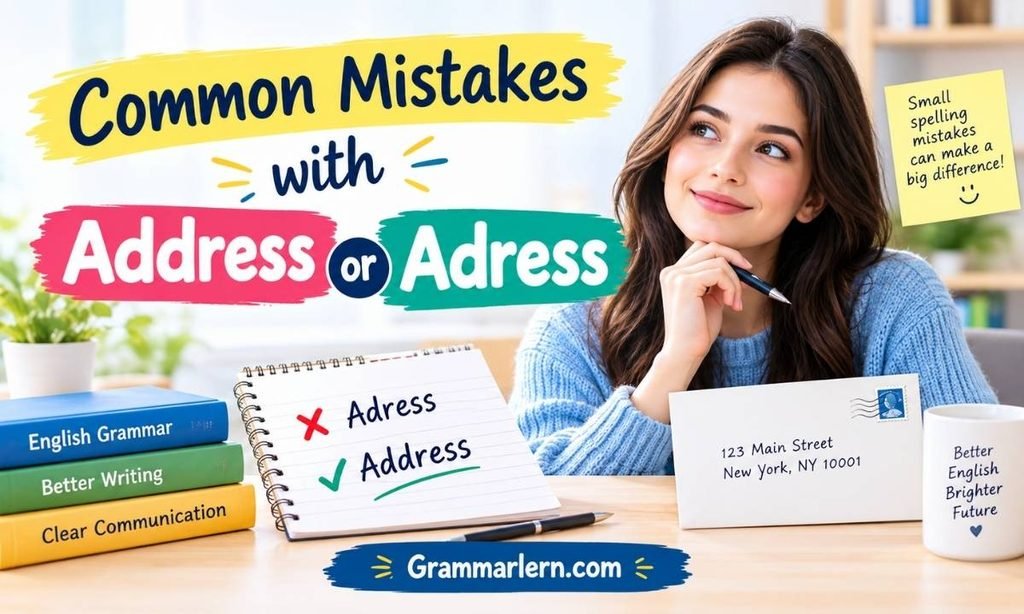
The most frequent error is dropping the second “d”: adress instead of address.
Confusing Pronunciation
Because the two d’s blend together when spoken quickly, some people assume only one is needed in writing.
Typing Fast
Rushed typing in emails, forms, or chat messages often drops a letter without the writer noticing.
Auto-correct Errors
Spellcheck tools don’t always catch “adress,” especially in browsers or apps with limited dictionaries, so it’s worth proofreading manually.
Address vs Addressee
These two words are related but not interchangeable. Address is the destination the location or contact detail. Addressee is the person the letter, parcel, or message is meant for. Example: Write the address on the envelope, but only the addressee should open what’s inside.
Address or Adress in Everyday Examples
Emails
“Please confirm your mailing address before we ship your order.”
News
“The president will address the nation this evening.”
Social Media
“Drop your email address below to join the waitlist.”
Formal Writing
“Kindly update your registered address in our company records.”
Comparison Table – Address vs Adress
| Feature | Address ✅ | Adress ❌ |
| Correct spelling | Yes | No |
| Recognized in dictionaries | Yes | No |
| Accepted in British/American English | Yes | No |
| Safe for professional writing | Yes | No |
| Common typing mistake | No | Yes |
Address or Adress – Google Trends & Usage Data
Why do people search this?
Because address is used constantly in emails, forms, and paperwork, small hesitations over spelling are common, even among fluent writers.
Popular Regions
Searches for this comparison are frequent in the United States, United Kingdom, India, Pakistan, and Canada regions where English is a primary or widely used second language.
Usage Context
Most searches happen while someone is filling out an online form, writing a professional email, or double-checking a school or job application.
Frequently Asked Questions
Is “address” or “adress” the correct spelling?
Address is correct. Adress is a common misspelling that drops one of the two d’s.
What does “adresse” mean?
Adresse is the French spelling of address, not an accepted English word. In English writing, always use address.
Why does “address” have double letters?
The double “d” and double “s” come from its Old French root, adresser, and were preserved as the word settled into modern English.
Is “address” spelled differently in British and American English?
No. Both use the same spelling address with no regional variation.
What is the difference between “address” and “addressee”?
Address is the location or contact detail; addressee is the person a letter or package is sent to.
How can I remember the correct spelling of “address”?
Break it into two parts: ad + dress. Since “dress” already starts with a “d,” joining the two naturally gives you the double “d” in address.
Final Thoughts
Getting address right comes down to one simple rule: two d’s, two s’s, no exceptions. Whether you’re writing a home address, an email address, or addressing a room full of people, the spelling never shifts with context or region.
Small details like this shape how professional your writing looks. Once you lock in the ad + dress trick, you’ll never second-guess address again and that’s one less thing to worry about the next time you hit send.