

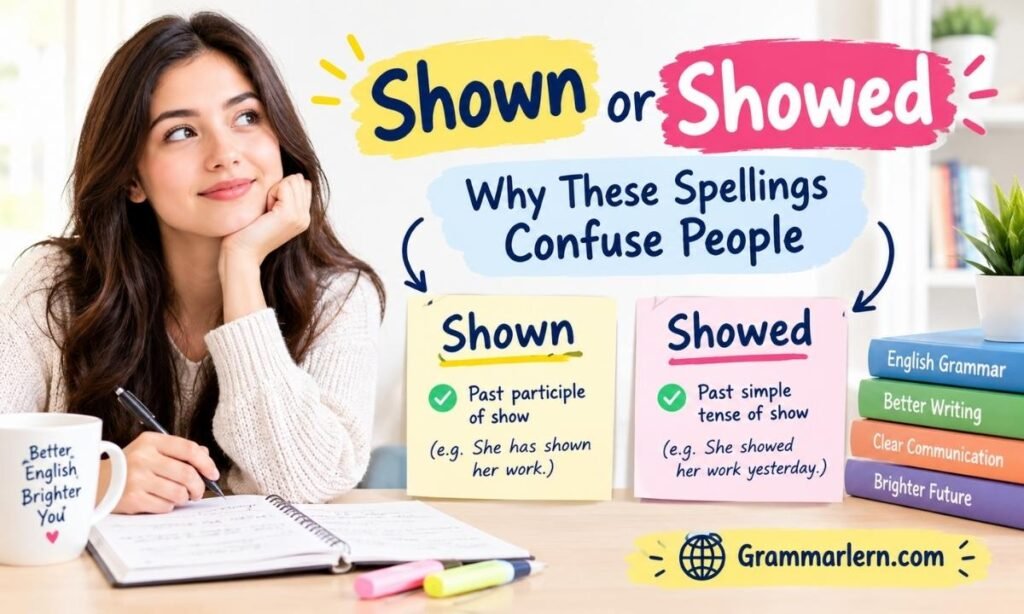
Confused about shown vs showed? You’re not alone this is one of the most common verb mix-ups in English grammar. The good news: one simple rule fixes it for good.
Showed is the simple past tense. You use it alone, with no helper verb, like “She showed me the photo.” Shown is the past participle. It always needs an auxiliary verb like has, have, or was as in “She has shown great progress.” Once you spot the helper verb, the choice becomes automatic.
Quick Answer: Shown vs Showed
Here’s the short version before we dig deeper.
Use showed when there’s no helper verb and the action already finished. Use shown whenever an auxiliary verb like has, have, had, was, or were shows up in the sentence.
- ✔ Correct: She showed me the results.
- ✔ Correct: She has shown me the results.
- ❌ Incorrect: She has showed me the results.
If you remember nothing else from this guide, remember this one line: no helper, use showed. Helper present, use shown.
Understanding the Verb “Show”: Why It’s an Irregular Verb
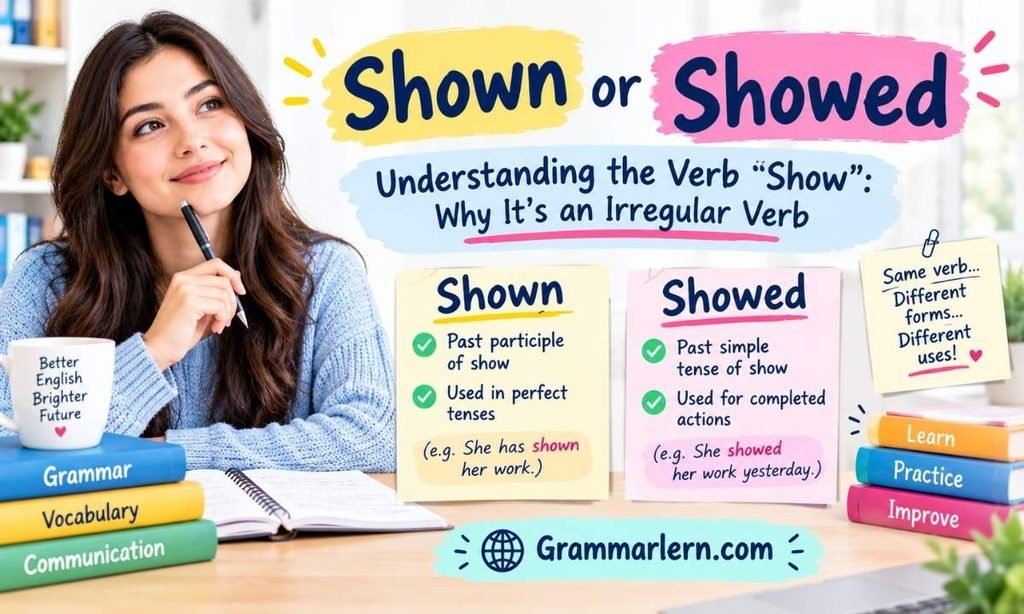
Most English verbs follow a simple conjugation pattern. You add -ed to the base form, and you’re done. Walk becomes walked. Talk becomes talked. No surprises.
Show doesn’t play by those rules. It’s an irregular verb, which means its past tense and past participle don’t follow the standard -ed pattern you’d expect in regular verb conjugation.
Here’s how it breaks down:
| Verb Form | Example |
| Base form | show |
| Past tense | showed |
| Past participle | shown |
This split is exactly why so many people mix up shown vs showed. Both forms look related, both come from the same root verb, and both show up constantly in everyday writing and speech. But they serve completely different jobs in a sentence’s grammatical structure.
When to Use “Showed”: Understanding the Simple Past Tense
Showed answers a straightforward question: did something happen and finish in the past? If yes, you’ve found your word.
You’ll use showed when:
- The action happened once and it’s already over.
- You don’t need an auxiliary verb to make the sentence work.
- You’re describing a completed event, not connecting it to the present moment.
The sentence structure is simple: subject + showed + object.
- I showed you the report yesterday.
- She showed him the new office.
- They showed real patience during the meeting.
Each of these sentences stands on its own. No helper verb, no complications just a clean, finished action in simple past tense.
Also Read This Sweetie vs Sweety vs Sweatie: Which Is Correct?
Quick Test
Not sure which word fits? Ask yourself one question:
“Did this happen once, and is it completely done?”
If the answer is yes, and there’s no helper verb sitting nearby, go with showed.
Common Errors With “Showed”
Even people who know the rule still slip up here. The mistake almost always happens when a helper verb sneaks into the sentence and showed gets used anyway.
❌ Incorrect: “I have showed you this already.”
✔ Correct: “I have shown you this already.”
Why does this matter? Because have is an auxiliary verb, and helper verbs always pair with the past participle shown, not showed.
❌ Incorrect: “The movie was showed last night.”
✔ Correct: “The movie was shown last night.”
Same logic applies here. The word “was” signals passive voice, and passive voice needs the past participle every single time.
Here’s a quick cheat sheet:
| Helper Verb Present? | Correct Form | Example |
| No | showed | I showed him the card. |
| Yes (has, have, had, was, were) | shown | The results were shown to the team. |
Keep this table in mind, and you’ll catch most grammar mistakes before you make them.
“Shown”: The Past Participle Explained Clearly
Shown never works alone it always needs backup. That’s the single most important thing to know about this word.
A past participle typically:
- pairs with an auxiliary verb
- shows up in perfect tenses
- appears in passive voice constructions
- can work as an adjective, but rarely stands alone otherwise
The helper verbs that team up with shown include has, have, had, was, were, is, are, been, and being.
Examples in Perfect Tenses
- She has shown impressive growth this quarter.
- They had shown interest before the announcement.
- I have shown you this trick more than once.
Notice how each sentence connects a past action to the present moment, or to another point in time. That connection is exactly why these sentences need shown instead of showed.
Using “Shown” in Passive Voice (With Examples)
Passive voice trips up a lot of writers, so let’s make it simple.
The sentence structure looks like this: object + a form of “be” + past participle.
Because shown is the past participle, it fits naturally into that slot.
- The error was shown in the report.
- The photos were shown during the presentation.
- The update is shown on the dashboard.
- The changes have been shown to boost efficiency.
Read these out loud and you’ll notice how natural they sound. Swap in “showed” and the sentences break passive voice simply doesn’t accept it in standard English usage.
Also Read This Sweetie vs Sweety vs Sweatie: Which Is Correct?
“Showed” vs “Shown”: Side-by-Side Comparison
Sometimes the clearest way to learn a grammar rule is to see both sides laid out together.
What “Showed” Does
- Works as simple past tense
- Stands alone, no helper needed
- Describes a completed past action
- Never appears in passive voice
- Never appears in perfect tenses
What “Shown” Does
- Works as the past participle
- Always needs an auxiliary verb
- Appears in perfect tenses
- Appears in passive voice
- Can function as an adjective in rare cases
Quick Comparison Table
| Use Case | Showed | Shown |
| Simple past | ✔ | ✘ |
| Present perfect | ✘ | ✔ |
| Past perfect | ✘ | ✔ |
| Passive voice | ✘ | ✔ |
| Without a helper verb | ✔ | ✘ |
| As an adjective | ✘ | ✔ |
Example Sentences Comparing Both
- I showed you the email yesterday.
- I have shown you this email several times.
- They showed me the numbers.
- The numbers were shown to me.
- She showed her badge at the entrance.
- Her badge was shown at the entrance.
Line these examples up, and the pattern jumps out fast.
Language Nuances: When “Showed” Is Sometimes Used as a Past Participle
Here’s something most grammar guides skip over. In certain dictionaries and some dialects, “showed” actually shows up as an accepted past participle not just a casual slip.
You might come across sentences like:
- “I have learned from what you have showed me.”
- “They have showed the world what they can do.”
Major dictionary sources note that both “shown” and “showed” are considered standard forms of the past participle, even though shown is far more common in modern formal writing. That said, academic papers, business communication, and professional English still favor shown almost exclusively.
So here’s the practical takeaway: if you’re writing for school, work, or anything formal, stick with shown. It’s the safer, more widely accepted choice in standard English even if showed occasionally passes as correct in casual speech or regional dialects.
Memory Tricks to Remember the Difference
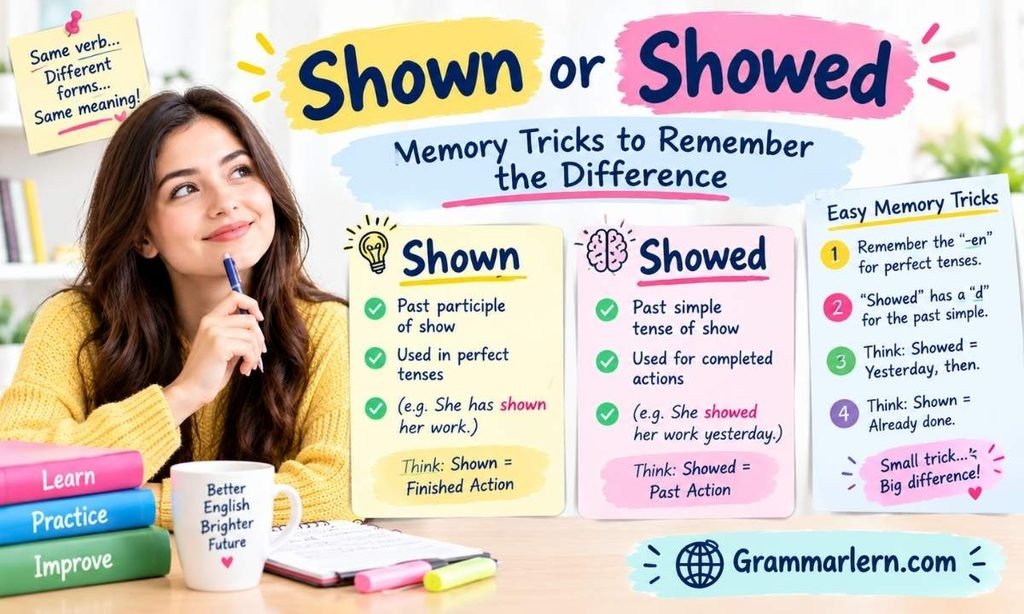
You don’t need to memorize grammar terminology to get this right. These simple tricks do the job just as well.
Trick 1: “Shown needs a buddy.”
If you spot a helper verb like has, have, had, was, were, or been, grab shown. It never travels alone.
Trick 2: “Showed stands alone.”
No auxiliary verb in sight, and the action already happened? That’s your cue for showed.
- I showed stands alone
- I have shown has a buddy
Trick 3: “Shown = past participle = passive voice.”
Passive voice always uses a past participle. So whenever you see “was” or “were,” think: passive voice, past participle, shown.
Trick 4: “If you can replace it with eaten, use shown.”
Try swapping in another past participle, like eaten, and see if the sentence still makes sense.
- I have eaten → I have shown
- The food was eaten → The data was shown
This trick works more often than you’d expect.
A Quick Quote
“Showed tells a story. Shown explains the result.”
That one line sums up the entire difference showed carries the narrative, shown carries the outcome.
Quick Practice Section
Test yourself with these five sentences.
- She has _____ me the report already.
- They _____ us their new apartment yesterday.
- The menu was _____ on the screen.
- I had _____ the steps earlier.
- He _____ the correct answer before the test.
Answers:
- shown
- showed
- shown
- shown
- showed
Got all five right? You’ve mastered the rule.
Frequently Asked Questions
Should I use showed or shown?
Use showed when there’s no helper verb and the action is complete, like “She showed me the way.” Use shown whenever an auxiliary verb appears, like “She has shown me the way.”
Is “I showed” grammatically correct?
Yes. “I showed” is correct simple past tense as long as no helper verb like have or had comes before it. If a helper verb is present, switch to “I have shown” instead.
Is showed a valid word?
Yes, showed is a fully valid word. It’s the standard simple past tense of “show,” and some dictionaries even accept it as an alternate past participle, though shown remains the more common choice in modern English usage.
Is it “had showed” or “had shown”?
“Had shown” is the standard, correct form. Since had is an auxiliary verb, it needs the past participle shown to follow it in formal writing.
Can “shown” stand alone without a helper verb?
Almost never. The one exception is when shown works as an adjective, like “a shown preference.” Outside of that, shown always needs a helper verb such as has, have, had, was, or were.
Is “shown” ever used as a past participle informally?
The opposite question is more common some dialects and informal speech use “showed” as a past participle instead of shown. It’s accepted in casual contexts, but formal writing should stick with shown.
Final Thoughts
Understanding shown vs showed really comes down to one question: is there a helper verb in the sentence? If not, showed is your answer. If yes, shown takes over.
Once that rule clicks, you’ll stop second-guessing sentences like “have showed” versus “have shown.” Showed carries the story of a finished action. Shown carries the result, tied to an auxiliary verb or passive voice construction.
Keep the tricks from this guide close by, run through the practice questions whenever you need a refresher, and trust the grammar pattern you’ve learned. Your writing will sound clearer and more confident every time you reach for the right verb form.
1 thought on “Shown or Showed? The Simple Rule You’ll Never Forget”