


Have you ever typed “any problem” in an email, then paused and changed it to “any problems,” unsure which one actually sounds right? You’re not alone. This tiny word choice trips up even confident English speakers every single day.
The truth is, both forms are grammatically correct, but they don’t mean the same thing. The right choice depends on whether you’re talking about one specific issue or multiple possible issues, and understanding this difference will instantly make your writing sound more natural and professional.
Quick Answer
Any problem is singular. Use it when referring to one specific or hypothetical issue.
Any problems is plural. Use it when referring to multiple or unknown issues.
Example: “Is there any problem with the plan?” versus “Are there any problems with the plan?” Both are correct; the meaning simply shifts based on number.
Meaning Explained
Any Problem Meaning (Singular)
“Any problem” refers to a single, often unspecified issue. It tends to sound more formal, cautious, and precise, which is why it shows up frequently in business writing, legal documents, and technical instructions.
Any Problems Meaning (Plural)
“Any problems” refers to multiple potential issues, or an unknown quantity of them. It feels more natural in everyday conversation and is the form most native speakers reach for by default.
Examples in Context
Singular usage:
- “If there is any problem, please let me know immediately.”
- “I don’t foresee any problem with completing the task.”
Plural usage:
- “Let me know if you encounter any problems during setup.”
- “Are there any problems we need to discuss before moving forward?”
Also Read This “Triple or Tripple: The Correct Spelling Explained”
Grammar Rule Behind “Any Problem” and “Any Problems”
“Problem” is a countable noun, meaning it naturally has both singular and plural forms. “Any” is flexible enough to pair with either, since it can mean “one” or “some, an unspecified number.”
Subject-verb agreement is where most people slip up. Singular “problem” pairs with “is”: “Is there any problem?” Plural “problems” pairs with “are”: “Are there any problems?” Mixing the two, as in “Is there any problems,” is a common and easily avoidable error.
When to Use “Any Problem” vs “Any Problems” (Formal vs Informal)
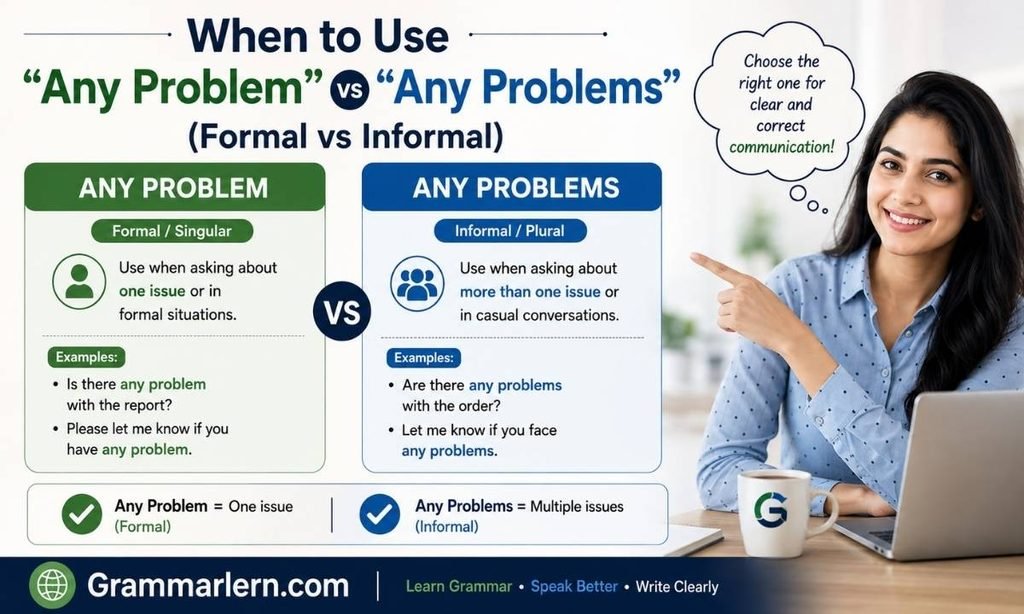
Formality is the biggest deciding factor. In formal writing, such as legal disclaimers, official policies, or technical manuals, the singular “any problem” often sounds more precise and professional.
In everyday conversation, customer support, or casual emails, “any problems” feels warmer and more natural. It also works better when you genuinely don’t know how many issues might come up.
A simple rule of thumb: if you’re unsure, use the plural. It’s the safer, more conversational default in most real-world situations.
Common Mistakes to Avoid
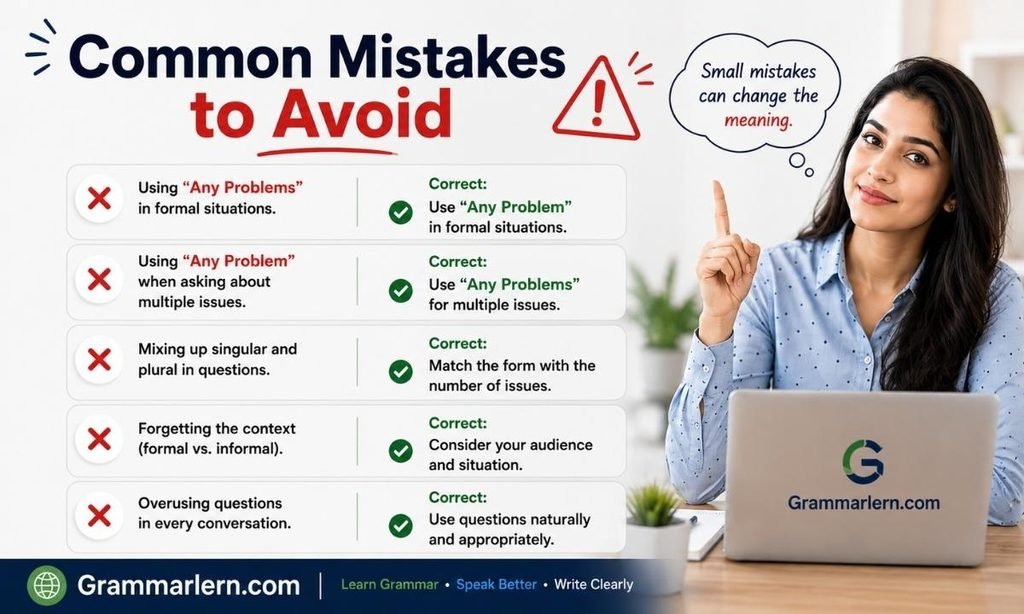
- Wrong: “Is there any problems with your order?”
Right: “Are there any problems with your order?” - Wrong: “There’s any problems with the system.”
Right: “There are any problems with the system.” - Wrong: “Do you have a any problem?”
Right: “Do you have any problem?” or “Do you have any problems?” - Wrong: Using “any problems” when the sentence clearly refers to one specific issue.
Right: Match the noun’s number to the actual meaning you intend.
American vs British English Differences
Both American and British English follow the same core grammar rule, but usage preference differs slightly by tone and formality.
| Feature | American English | British English |
| Singular usage | Rare in casual speech | More common in formal writing |
| Plural usage | Very common | Common in both formal and informal writing |
| Typical example | “Do you have any problems?” | “Do you have any problem with this arrangement?” |
In most professional emails and everyday conversations across both dialects, “any problems” is the safer, more universally accepted choice.
Related Terms and Synonyms
Several words can substitute for “problem” depending on tone and context:
- Issue / Issues, often used interchangeably
- Obstacle / Obstacles, slightly more formal, business-focused
- Complication / Complications, implies added complexity
- Difficulty / Difficulties, a general term for challenges
Example: “Are there any issues with the new system?” or “We don’t anticipate any difficulties during the launch.”
Idiomatic Expressions (“No Problem” vs “No Problems”)
Some fixed phrases don’t follow the usual singular or plural logic. “No problem” is the standard, idiomatic response meaning “it’s fine,” while “no problems whatsoever” is used for emphasis. In these set expressions, singular tends to feel more natural and idiomatic overall.
Frequently Asked Questions
Is “any problem” grammatically correct?
Yes. “Any problem” is grammatically correct and is typically used for a single, specific, or hypothetical issue, especially in formal contexts.
Is it correct to say “Is there any problem”?
Yes, this is correct when you’re asking about one possible issue. If you mean multiple issues, the correct plural form is “Are there any problems?”
Is there any problem or are there any problems, which is correct?
Both are correct, but they aren’t interchangeable. Use “is there any problem” for a single issue and “are there any problems” for multiple or unknown issues, matching your verb to the noun’s number.
Which is more common: any problem or any problems?
“Any problems” is more common in everyday spoken and written English, since most situations involve an unspecified number of potential issues.
Do you have any problem or do you have any problems?
Both are grammatically valid. “Do you have any problem?” sounds more formal and singular-focused, while “Do you have any problems?” is the more natural, everyday version.
Can I use “any problem” in formal writing?
Yes. “Any problem” works well in formal writing, contracts, and technical documents, where precision and a single-issue focus are often preferred.
Final Thoughts
Choosing between any problem and any problems really comes down to one simple question: are you referring to one issue or several? Singular for one, plural for multiple or unknown, and your writing instantly becomes clearer and more confident.
Keep subject-verb agreement in mind, lean toward the plural in casual or uncertain situations, and reserve the singular for formal or highly specific contexts. With this small adjustment, you’ll never second-guess this phrase again.
1 thought on “Any Problem or Any Problems? The Correct Usage Explained”