

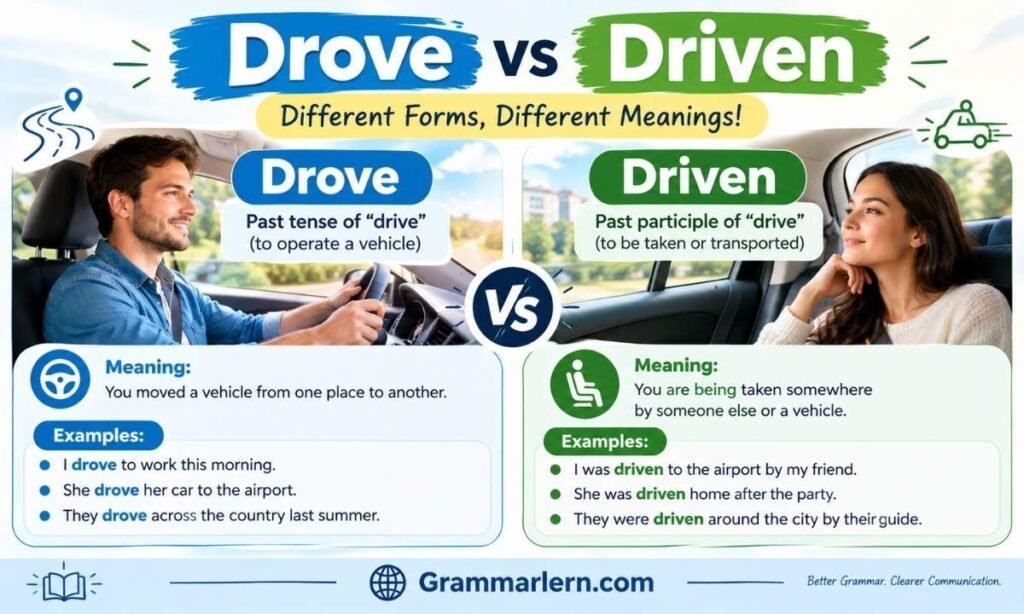
Saying “I have drove there” instead of “I have driven there” is one of the most common English grammar mistakes, even native speakers slip up. The confusion happens because drove and driven both come from the same verb, “drive,” but they follow completely different rules of verb conjugation.
In this guide, you’ll learn the exact difference between drove and driven, when to use each one, and how to avoid the mistakes that make your writing sound unpolished. By the end, you’ll never second guess this choice again.
Understanding the Verb “Drive”
The verb “drive” means to operate and control a vehicle, but it also carries a metaphorical meaning, as in “drive change” or “driven by ambition.” Every form of this verb, whether present, past, or participle, follows a specific grammatical role tied to tense consistency and subject-verb agreement.
Before comparing drove and driven directly, it helps to understand that “drive” is an irregular verb. Unlike regular verbs that simply add “-ed” for the past tense, drive shifts internally to form drove and driven.
Forms of “Drive” at a Glance
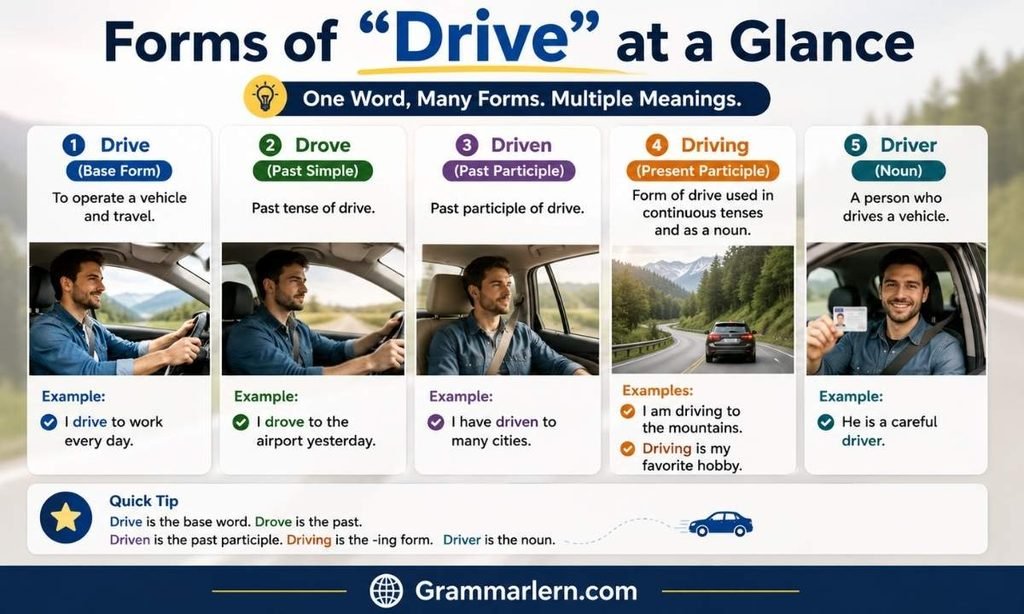
English verbs change shape depending on tense and sentence structure. Here is how “drive” transforms across its three main forms, often called the principal parts, or V1, V2, and V3.
| Verb Form | Word | Used When |
| Base Form (V1) | drive | Present tense, commands, infinitives |
| Simple Past (V2) | drove | Completed action in the past |
| Past Participle (V3) | driven | Perfect tenses and passive voice |
Drove and Driven at a Glance
If you only remember one rule, remember this: drove stands alone, while driven always needs a helping verb.
- Drove — simple past tense, used without any auxiliary verb (I drove to work).
- Driven — past participle, used with has, have, had, is, was, or been (I have driven to work).
What Is the Simple Past? (Drove)
The simple past describes an action that started and finished in the past, with no connection to the present moment.
Examples:
- I drove to work yesterday.
- She drove the kids to school.
- They drove nonstop for six hours.
No helping verb is needed here. The action is complete, and “drove” carries the full weight of the sentence on its own.
Also Read This Pre vs Post: What’s the Real Difference? (With 100+ Examples)
What Is the Past Participle? (Driven)
The past participle is a special verb form that cannot stand alone. It must be paired with an auxiliary verb such as has, have, had, is, was, were, or been.
Examples:
- I have driven this road many times.
- The car was driven by my brother.
- She had driven for hours before resting.
Whenever a sentence uses a perfect tense or passive voice, driven is the correct choice, not drove.
Drove vs Driven: What’s the Real Difference?
Here is the simplest way to remember it:
- Drove equals simple past, and it works alone.
- Driven equals past participle, and it needs a partner verb.
If you try to use driven without a helper, the sentence breaks. If you add a helper to drove, the sentence becomes incorrect. This single distinction, rooted in basic verb conjugation, resolves the majority of confusion around these two words.
How to Use “Drove” Correctly
When to Use “Drove”
Use drove when the action happened in the past, there is no auxiliary verb present, and the sentence describes a direct, completed event.
Key Grammar Rule
If the sentence does not contain has, have, had, is, was, or been, then drove is the correct form.
Correct Examples
- She drove to the airport early.
- He drove across three states.
- We drove through heavy rain.
Also Read This Pre vs Post: What’s the Real Difference? (With 100+ Examples)
How to Use “Driven” Correctly
When “Driven” Is Required
Driven is required whenever the sentence forms a perfect tense or uses the passive voice.
Perfect Tense Examples
- I have driven that car before.
- She had driven the route many times.
- We will have driven 1,000 miles by tomorrow.
Passive Voice Examples
- The truck was driven by Sam.
- The car has been driven for only 10,000 miles.
- The limo is being driven by a professional driver.
Context Matters: How Tense Changes the Choice
Tense does more than change grammar. It changes meaning. Here is how context shapes the choice between drove and driven.
Example 1
- Drove: I drove the car — a simple, finished action.
- Driven: I have driven the car — an experience that still feels relevant now.
Example 2
- Drove: She drove for hours yesterday.
- Driven: She had driven for hours before she stopped.
Example 3
Drove focuses on a single past event. Driven focuses on completion, experience, or a connection to another moment in time.
Common Errors to Avoid With “Drove vs Driven”
Mistake 1: Using “Drove” with a Helping Verb
- Incorrect: I have drove this before.
- Correct: I have driven this before — because “have” always requires a past participle.
Mistake 2: Using “Driven” Without a Helping Verb
- Incorrect: I driven to work today.
- Correct: I drove to work today — since driven can never appear without a helper.
Also Read This Pre vs Post: What’s the Real Difference? (With 100+ Examples)
Quick Decision Guide (Drove vs Driven)
Does the Sentence Have a Helper Verb?
If yes, use driven.
Is It Just a Simple Past Action?
If yes, use drove.
Is the Sentence Passive?
If yes, use driven.
Am I Describing Experience or Completed Action With Present Meaning?
If yes, use driven.
Am I Talking About a Finished Action in the Past?
If yes, use drove.
Perfect Tenses With “Driven” (Deep Dive)
Perfect tenses connect past actions to other points in time, and driven plays the central role in each one.
Present Perfect
Used for life experience or actions with present relevance.
- I have driven a Tesla before.
- She has driven manual cars since college.
Past Perfect
Used when one action finished before another past event.
- He had driven 300 miles before the engine failed.
Future Perfect
Used for an action that will be complete before a specific future point.
- By next year, they will have driven across all 50 states.
Case Study: Real-Life Use of Drove vs Driven
Case Study: A Road Trip Gone Wrong
Maria and John planned a long road trip together. Their word choices reveal how naturally drove and driven fit into real conversation.
- Using drove: John drove the first 200 miles. Maria drove through the mountains.
- Using driven: John has driven in bad weather before, so he volunteered. Maria had driven farther, but they stopped due to fog.
The lesson here is simple. Using the wrong form instantly makes a sentence sound unnatural, even if the meaning is still understood.
Quote to Remember
“Drove stands alone. Driven never walks without help.”
Keep this single line in mind, and the choice between these two words becomes automatic.
Drove and Driven Pronunciation
Drove rhymes with “trove,” pronounced as one syllable — /droʊv/. Driven has two syllables, pronounced as /ˈdrɪv.ən/, with the stress falling on the first syllable. Both words are often confused in spelling because they look similar, but their pronunciation and grammatical role are entirely different.
Similar Irregular Verbs Like “Drive”
Drive is not the only verb that follows this pattern of shifting internally rather than adding “-ed.” Recognizing the pattern in other irregular verbs makes drove and driven easier to remember.
| Base | Simple Past | Past Participle |
| Drive | Drove | Driven |
| Ride | Rode | Ridden |
| Write | Wrote | Written |
| Fly | Flew | Flown |
Once you notice this shared vowel-shift pattern, irregular verbs stop feeling random and start feeling predictable.
Frequently Asked Questions
When to Use “Drove” or “Driven”?
Use drove for a completed action in the simple past, with no helping verb. Use driven when the sentence includes an auxiliary verb like has, have, had, is, or was.
Is It “I Have Never Driven” or “I Have Never Drove”?
The correct form is “I have never driven.” Since “have” is a helping verb, it must be followed by the past participle, driven, not the simple past form drove.
What Is the Difference Between “Driven” and “Drive”?
Drive is the base form of the verb, used in the present tense — I drive to work. Driven is the past participle, used with helping verbs to form perfect tenses or the passive voice — I have driven to work.
What Does “Drove” Mean?
Drove is the simple past tense of “drive.” It describes an action that started and finished in the past, such as “She drove to the store yesterday.”
Have You Ever Drove or Driven — Which Is Correct?
The correct version is “Have you ever driven?” Since “have” requires a past participle, driven is the only grammatically correct choice here, not drove.
Is “Driven” a Past Tense?
Not exactly. Driven is the past participle, not the simple past tense. It works alongside helping verbs to show perfect tenses or passive voice, while drove is the true simple past form.
Final Thoughts
Choosing between drove and driven comes down to one simple test — check for a helping verb. If there is none, drove stands on its own. If a helper like has, have, or had appears, driven is the only correct choice.
Once this rule becomes second nature, sentences with drove and driven will feel effortless instead of confusing. Keep practicing with real examples, and your English will sound clearer, more confident, and more professional every time you write or speak.
1 thought on “Drove vs Driven: Grammar Rules, Examples & Common Mistakes”