

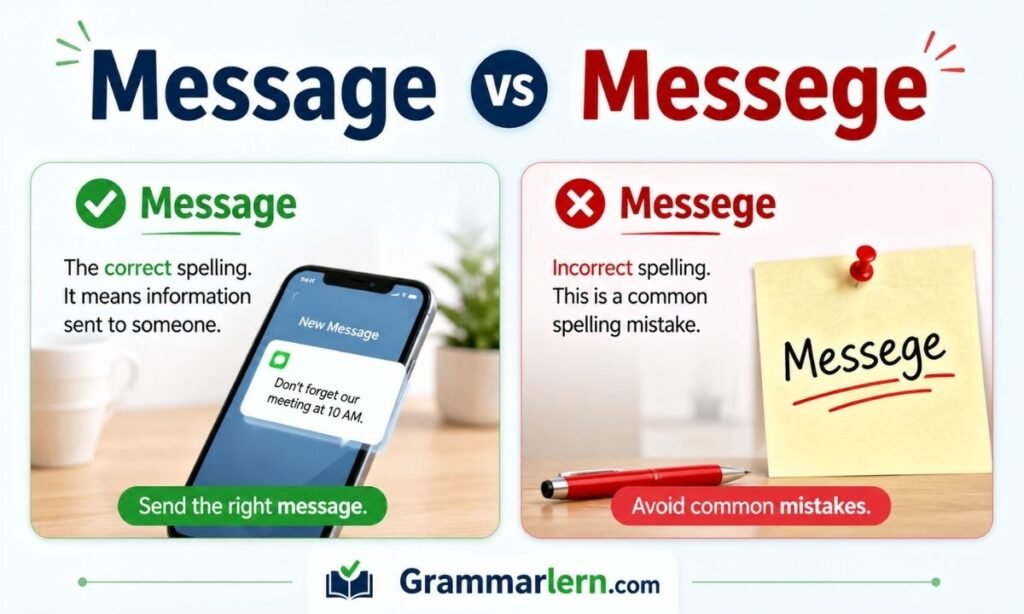
Typed “messege” and then paused, unsure if it’s right? You’re not alone — this is one of the most common spelling mix-ups in English. The good news: the answer is simple, and you’ll know it for good in the next two minutes.
“Message” is the correct spelling — “messege” is not a real word in any English dictionary. In this guide, you’ll learn the correct meaning, see real examples, and pick up an easy trick to never misspell it again.
Quick Answer
Message is the only correct spelling. It refers to a piece of information sent from one person to another, whether spoken, written, texted, or emailed. Messege is a misspelling with no meaning of its own and does not appear in any recognized English dictionary. If you are ever unsure which one to use, always choose message.
Meaning of “Message”
A message is a piece of information passed from a sender to a receiver. It can be a text, an email, a phone call, a spoken instruction, or even the underlying idea behind a book or movie.
What Does “Message” Mean in English?
In everyday use, a message usually refers to:
- A written or spoken communication
- A text or app notification
- An important idea, lesson, or theme
- A signal, warning, or instruction
For example: “I left you a message on your phone” or “The documentary carries a strong message about climate change.”
Message as a Noun vs a Verb
Message works as both a noun and a verb. As a noun, it is the piece of information itself — “I got your message.” As a verb, it means to send that information — “I’ll message you tonight.” The verb form is a more recent addition to English, shaped largely by texting and social apps, but it now appears in standard dictionaries as well.
Is “Messege” a Real Word?
No. “Messege” does not appear in the Oxford English Dictionary, Merriam-Webster, or the Cambridge Dictionary. It carries no independent meaning — it exists only as a misspelling of message, most often caused by how the word sounds when spoken. If you see it written anywhere, treat it as a typo, not an alternate spelling.
Also Read This Also Read This Targetted or Targeted? The Correct Spelling Explained
Why People Write “Messege” Instead of “Message”
The mix-up isn’t random — it comes from a few predictable habits.
Pronunciation Confusion
When spoken aloud, message sounds close to “mess-ij,” and that unclear middle vowel sound makes it easy to guess the wrong letter. English spelling doesn’t always match pronunciation, and this word is a good example of that gap.
Fast Typing and Autocorrect Errors
Quick typing on a phone or keyboard often leads to swapped letters, and once the wrong spelling is typed a few times, muscle memory can make it stick. Autocorrect usually catches the error, but not always — especially in apps with weaker spell-check.
Messege vs Message Comparison Table
| Feature | Message | Messege |
| Correct spelling | Yes | No |
| Recognized in dictionaries | Yes | No |
| Accepted in formal writing | Yes | No |
| Meaning | Communication or information | None |
| Common spelling mistake | No | Yes |
The rule is simple — if you see “messege,” correct it to “message” every time.
Correct Usage of “Message” in Sentences
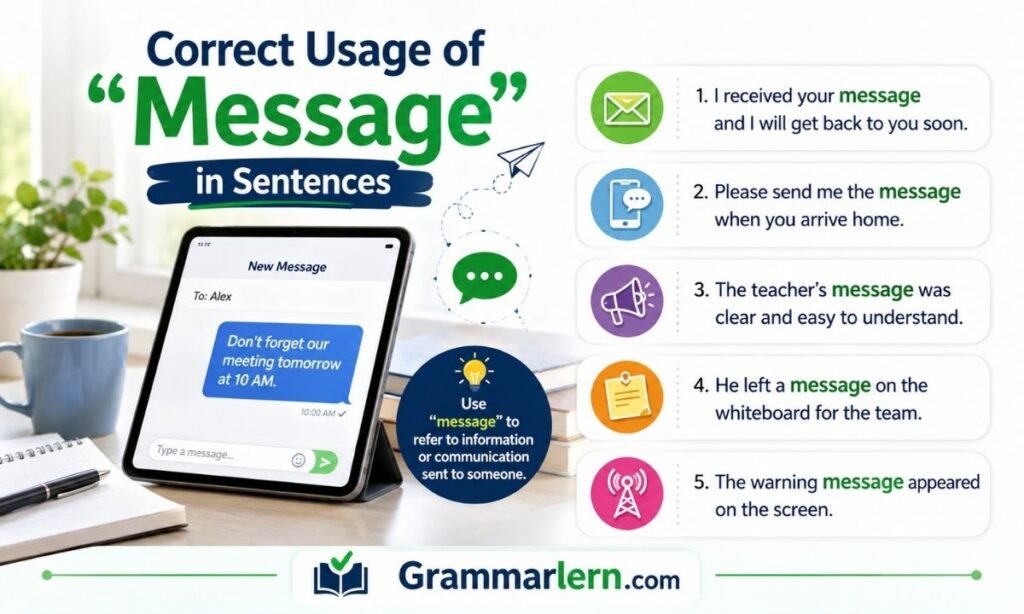
Seeing the word in real sentences helps the correct spelling stick.
Everyday Conversation Examples
- Did you read my message?
- She left me a message on my voicemail.
- He sent a voice message instead of calling.
Formal and Professional Examples
- Please leave a message after the tone.
- The manager delivered an important message to the team.
- Thank you for your message regarding the project.
Digital Communication Examples
- I received your WhatsApp message.
- Your message has been delivered.
- Don’t message him during work hours.
Message vs Massage: A Common Confusion
Message and massage look and sound similar, but they mean completely different things. A message is a piece of communication — a massage is a therapeutic treatment involving the muscles and body. Mixing the two up in a text can lead to an awkward — and funny — misunderstanding, so it’s worth double-checking before you hit send.
Common Mistakes Related to “Message”
Along with “messege,” a few other misspellings show up regularly:
- mesage → message
- messsage → message
- messege → message
- messegeing → messaging
The correct spelling always includes a double s in the middle and an -age ending, never -ege.
Also Read This Targetted or Targeted? The Correct Spelling Explained
Spelling Rule Behind “Message”
Understanding where the word comes from makes the correct spelling easier to remember.
Word Origin: Old French and Latin Roots
Message comes from Old French message, which traces back to the Latin missus, meaning “sent.” Because of this history, the word keeps its traditional spelling rather than following a purely phonetic pattern — which is exactly why it doesn’t turn into “messege” just because that’s closer to how it sounds.
Words With the Same “-age” Pattern
Several common English words follow the same ending pattern as message — package, village, damage, and courage. None of them end in “-ege,” and neither does message.
American vs British English Differences
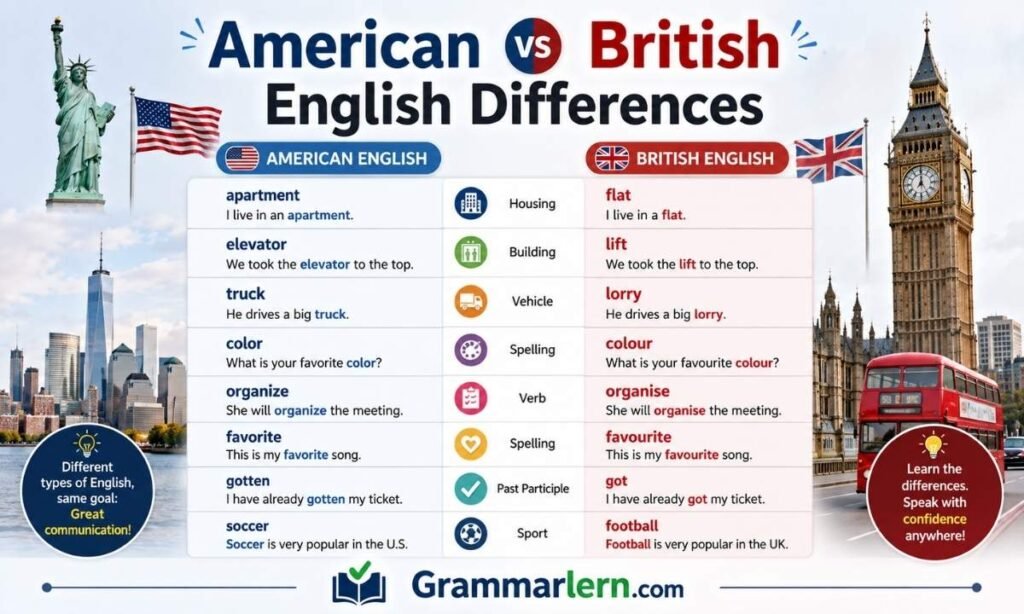
There is no difference between American and British English here. Both varieties of English use message, and neither accepts messege as a valid alternative. Whether you’re writing for readers in the US, UK, Canada, or Australia, the spelling stays exactly the same.
Related Words and Variations
Recognizing the word family reinforces the correct root spelling.
Messages, Messaging, Messaged, Messenger
- Messages — the plural form
- Messaging — the act of sending messages
- Messaged — the past tense
- Messenger — a person, service, or app that delivers messages
Every one of these keeps the same base spelling: message.
Easy Memory Tricks
If the spelling still trips you up, these tricks help it stick:
- Break it down: mess + age = message — both parts are familiar English patterns.
- Use the rhyme: “A message has age,” a reminder that it ends in -age, not -ege.
- Type it slowly — M-E-S-S-A-G-E — and notice the double S always comes before the A.
When “Messege” Might Appear
You may still spot “messege” in social media comments, casual chats, or quick typing mistakes — but seeing it doesn’t make it correct. Every major dictionary and style guide confirms that messege is simply an error, never an accepted variation.
Why Correct Spelling Matters
Getting message right isn’t just about grammar rules — it affects how your writing comes across.
- It improves your credibility as a writer
- It makes your message easier to read at a glance
- It signals professionalism in emails, resumes, and reports
- It avoids the small confusion a typo can create
In job applications, client emails, or academic work, a simple spelling error can leave a negative impression even when the ideas behind it are strong.
Frequently Asked Questions
What is correct, message or messege?
Message is the correct spelling. Messege is a common misspelling and does not appear in any English dictionary.
What is the difference between “message” and “massage”?
A message is a piece of communication sent from one person to another. A massage is a physical treatment that involves working the muscles and soft tissue of the body.
What is the definition of a message?
A message is a piece of information conveyed from one person or entity to another — spoken, written, texted, or signaled in some other way.
Why do people misspell message as messege?
It mostly comes down to pronunciation — the middle vowel sound in “mess-ij” isn’t obvious from how it’s spoken — combined with fast typing and occasional autocorrect misses.
How can I remember the correct spelling of message?
Break the word into mess + age, and remember that it always ends in -age, never -ege. Practicing the full spelling — M-E-S-S-A-G-E — a few times also helps it stick.
Is there a difference between British and American English spelling of message?
No. Both British and American English use the same spelling — message — with no regional variation.
Final Thoughts
The choice between message and messege really comes down to one simple fact — message is the correct spelling, recognized by every major English dictionary, while messege is nothing more than a common typing mistake. Once you understand the double-S-plus-age pattern and where the word comes from, the confusion tends to disappear for good.
Whether you’re writing a quick text, a formal email, or an important report, using message correctly adds clarity and credibility to your writing. Keep the simple rule in mind — mess + age, never ege — and you’ll never second-guess this spelling again.