

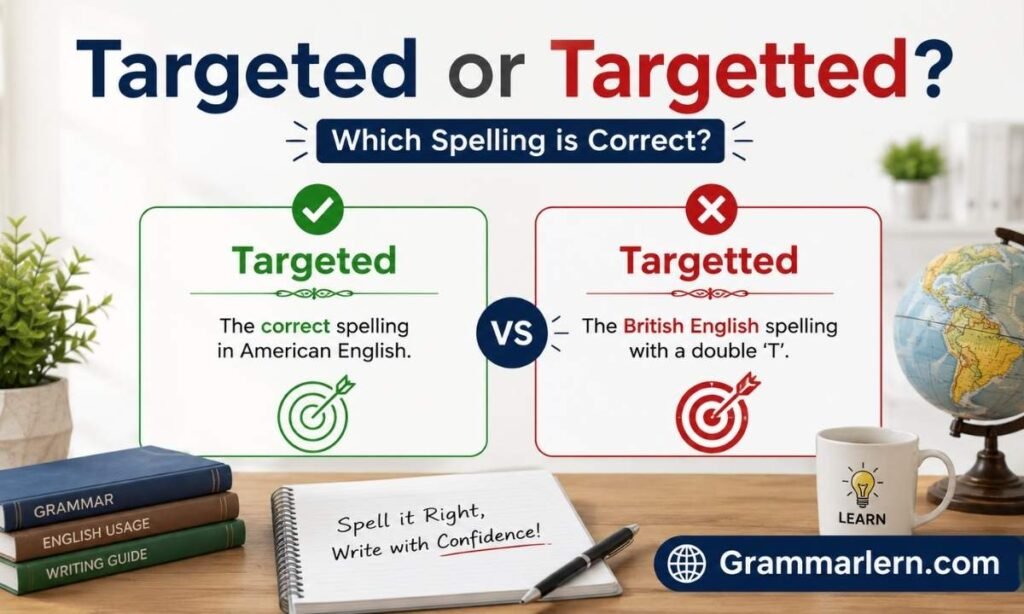
Targeted is the correct spelling in modern English not targetted. This applies to both American and British English, whether you’re writing “targeted,” “targeting,” or any other form of the word.
The confusion happens because many verbs double their final consonant before -ed or -ing (stopped, admitted, committed), so target feels like it should follow suit. It doesn’t and this guide breaks down exactly why, plus how to use the word correctly every time.
Quick Answer
Targeted is correct. Targetted is a common misspelling with no dictionary support in either American or British English. The same logic applies to targeting (correct) versus targetting (incorrect). The reason comes down to word stress: because target is stressed on its first syllable, English spelling conventions don’t call for doubling the final consonant when adding a suffix.
Targeted vs Targetted at a Glance
| Word | Correct? | Meaning |
| Targeted | Yes | Aimed or directed at a specific person, group, or goal |
| Targetted | No | Nonstandard misspelling of targeted |
| Targeting | Yes | The ongoing act of aiming or directing effort at something |
| Targetting | No | Nonstandard misspelling of targeting |
Every major dictionary Merriam-Webster, Cambridge, Collins, and the Oxford English Dictionary lists only the single-t forms. If you’re writing for school, work, or publication, targeted and targeting are the only versions you should use.
Which Spelling Is Correct: Targeted or Targetted?
The verb target means to aim at, focus on, or direct effort toward something specific. When you add -ed to form the past tense, standard English produces targeted a single t before the ending.
Targetted, with a doubled t, isn’t recognized as a valid spelling by any current dictionary or style guide. It shows up occasionally in casual writing, but that doesn’t make it correct it simply means the mistake is common enough to spread.
The rule to remember is straightforward:
- Correct: targeted
- Incorrect: targetted
What Does “Targeted” Mean?
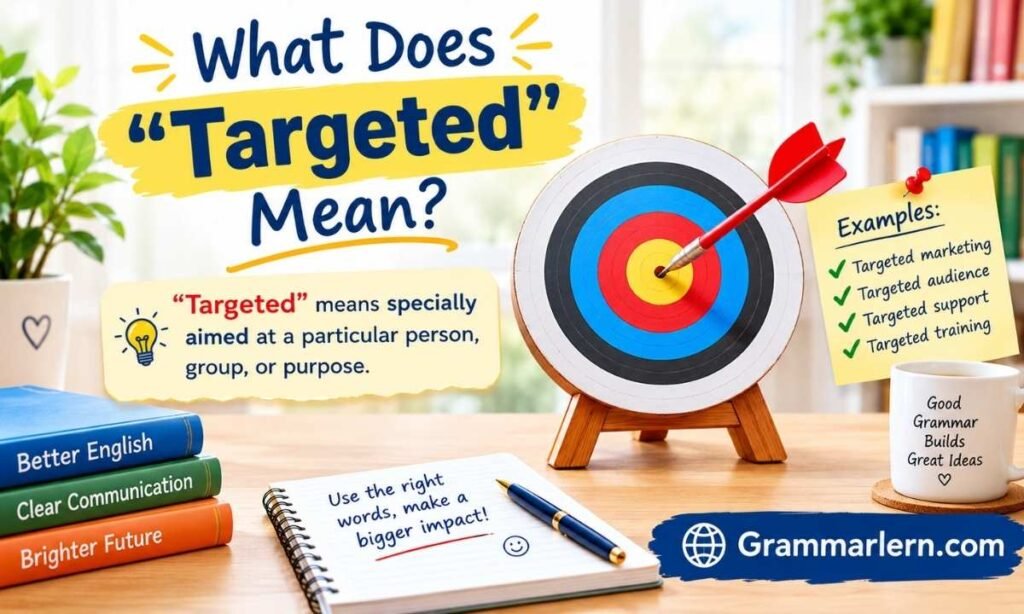
Targeted describes something aimed or directed at a specific person, group, goal, or issue. It’s used constantly across marketing, healthcare, education, and everyday communication.
A few examples of how it’s typically used:
- The brand ran a targeted advertising campaign for new customers.
- Doctors recommended a targeted treatment plan based on the diagnosis.
- The school introduced targeted support for struggling students.
In each case, “targeted” signals that something was chosen and directed with a specific purpose in mind as opposed to something general or unfocused.
Why Is “Targeted” Spelled With Only One T?
This comes down to a real, predictable rule in English spelling: consonant doubling depends on where the stress falls in a word.
When a word ends in a single consonant preceded by a single vowel, English typically doubles that consonant before adding -ed or -ing but only if the final syllable is stressed. Compare:
- ad-MIT → admitted (stress on the last syllable → doubled)
- re-FER → referred (stress on the last syllable → doubled)
- TAR-get → targeted (stress on the first syllable → not doubled)
Because target is stressed on “TAR,” not “get,” the consonant doubling rule doesn’t apply. The same logic explains why words like offer → offered and enter → entered also keep a single consonant.
Why Do People Mistakenly Write “Targetted”?
The mix-up usually comes from pattern matching. Writers see plenty of verbs that do double their final letter stopped, planned, committed and assume target behaves the same way. Add in the fact that “targetted” occasionally appears in informal writing or gets missed by spell-checkers, and the error spreads.
This isn’t unique to target several other English words face the same kind of confusion:
- Focused vs. Focussed
- Benefited vs. Benefitted
- Canceled vs. Cancelled
In each case, the shorter, single-consonant form is the one recognized as standard in modern usage.
Targeting vs Targetting: Which Is Correct?
The same stress-based rule applies here. Targeting with one t is the only accepted form.
| Word | Correct? |
| Targeting | Yes |
| Targetting | No |
Some real-world examples:
- The company is targeting first-time buyers this quarter.
- Researchers are targeting a specific gene in their trial.
- The campaign is targeting small business owners.
If you keep the pattern target → targeted → targeting in mind, you’ll never need to double the t.
Is “Targetted” Ever Correct in British English?
No this is one of the more persistent myths around this word. Unlike spelling pairs such as color/colour or traveling/travelling, where American and British English genuinely diverge, targeted doesn’t change across regions.
British dictionaries and style guides, including Oxford’s own references, list targeted and targeting as the standard forms. You may occasionally spot “targetted” in older or informal British text, but it isn’t accepted as correct usage today. Whether you’re writing for a US or UK audience, the single-t spelling is the safe, correct choice.
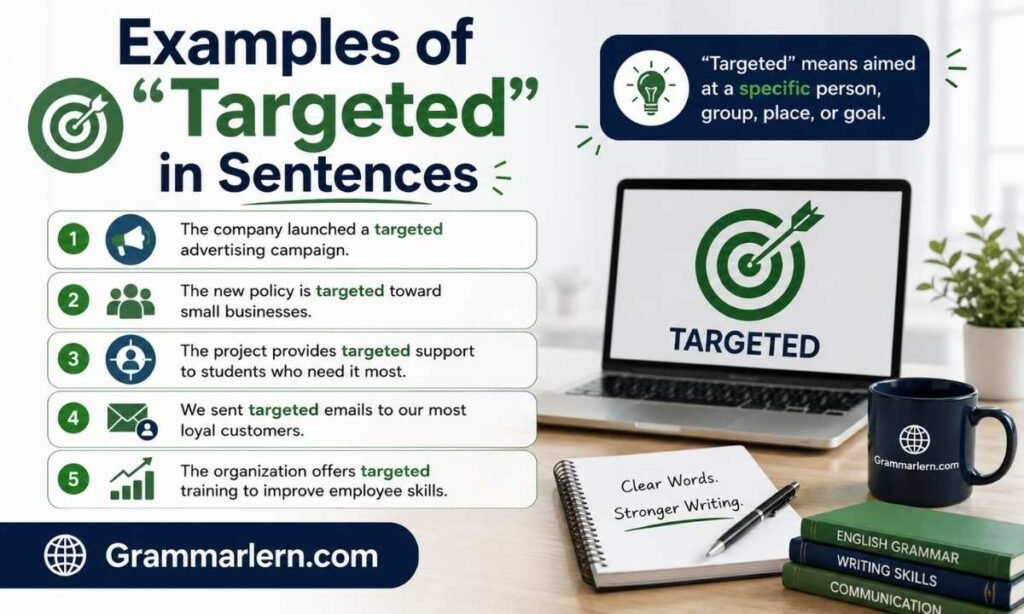
Examples of “Targeted” in Sentences
Business Examples
- The company launched a targeted marketing strategy to reach younger customers.
- Our team created targeted content to improve engagement rates.
- The agency used targeted outreach to connect with local businesses.
Academic Examples
- Researchers conducted a targeted study on early language development.
- The university launched a targeted mentorship program for first-year students.
Everyday Examples
- The coach gave targeted feedback before the final match.
- The charity offered targeted assistance to families in need.
- Her teacher provided targeted advice to help her improve her essay.
Targeted Pronunciation and Common Synonyms
Targeted is pronounced the same way in both American and British English: /ˈtɑːr-gɪ-tɪd/. There’s no regional shift in pronunciation to match the (incorrect) regional spelling myth.
Common synonyms include:
- Focused
- Directed
- Aimed
- Intended
- Specific
These words can often substitute for “targeted” depending on context, though “targeted” remains the most precise choice when describing something deliberately aimed at a defined audience or goal.
Common Words Similar to Targeted
Several other English words trip up writers for the same reason assumed consonant doubling that doesn’t actually apply.
| Correct | Common Misspelling |
| Targeted | Targetted |
| Targeting | Targetting |
| Focused | Focussed |
| Benefited | Benefitted |
| Canceled | Cancelled |
The safest approach is to check a current dictionary whenever you’re unsure, rather than relying on pattern instinct English spelling rules aren’t always as consistent as they seem.
Frequently Asked Questions
How do you spell “targeted”?
The correct spelling is targeted, with a single t. “Targetted” is a common misspelling and isn’t recognized by any major dictionary.
What does it mean to be targeted?
Being “targeted” means being specifically chosen, aimed at, or focused on whether by a marketing campaign, a medical treatment, or an action directed at a particular person or group.
Is “targeted” or “targetted” used in British English?
Only targeted is standard in British English. “Targetted” isn’t a recognized regional variant it’s simply an error.
Is there a word “targeted”?
Yes. “Targeted” is a real word it’s the past tense and past participle of the verb “target.”
What does “target” mean?
As a noun, a target is an object, goal, or person that something is aimed at. As a verb, “to target” means to aim at, focus on, or direct effort toward something specific.
Is “targetting” ever correct?
No. Like “targetted,” “targetting” is a nonstandard spelling. The correct form is always targeting.
Final Thoughts
When it comes to targeted or targetted, only one spelling holds up: targeted. The same goes for targeting vs. targetting the single-t form is the one every major dictionary supports, in both American and British English.
Remember the stress falls on “TAR,” not “get,” and the rule sticks for good. Small details like this add up, making your writing that much more polished and credible.