

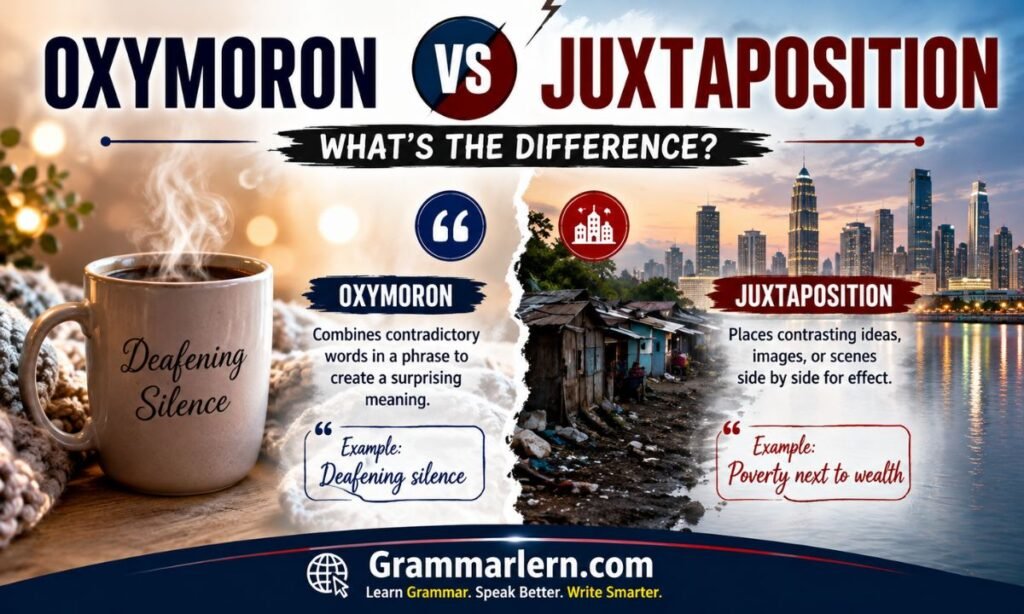
Ever paused mid sentence, unsure if a phrase is an oxymoron or a juxtaposition? You’re not alone. Both are common literary devices, but they work in completely different ways.
An oxymoron joins two contradictory words in one short phrase. Juxtaposition places two contrasting ideas side by side to highlight their difference. This guide breaks down both with clear examples.
Quick Answer: Oxymoron vs Juxtaposition
An oxymoron is a short phrase made up of two words with opposite meanings, such as “deafening silence” or “bitter sweet.” Juxtaposition is a broader technique that places two contrasting ideas, images, or characters near each other, sometimes in a single sentence and sometimes across an entire story. In short: an oxymoron works at the word level, while juxtaposition works at the idea level.
What Is an Oxymoron?
An oxymoron is a figure of speech that pairs two words with opposite meanings inside one short phrase. The contradiction is intentional. Writers use it to surprise the reader, add humor, or express a complex feeling in very few words.
For example, “the silence was deafening” combines two ideas that shouldn’t logically go together, yet the phrase makes emotional sense. That tension is exactly what makes an oxymoron memorable.
Why Writers Use Oxymorons
Oxymorons are compact. A single phrase like “controlled chaos” or “same difference” can capture a feeling that might otherwise take a full sentence to explain. They also add rhythm and wit, which is why they show up so often in poetry, headlines, and everyday speech.
What Is Juxtaposition?
Juxtaposition is a literary device where two different or opposing elements are placed close together so the reader notices the contrast between them. Unlike an oxymoron, juxtaposition isn’t limited to a single phrase. It can appear in one sentence, across a paragraph, or throughout an entire novel.
For instance, a story might place a wealthy character right next to a struggling one, or open with a peaceful scene that suddenly cuts to chaos. The comparison itself creates meaning, and the reader is left to interpret what that contrast says about the story.
Why Writers Use Juxtaposition
Juxtaposition helps writers highlight differences without stating them directly. Instead of telling readers that a character is cruel, a writer can juxtapose that character’s actions against a kind one and let the contrast speak for itself. It’s a subtle, powerful way to build tension and meaning.
Oxymoron vs Juxtaposition Comparison Table
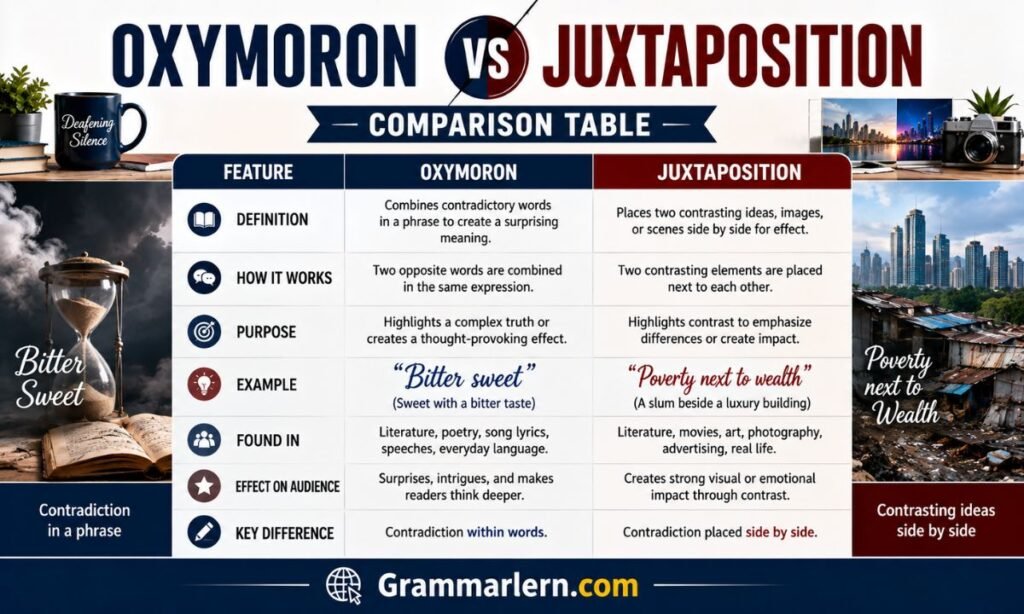
| Aspect | Oxymoron | Juxtaposition |
| Definition | Two contradictory words combined in one phrase | Two contrasting ideas placed side by side |
| Scope | Word or phrase level | Sentence, scene, or entire story |
| Structure | Always short (usually two words) | Can be brief or extend across a full narrative |
| Purpose | Creates surprise, wit, or emotional depth in few words | Highlights differences to build meaning or tension |
| Example | “Deafening silence” | Placing a peaceful village beside a war zone |
Key Differences Between Oxymoron and Juxtaposition
The biggest difference comes down to scale. An oxymoron is confined to a phrase, usually just two words that contradict each other. Juxtaposition has no such limit. It can be as short as one line or stretch across an entire book.
Structure is another key difference. An oxymoron always follows the same pattern: two opposing words fused together. Juxtaposition doesn’t have a fixed structure. It can compare characters, settings, emotions, or entire timelines, and it doesn’t require the two elements to be strict opposites, only different enough to create contrast.
Finally, think of it this way: every oxymoron is technically a tiny form of juxtaposition, but most juxtapositions are not oxymorons. Oxymoron is the specific, word level case. Juxtaposition is the broader category.
Oxymoron vs Juxtaposition Examples
Seeing both devices side by side makes the difference click faster than any definition.
Oxymoron Examples
- Deafening silence
- Bitter sweet
- Controlled chaos
- Same difference
- Living dead
- Pretty ugly
Juxtaposition Examples
- “It was the best of times, it was the worst of times.” (Charles Dickens, A Tale of Two Cities)
- A story that opens with a quiet sunrise and cuts to a battlefield in the very next scene
- Placing a character’s wealth directly beside another character’s poverty to highlight inequality
- Sunlight streaming through a window while a cold, tense silence fills the room
- Two characters, one wild and reckless, the other calm and disciplined, standing in the same scene
Related Literary Devices: Paradox, Antithesis & Contrast
Oxymoron and juxtaposition aren’t the only devices that play with contradiction. A few related terms are easy to confuse with them.
Oxymoron vs Paradox
A paradox is a full statement or situation that seems self contradictory on the surface but reveals a deeper truth once examined, such as “the only constant in life is change.” An oxymoron is much smaller: just a two word phrase, like “alone together,” with no larger idea to unpack.
Oxymoron vs Antithesis
Antithesis sets up two opposing ideas in a balanced sentence structure, such as “give me liberty, or give me death.” It relies on parallel grammar to sharpen the contrast. An oxymoron skips the sentence structure entirely and simply fuses two contradictory words together.
Juxtaposition vs Contrast
Contrast is the general concept of showing how two things differ. Juxtaposition is one specific technique for creating that contrast: physically placing the two elements near each other in the text. In other words, juxtaposition is a tool for achieving contrast, not a separate, unrelated idea.
Frequently Asked Questions
Is an oxymoron the same thing as juxtaposition?
No. An oxymoron is a specific, word level example of contradiction, while juxtaposition is the broader technique of placing contrasting ideas near each other. You could say every oxymoron is a tiny juxtaposition, but not every juxtaposition is an oxymoron.
What are 5 examples of oxymorons?
Five common oxymorons are deafening silence, bitter sweet, controlled chaos, same difference, and living dead. Each one combines two words with opposite meanings into a single, memorable phrase.
What is an example of juxtaposition?
A classic example is the opening line of A Tale of Two Cities: “It was the best of times, it was the worst of times.” The line places two opposite ideas next to each other to capture a divided, unequal era.
Is “happily married” an oxymoron?
Not by definition. “Happy” and “married” aren’t true opposites, so this phrase doesn’t meet the strict requirement of an oxymoron. It only reads as one if the speaker means it sarcastically, implying their marriage isn’t actually happy, which shifts it toward irony rather than a genuine oxymoron.
Why do writers use juxtaposition instead of an oxymoron?
Writers reach for juxtaposition when they want to build meaning over a larger space, such as a scene or an entire story, rather than compress it into two words. It lets readers draw their own conclusions from the contrast instead of being told directly.
Can juxtaposition happen without a direct contrast?
Not really. Juxtaposition depends on the reader noticing a difference between the two elements placed together. The contrast doesn’t have to be total opposites though; even subtle differences in tone, setting, or character traits can create an effective juxtaposition.
Final Thoughts
Oxymoron and juxtaposition both rely on contrast, but they operate at completely different scales. An oxymoron packs contradiction into two words, while juxtaposition can stretch across a single scene or an entire story to make its point.
Once you know what to look for, spotting these devices becomes second nature, whether you’re reading a novel, a poem, or even a movie script. The words might seem interchangeable at first glance, but each one does a distinct job in shaping meaning.
Next time you come across a phrase like “deafening silence” or a story that places two opposite worlds side by side, you’ll know exactly which device is at work, and why the writer chose it.