

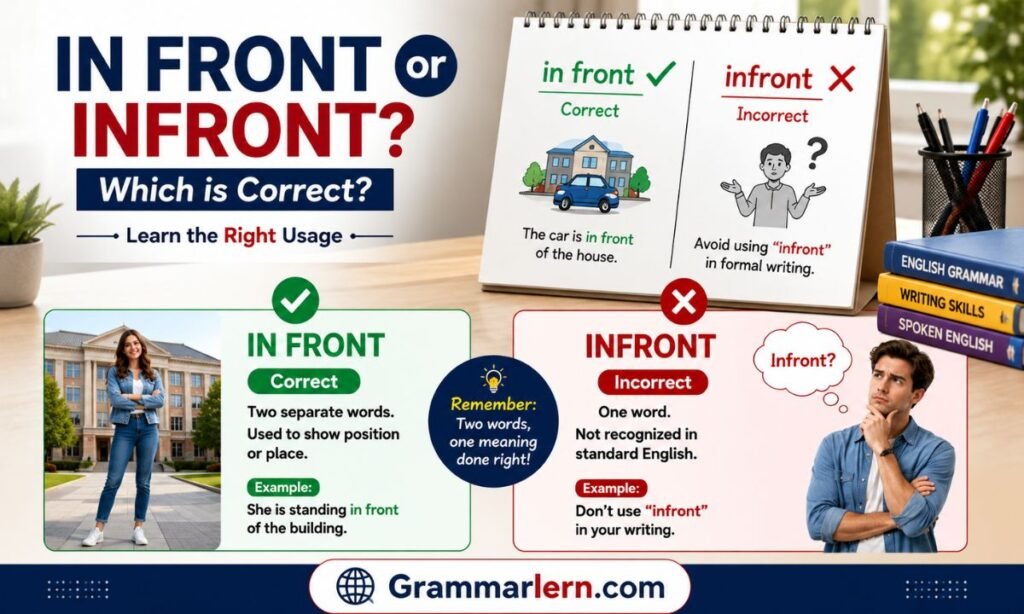
Many writers pause at the exact same spot: is it in front or infront? This tiny spacing question trips up students, professionals, and even confident English speakers. The good news is that the rule is far simpler than it seems.
“In front” is the only correct spelling in standard English — used the same way in American and British English. “Infront” is a common mistake, not a real word. This guide breaks down the grammar rule, clear examples, and simple tricks to get it right every time.
Quick Answer
Always write “in front” as two separate words. It is a standard prepositional phrase meaning ahead of, before, or at the forward position of someone or something.
“Infront” is not recognized by any major English dictionary or style guide. Whether you’re writing an email, essay, or report, “in front” is the only accepted form.
Is It “In Front” or “Infront”?
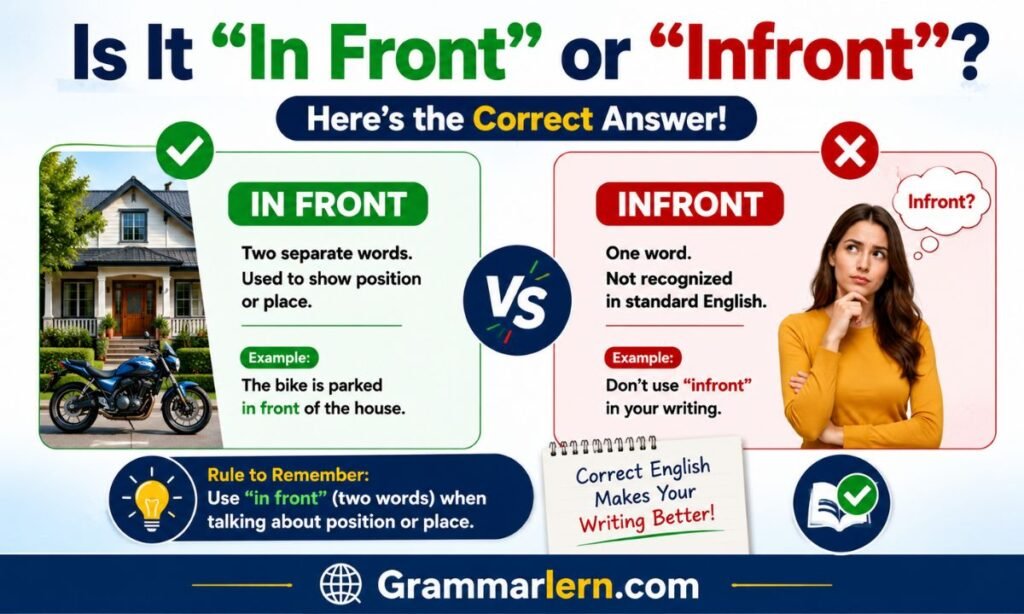
The correct spelling is “in front.“ It functions as a prepositional phrase in English grammar, which is why it stays as two words rather than merging into one, the way “inside” or “into” did.
You may spot “infront” in text messages, comments, or casual social media posts, but it has never been accepted as standard English. Using the two-word form consistently signals that you understand basic English usage, and it keeps your writing clear and credible.
What Does “In Front” Mean?
“In front” describes a position that is ahead of, or facing toward the forward side of, someone or something. It’s one of the most common positional phrases in English, appearing in conversation, writing, and everyday instructions.
For example: “The teacher stood in front of the class” or “A fountain stands in front of the hotel.” In both cases, the phrase tells you exactly where something is located relative to another point.
“In Front” vs. “In Front Of” — What’s the Difference?
“In front” can stand alone, without an object following it, as in “We sat in front” or “She’s still in front.” Here it simply describes a position or ranking without naming what it’s relative to.
“In front of,” on the other hand, is followed by a noun or pronoun that anchors the position — “in front of the house,” “in front of me.” Both forms are correct; the choice depends purely on whether you need to name the reference point.
“In Front” in a Race or Competition (Leading Position)
Beyond physical location, “in front” also describes who is winning or leading in a race or contest. For instance, “She’s still in front, but the other runners are closing the gap” means she is currently ahead in the competition, not standing somewhere.
This sense is often paired with “out,” as in “out in front,” which emphasizes a clear lead. It’s a smaller but genuinely useful meaning that many learners overlook.
Why “In Front” Is the Correct Form
The reasoning comes down to basic grammar. “In” is a preposition, and “front” is a noun. Together, they form a prepositional phrase, and prepositional phrases in English keep their individual words separate.
This is different from true compound words like “inside” or “into,” which merged into single words over time through natural language evolution. “In front” never went through that same shift, so it has remained two words in every stage of modern English. Recognizing this distinction is the fastest way to stop second-guessing the spelling.
Can “Infront” Ever Be Correct?
No. “Infront” is not listed as a valid spelling in any trusted English dictionary or style guide, in any context — formal or informal. People often write it as one word because they mentally group it with compound words like “inside,” or because they’re typing quickly without checking their work.
Even though “infront” shows up frequently online, frequency of use doesn’t make it correct. It remains a spelling error regardless of platform, audience, or tone.
In Front vs. Infront (Comparison Table)
| Feature | In Front | Infront |
| Correct spelling | Yes | No |
| Recognized by dictionaries | Yes | No |
| Accepted in formal writing | Yes | No |
| Accepted in informal writing | Yes | No |
| Grammar classification | Prepositional phrase | Spelling error |
| Example | The car is in front of the house. | The car is infront of the house. (incorrect) |
How to Use “In Front” Correctly in Sentences
Seeing “in front” in real sentences is the easiest way to internalize the correct spelling. In every case, it describes position, direction, or rank — and it’s always written as two words.
- The bus stopped in front of the school.
- She stood in front of the mirror before leaving.
- Please wait in front of the office.
- A fountain stands in front of the hotel.
- The runner stayed in front for most of the race.
In Front for Physical Position or Location
This is the most common use — describing where a person, object, or place sits relative to something else. Examples include “The garden is in front of the house” or “He parked in front of the library.” This usage covers buildings, vehicles, people, and everyday physical settings.
In Front in Formal and Professional Writing
In business emails, reports, and academic writing, “in front” appears just as naturally: “Please gather in front of the conference room at 9 a.m.” or “The proposal puts our solution in front of competing options.” Keeping the two-word spelling consistent in professional contexts protects your credibility as a careful writer.
Synonyms of “In Front”
Depending on context, several words can substitute for “in front” while keeping your writing varied and natural:
- Ahead of — used for movement, time, or ranking (“She walked ahead of the group”)
- Before — often used for time or sequence (“He arrived before the others”)
- Facing — used when something is oriented toward another point
- At the forefront of — used for leadership or innovation (“The team is at the forefront of the industry”)
- Leading — used for rankings or competitions (“She’s the leading candidate”)
Rotating between these alternatives keeps your writing from feeling repetitive, especially in longer pieces.
Common Mistakes People Make
The most frequent error is merging “in” and “front” into “infront,” usually because writers associate it with words like “inside” that did become single words over time. Fast typing on phones, combined with autocorrect not always flagging the error, also spreads the mistake.
Another common slip is dropping “of” where it’s needed — writing “in front the door” instead of “in front of the door.” A quick proofreading pass, or a simple search for “infront” in your document before submitting it, catches both errors easily.
Similar Word Pairs That Follow the Same Rule
English has several other word pairs where writers mistakenly merge two words that should stay separate, or vice versa. Learning these together builds a stronger overall sense of spacing rules:
- Into vs. In to
- Onto vs. On to
- Everyday vs. Every day
- Setup vs. Set up
- Login vs. Log in
- Workout vs. Work out
- Maybe vs. May be
- Anymore vs. Any more
Each pair follows its own logic, so it’s worth learning them individually rather than assuming one rule applies to all.
Easy Tricks to Remember the Correct Spelling
A simple trick is to ask yourself, “Where is it?” The word “in” signals the relationship, and “front” names the position — two separate jobs, two separate words. Reading your sentence aloud also helps: if it describes a location, it should be “in front.”
Before finishing any piece of writing, search the document for “infront.” If it appears, replace it with “in front.” This one habit prevents the mistake from slipping into final drafts.
Does American English or British English Use “Infront”?
No. Neither American English nor British English accepts “infront” as a standard spelling. Newspapers, books, and official documents from both regions consistently use “in front” as two words.
This means there’s no regional exception to rely on — the rule is identical everywhere English is written formally. If your goal is clear, professional communication, “in front” is always the safe choice.
Frequently Asked Questions
Is “infront” a real word or a single word?
No, “infront” is not a real word in standard English. It is a common misspelling of “in front,” which is always written as two separate words.
What is meant by “infront”?
“Infront” is simply an incorrect spelling of “in front.” It carries no separate meaning of its own — it is a spacing mistake, not a distinct word.
Is “in front of” grammatically correct?
Yes, “in front of” is grammatically correct. It is a prepositional phrase used to show that something is ahead of or before another person or object, as in “She sat in front of me.”
Do we say “in front” or “on front”?
We say “in front,” not “on front.” “On front” is not a standard English expression and is never used to describe position or location.
Is there a synonym for “in front”?
Yes. Common alternatives include “ahead of,” “before,” “facing,” and “at the forefront of,” depending on whether you mean physical position, rank, or leadership.
Does British English spell it differently from American English?
No. Both American and British English use the same spelling, “in front,” as two separate words. There is no regional variation for this phrase.
Final Thoughts
Getting in front or infront right comes down to one simple rule: always write it as two words. “In front” is a prepositional phrase, not a compound word, and no major dictionary or style guide accepts “infront” as correct.
Once you understand why the words stay separate, the mistake becomes easy to avoid in emails, essays, and everyday writing. Keep this guide handy, and you’ll never second-guess “in front” again.