

Leafs or Leaves – Quick Answer
“Leaves” is the correct plural of “leaf” in nearly every situation trees, plants, book pages, and everyday writing. “Leafs” is rare and correct only as a verb or inside one famous proper noun.
- Correct: The tree has many leaves.
- Incorrect: The tree has many leafs.
- Rare but correct: He leafs through the book.
Leafs or Leaves – Meaning
“Leaves” is the standard plural noun, referring to the green parts of a plant or the pages of a book. “Leafs,” on the other hand, works as a verb meaning to flip through pages, or as part of a proper name. Knowing which role the word plays instantly tells you which spelling to use.
The Origin of Leafs or Leaves
The word “leaf” comes from Old English lēaf. Over centuries, English shifted the “f” sound to a “v” sound in certain plurals the same pattern seen in knife → knives and wolf → wolves. This sound change became the standard rule, which is why leaves, not leafs, is the accepted plural for plants and pages today.
British English vs American English Spelling

There is no regional difference here. Both British and American English use leaves as the correct plural of leaf, whether you’re writing about autumn foliage or a chequebook. “Leafs” is not a recognized British or American spelling variant; it simply belongs to a different grammatical role.
Which Spelling Should You Use?
Use leaves whenever you’re talking about plants, trees, or nature. A leaf on a tree always becomes leaves in the plural, never leafs. The same applies to a leaf on a plant or in a garden. The simple rule: if it grows, it’s leaves.
When Is “Leafs” Actually Correct?
“Leafs” isn’t wrong; it just has two narrow, legitimate uses outside the plant sense.
As a Verb (He Leafs Through a Book)
As a verb, “leafs” is the third-person singular form of “to leaf,” meaning to flip quickly through pages. For example: She leafs through the magazine while waiting. Here, the “f” stays because you’re adding a verb ending, not forming a plural noun.
Toronto Maple Leafs – The Famous Exception
The most famous exception is the Toronto Maple Leafs, the NHL hockey team. Proper nouns don’t have to follow standard grammar rules, and the team intentionally kept “Leafs” instead of “Leaves” since its founding, making it one of English’s most well-known deliberate spelling exceptions.
Leaf vs Leave: Are They the Same Word?
No. “Leaf” and “leave” are entirely different words that only look similar. “Leaf” refers to plant foliage or a page. “Leave” means to depart, or as a noun, time off work. Their plural/verb forms can look alike (“leaves” is both the plural of leaf and the verb form of leave), which is exactly where confusion starts.
Leafs or Leaves Pronunciation
- Leaves pronounced “leevz,” rhymes with thieves.
- Leafs pronounced “leefs,” rhymes with chiefs.
The soft “v” sound in leaves signals the plural noun; the sharp “f” sound in leafs signals the verb or proper noun.
Common Mistakes with Leafs or Leaves
- ❌ The tree has many leafs. → ✅ The tree has many leaves.
- ❌ One leaves fell from the branch. → ✅ One leaf fell from the branch.
- ❌ Assuming “Leafs” changes the grammar rule for plants. → ✅ Proper nouns are exceptions, not new rules.
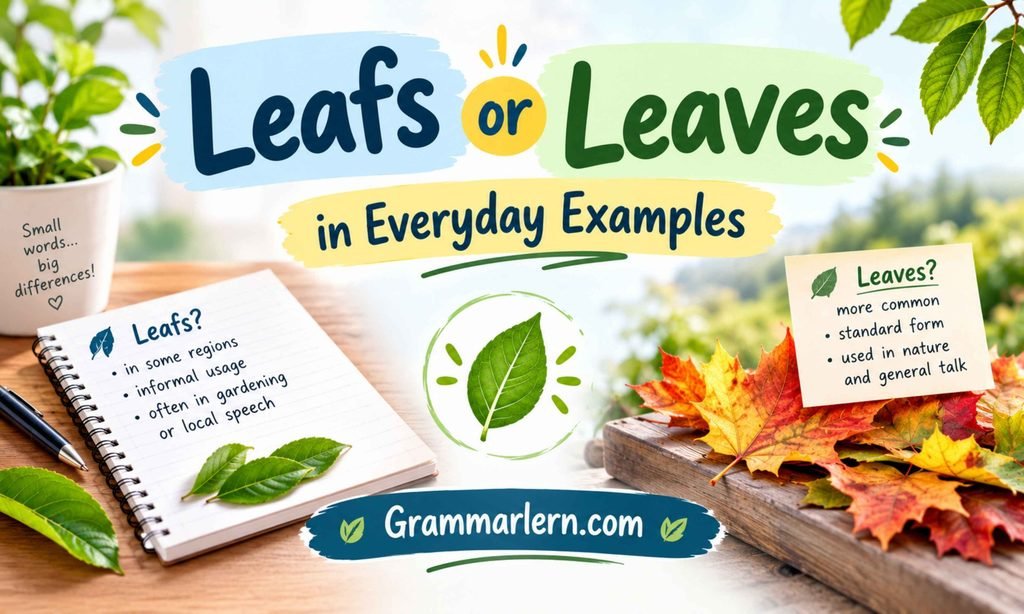
Leafs or Leaves in Everyday Examples
- Email: Please clear the leaves from the path.
- News: Wind scattered dry leaves across the road.
- Social media: Love walking through crunchy leaves.
- Formal writing: The study measured water loss from plant leaves.
- Verb use: She leafs through her notes before class.
Compound Leaf Words (Table Leaf, Door Leaf, Cheque Leaf)
The word “leaf” also appears in specialized compound nouns, and every one of them follows the same plural rule. A removable section of a dining table is a table leaf, plural table leaves. A single door panel is a door leaf, plural door leaves. And a page in a chequebook is a cheque leaf, plural cheque leaves, common in British and South Asian English.
Is “Leaf” Countable or Uncountable?
“Leaf” is a countable noun: one leaf, two leaves, three leaves. This differs from an uncountable word like “foliage,” which describes leaves collectively with no plural form of its own.
Leafs or Leaves – Google Trends & Usage Data
Search and usage data consistently show “leaves” appearing far more often than “leafs” across writing, education, and news. The confusion mostly comes from English learners who see “leafs” used online, in sports headlines or verb form, and assume it applies to plants too.
Comparison Table: Leafs vs Leaves
| Feature | Leafs | Leaves |
| Correct for plants | ❌ No | ✅ Yes |
| Common in writing | ❌ Rare | ✅ Very common |
| Used as a verb | ✅ Yes | ❌ No |
| Safe for exams/formal writing | ❌ No | ✅ Yes |
Frequently Asked Questions
What is the plural form of “leaf”?
The plural of “leaf” is “leaves.” This applies to plants, trees, and book pages alike.
Is “leafs” ever correct?
Yes, but only as a verb (“she leafs through the book”) or inside the proper noun “Toronto Maple Leafs.”
Is it “leaf” or “leaves” on a tree?
Always “leaves.” A tree never has “leafs”; that spelling doesn’t apply to plants.
Is it “leave” or “leaves” as the plural of leaf?
Neither, exactly. “Leaf” becomes “leaves.” “Leave” is a completely different word meaning to depart, though its verb form (“she leaves”) looks similar in spelling.
Is it “door leaves” or “door leafs”?
“Door leaves” is correct. Every compound sense of “leaf,” door, table, or cheque, follows the same standard plural rule.
Why do the Toronto Maple Leafs spell their name with “Leafs”?
Because proper nouns aren’t bound by ordinary grammar rules. The team chose “Leafs” deliberately when it was founded, and the spelling has stayed ever since.
Final Thoughts
Choosing between leaves or leafs comes down to one simple check: are you talking about plants, pages, or objects, or are you describing an action or a name? For nearly everything you write, leaves is the safe, correct choice.
Once you remember that “leafs” only survives as a verb and inside the Toronto Maple Leafs, the confusion disappears for good. Stick with leaves for nature and writing, and you’ll never second-guess this word again.