

Ever typed “what happen” and then paused, wondering if it should be “what happened” instead? You’re not alone — this is one of the most common grammar mistakes in English, especially among ESL learners and fast typers. The good news is the answer is simple once you understand the underlying verb tense rule.
Only one of these phrases follows standard English grammar, and it depends entirely on verb tense agreement. In this guide, you’ll learn exactly which form is correct, why the other one breaks basic grammar rules, and how to use both forms confidently in everyday speech and writing.
Quick Answer — What Happen or What Happened?
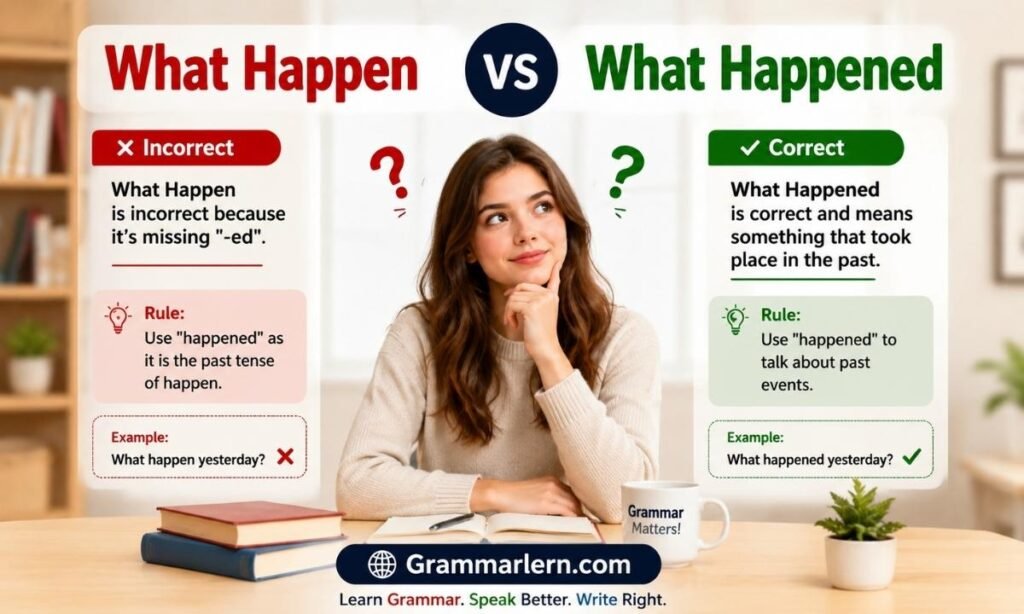
“What happened” is the grammatically correct form when asking about something that already occurred. “What happen” is incorrect on its own because it uses the base form of the verb instead of the past tense form, breaking basic subject-verb tense agreement.
So if you’re asking about a past event, always say “What happened?” — not “What happen?”
Understanding Why “What Happen” Feels Right
Spoken English is fast, and native speakers often drop word endings or shorten phrases without even noticing. That’s exactly why “what happen” can sound normal in casual conversation, texting, or social media slang.
But sounding natural in informal speech doesn’t make something correct in standard written English. Every verb needs to match its correct tense form, and skipping that tense marker changes how clear, polished, and professional your sentence sounds.
How Verb Tenses Communicate Time
Verb tense tells your reader or listener exactly when an action takes place. Without proper tense agreement, a sentence can sound broken or confusing, even if your intended meaning is obvious.
- Present tense — describes something happening now or a general truth
- Past tense — describes something already completed
- Future tense — describes something that hasn’t happened yet
What Happens, What Happened, and What Will Happen
Each variation of the verb “happen” fits a different point in time:
- What happens — used for routines, habits, or general truths (“What happens at midnight?”)
- What happened — used for completed past events (“What happened last night?”)
- What will happen — used for future predictions (“What will happen next?”)
Mixing up these tense forms is one of the fastest ways to confuse a reader, so matching the verb to the correct timeframe is essential for clear communication.
Understanding the Verb “Happen”
“Happen” is a regular verb, meaning its tense forms follow a simple, predictable conjugation pattern rather than an irregular one.
| Form | Tense | Example |
| happen | Base / Present | Accidents often happen unexpectedly. |
| happened | Simple Past | Something happened yesterday. |
| happening | Present Participle | What is happening right now? |
| has/have happened | Present Perfect | A lot has happened this week. |
There’s no irregular version of this verb — no “hapened” or “happeneded.” The past tense always adds -ed, and that single rule covers almost every case you’ll encounter.
What Does “What Happen” Mean?
On its own, “what happen” doesn’t follow standard grammar rules. The speaker usually intends to ask about a past event, but the sentence uses the base verb form instead of the correct past tense verb. People still understand the intended meaning, especially in casual chats or regional dialects, but it isn’t accepted in formal writing or standard English.
Why “What Happen” Is Grammatically Incorrect
The core issue is simple: “what happen” is missing its past tense marker. Standard English requires the past form of a verb whenever a question refers to something that has already occurred.
Compare these examples:
- “What happens every Monday?” — correct, present tense
- “What happened yesterday?” — correct, past tense
- “What happen yesterday?” — incorrect, missing past tense
English grammar doesn’t allow the base verb alone to describe a completed action. Even if the sentence sounds acceptable out loud, it violates a fundamental tense agreement rule.
Why “What Happened” Works
“What happened” is correct because the past tense is already built into the verb itself. There’s no need for an extra helping (auxiliary) verb to indicate that the action is finished.
- “What happened at the meeting yesterday?”
- “Do you know what happened to John?”
Adding “did” here would actually create a grammar error, since the past tense marker is already present in the verb:
- Incorrect: “What did happened?”
- Correct: “What happened?”
Subject Questions vs Object Questions
English forms questions differently depending on whether you’re asking about the subject (the doer of the action) or the object (the receiver of the action).
- Subject question — asks who or what performed the action, e.g., “Who arrived late?” (no auxiliary verb needed)
- Object question — asks about what was done to something, e.g., “What did you see?” (requires the auxiliary “did”)
“What happened” is a subject question. It asks about the event itself rather than about someone performing an action on something else — which is exactly why no auxiliary verb like “did” is required here.
When to Use “What Happened”
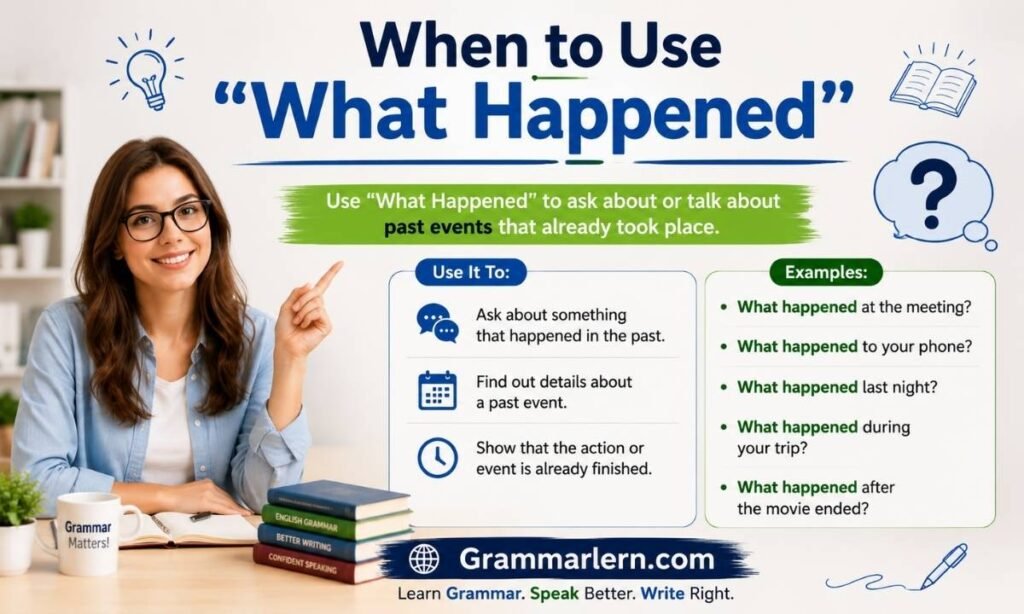
Use “what happened” whenever you’re asking about something that has already taken place. This covers a wide range of everyday situations:
- Asking about news or events — “What happened at the game?”
- Reacting to something unexpected — “I heard a loud noise. What happened?”
- Clarifying a mistake or accident — “The vase is broken. What happened?”
It works equally well in formal writing and casual conversation, making it one of the most versatile and reliable question forms in English.
“What Happened to You” or “What Happen to You”?
This exact phrase shows up constantly in real conversations, text messages, and even song lyrics. The rule doesn’t change here — “What happened to you?” is the grammatically correct version, since it refers to something that already took place.
- Correct: “What happened to you? You look tired.”
- Incorrect: “What happen to you?”
You’ll often hear “what happen to you” in casual texting, song lyrics, or certain regional dialects, but it remains non-standard in written and professional English.
Why “What Happen” Should Be Avoided
Even though “what happen” appears in movies, casual chats, and text messages, it is never considered correct in standard English grammar.
- Exams and academic writing mark it as an error
- Professional emails and reports require grammatically correct language
- It often signals a gap in understanding basic verb tense rules
If clarity, credibility, and professionalism matter to you, always use “what happened” when referring to anything in the past.
Spoken English vs Written English
Many learners blend the habits of informal spoken English with the standards of formal written English, and that overlap is often where this mistake comes from.
- Fast, casual speech often drops verb endings — “What happen?”
- Texting and slang sometimes tolerate it — “Yo, what happen?”
- Formal writing always requires the complete, correct verb form — “What happened?”
Recognizing this difference helps you switch naturally between everyday conversation and polished, professional communication.
Common Mistakes Related to “What Happened”
- Mixing tenses within one sentence
- Incorrect: “What happen yesterday?”
- Correct: “What happened yesterday?”
- Overcorrecting with an unnecessary auxiliary verb
- Incorrect: “What did happened?”
- Correct: “What happened?”
- Confusing subject and object question structures
- Incorrect: “What did happen?” (when a simple subject question is needed)
- Correct: “What happened?”
- Carrying casual speech habits into formal writing
- Always double-check verb tense agreement before submitting or sending a message.
Real-Life Examples: Correct vs Incorrect Usage
| Situation | Incorrect | Correct |
| Conversation | What happen at the party? | What happened at the party? |
| Texting | Yo, what happen bro? | Yo, what happened, bro? |
| Academic | What happen during the experiment? | What happened during the experiment? |
| Workplace | What happen in the meeting? | What happened in the meeting? |
These examples show that even though casual English sometimes tolerates “what happen,” the grammatically correct form for describing a past event is always “happened.”
“Happen” vs Similar Verbs: Occur, Take Place, and More
“Happen” isn’t the only verb English speakers use to describe events. Words like occur, take place, and come about carry similar meanings but often appear in more formal registers of English.
- “What occurred at the hearing?” — formal, legal or academic tone
- “What took place during the ceremony?” — formal, descriptive tone
- “What happened at the party?” — everyday, conversational tone
Knowing these near-synonyms helps you choose the right verb depending on how formal or casual your writing needs to be.
Grammar Rule at a Glance
If you remember nothing else from this guide, remember this one rule:
Past event → “what happened.” Present or routine → “what happens.” Future event → “what will happen.”
This single tense-based rule resolves almost every point of confusion around this phrase.
Quick Rule to Remember
For any completed, past event, always use “what happened.” It’s simple, memorable, and eliminates the guesswork for good.
Key Takeaways
- “What happened” is grammatically correct for past events; “what happen” is not standard English.
- The verb “happen” is a regular verb, so its past tense simply adds -ed.
- No extra auxiliary verb like “did” is needed with “what happened,” since it functions as a subject question.
- Casual speech and texting may tolerate “what happen,” but formal and professional writing never should.
Frequently Asked Questions
What is the correct answer — “what happen” or “what happened”?
“What happened” is the grammatically correct form when asking about a past event. “What happen” is incorrect because it lacks the necessary past tense marker.
Is “what happen” ever grammatically correct?
On its own, no. It only becomes acceptable when paired with an auxiliary verb, such as in “What did happen here?”
What did happen or what happened — which one should I use?
Both are grammatically valid, but they serve different purposes. “What happened?” is the standard, neutral way to ask about a past event. “What did happen?” adds emphasis, often used when clarifying or questioning a previous statement.
What is the difference between “what happened” and “what happens”?
“What happened” refers to something that already occurred, while “what happens” refers to something ongoing, routine, or generally true.
What does “what happen or what happened” mean?
It refers to the common confusion between the base form of the verb “happen” and its correct past tense form “happened,” used when asking about events that have already taken place.
What’s the difference between “what happened to you” and “what happen to you”?
“What happened to you?” is the grammatically correct version. “What happen to you?” is a common but incorrect form often heard in casual speech, texting, or certain dialects.
Final Thoughts
Getting “what happen or what happened” right comes down to one simple idea — match your verb to the correct tense. “What happened” works for anything already completed, while “what happen” only sounds natural in casual, spoken English and should be avoided in formal contexts.
Once this grammar rule feels automatic, you’ll stop second-guessing yourself in conversations, emails, and everyday writing. Small details like verb tense agreement make a real difference in how clear, correct, and confident your English sounds.